
France’s tourism numbers are lopsided in a specific way: Paris alone accounts for a huge share of the country’s international visitors, and most “best of France” content built for a non-French audience narrows further still, to a handful of names — Nice, Bordeaux, the bigger Loire chateaux, maybe Colmar at Christmas. Meanwhile France has more UNESCO World Heritage sites than all but a few countries on Earth, spread across regions most itineraries never touch. This guide picks seven towns that hold up on their own historical or architectural merits, are reachable without a private guide, and get meaningfully less attention than what’s already crowding everyone’s Paris day-trip list.
Last verified: August 29, 2026. This guide was built from desk research against official tourism boards, UNESCO’s own listings, national rail operator schedules, and each site’s own admission and hours pages — not from a personal visit. Where an official source didn’t have an answer, that detail is left out rather than guessed at.
- Dinan, Brittany — a walled medieval port with real data showing it’s a fraction of Saint-Malo’s or Mont Saint-Michel’s scale.
- Troyes, Grand Est — a Champagne-region city built in the shape of a champagne cork, an hour and a half from Paris by direct train.
- Vézelay, Burgundy — a hilltop pilgrimage basilica that’s genuinely popular within France, just not on most non-French travelers’ radar.
- Semur-en-Auxois, Burgundy — a fortified river town with almost no published visitor data at all, which is itself the point.
- Loches, Loire Valley — a royal fortress town that just earned the Michelin Green Guide’s top rating, at a third of Chambord’s ticket price.
- Conques, Occitanie — a village of a few hundred people with an 11th-century abbey church, reachable mainly by a seasonal bus.
- Albi, Occitanie — a UNESCO Episcopal City with the world’s largest Toulouse-Lautrec collection, an hour from Toulouse.
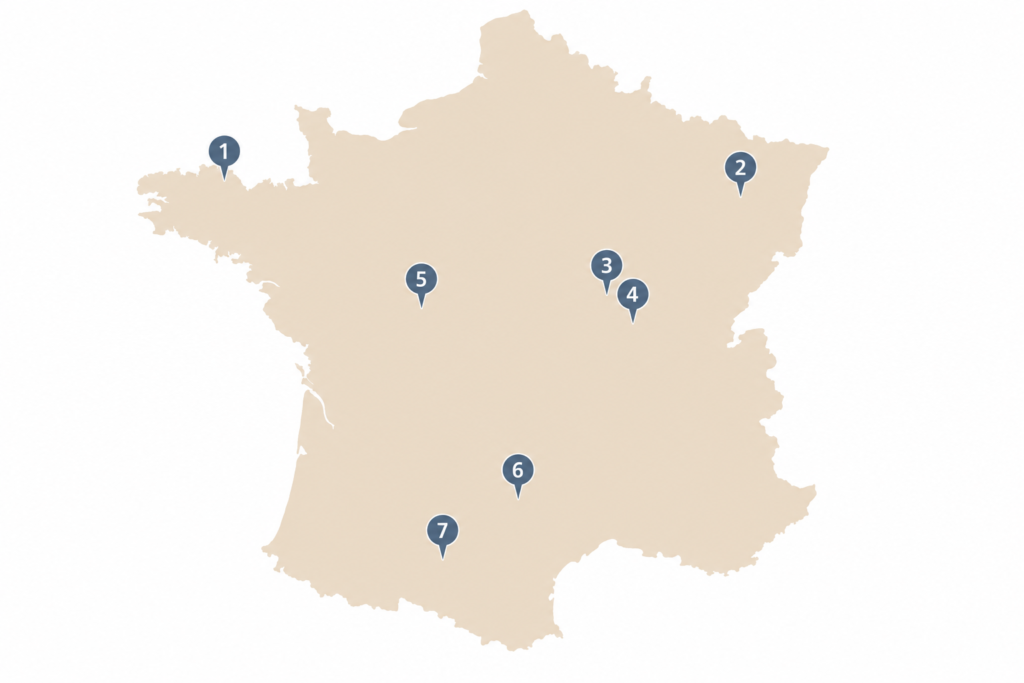
Map key: 1. Dinan • 2. Troyes • 3. Vézelay • 4. Semur-en-Auxois • 5. Loches • 6. Conques • 7. Albi
1. Dinan, Brittany: A Walled Port Town a Fraction of Its Neighbors’ Size
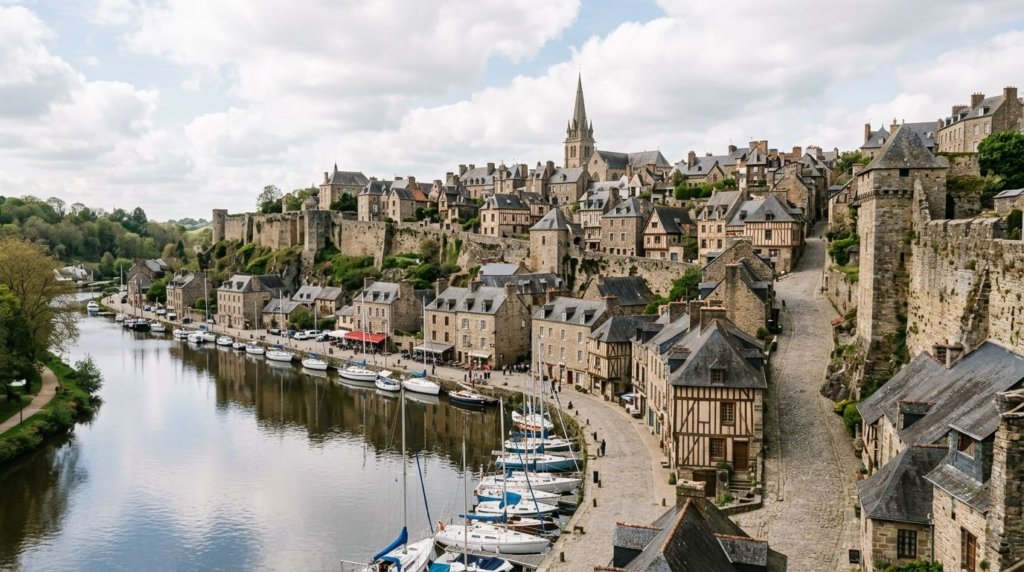
Dinan sits on the Rance river in Brittany’s Côtes-d’Armor department, and it’s one of the few towns on this list where the “underrated relative to what” question has an actual numeric answer. Dinan Agglomération logged 1.6 million overnight stays in 2023. Saint-Malo, 30 minutes away, logged 7.2 million overnight stays and nearly 20 million total visits that same year, counting day-trippers. Mont Saint-Michel, reachable from the same corner of Brittany, drew 2.79 million visitors in 2025 to the abbey alone. None of these figures come from a single report comparing the three directly — they’re each destination’s own published numbers — but set side by side, they make the case for Dinan cleanly.
What you’re actually seeing: 2.7 kilometers of ramparts, among the longest intact in Brittany, with ten towers and four gates; roughly 130 half-timbered houses dating from the 15th through 18th centuries; and a working port at the base of the old town that traded with England, Flanders, and Spain from the 11th century onward. The steep cobbled Rue du Jerzual connects the port to the upper town — Dinan’s own tourism office describes it as not recommended for anyone with walking difficulties or breathing problems, which is a fair warning rather than an exaggeration.
- Getting there: Direct TER train from Rennes, about an hour, roughly hourly service. From Saint-Malo, there’s no direct train; expect a connection, typically 40 minutes to under 2 hours depending on the service.
- Do you need a car? Not for Rennes access. It helps for the Saint-Malo leg and for exploring the wider Rance valley.
- What costs money: The ramparts walkway is free. The Tour de l’Horloge is €4 full / €2.50 reduced. The Château de Dinan is €8 full / €5 reduced, with a combined 2-day ticket covering both for €10 full / €6 reduced.
- Recommended stay: A day covers the old town comfortably; the port and surrounding Rance valley are worth a second day if you have it.
Is It Worth the Detour?
Yes, particularly if Saint-Malo or Mont Saint-Michel are already on your itinerary and you want the same medieval-Brittany atmosphere with room to actually see it. The hill between port and old town is a genuine physical drawback for anyone with mobility concerns, and it’s worth knowing before you arrive that most of what makes Dinan worthwhile — the ramparts, the streets — is free, so the appeal isn’t really about ticking off paid attractions.
2. Troyes, Grand Est: A Champagne City Shaped Like a Cork, 90 Minutes From Paris
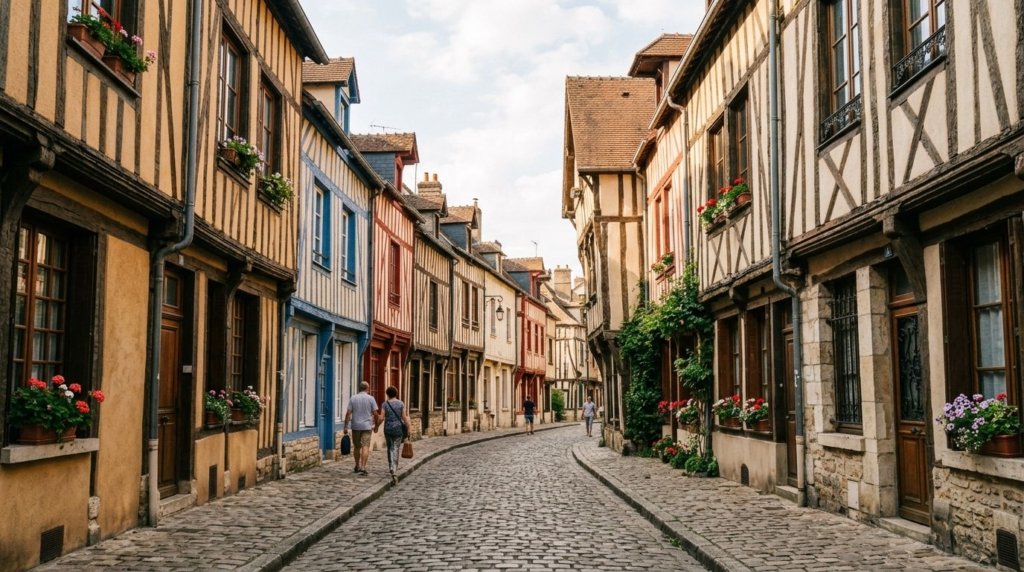
Troyes’ old town grew, in the 12th and 13th centuries, into a shape its own tourism board still points out today: a rough outline of a champagne cork, “bouchon de champagne,” the result of the city expanding beyond its original Roman walls. It’s a good visual anchor for a place whose history is genuinely tied to the drink: Troyes hosted the medieval Champagne Fairs, seasonal trading events that made the region an economic center of Europe long before anyone bottled sparkling wine here, and the English “troy ounce” — still used for gold and silver — takes its name from the city.
The old town itself is dense with half-timbered buildings, and its stained-glass heritage is unusually deep: the Cathédrale Saint-Pierre-et-Saint-Paul holds roughly 1,500 square meters of glass, and the dedicated Cité du Vitrail museum, housed in the former Hôtel-Dieu-Le-Comte, exists specifically because of how much of it the region has produced across eight centuries. Troyes is also, more practically, one of Europe’s larger outlet-shopping destinations — McArthurGlen Troyes alone draws around 4 million visitors a year on its own account, a detail worth knowing if you’re trying to gauge how “undiscovered” the area actually is; the old town and the outlet villages pull very different crowds.
- Getting there: Direct SNCF trains from Paris Gare de l’Est, about 13 a day, journey time roughly 1.5 to 2 hours.
- Do you need a car? No, for the old town itself — it’s walkable and the station is central.
- What costs money: The cathedral is free to enter. The Cité du Vitrail is €7 full / €10 with a guided tour, free for under-26 and on first Sundays.
- Recommended stay: A long day trip from Paris works, though an overnight gives you time for both the old town and the outlet villages without rushing either.
Who Is This For?
Travelers who want a Paris day trip that isn’t Versailles or Giverny, and who don’t mind a destination with a genuinely commercial second identity (the outlet malls). It’s a weaker fit if you’re specifically chasing quiet, car-free medieval streets with nothing else competing for attention — Troyes is comfortably a going concern, not a sleepy backwater.
3. Vézelay, Burgundy: Popular Within France, Overlooked Everywhere Else
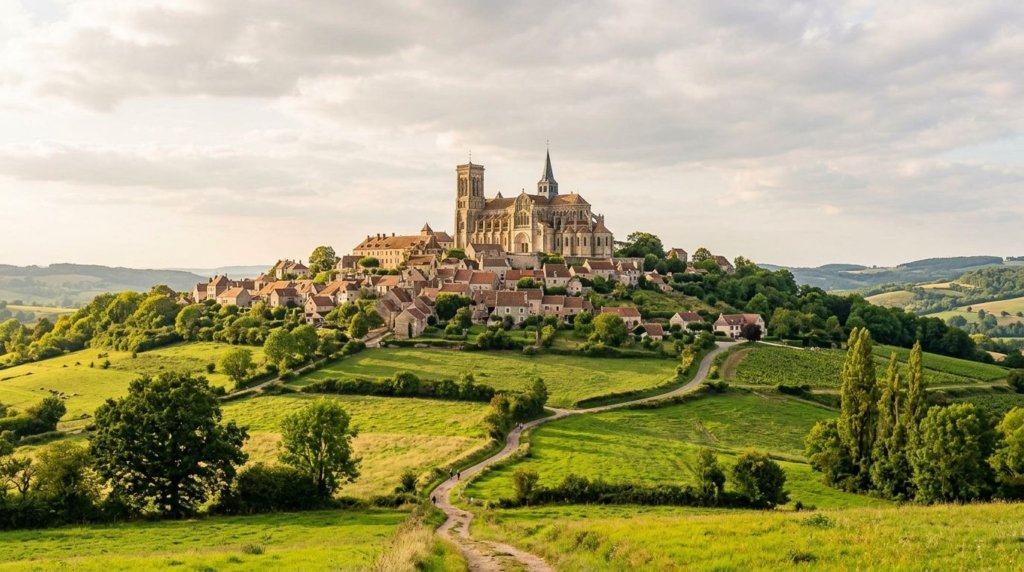
Vézelay isn’t hidden, and presenting it that way would be dishonest: Yonne’s own tourism authority describes it as the department’s premier tourist site, and it drew close to 950,000 visitors in 2024 — a striking number for a hilltop village with a legal population of 476. What it doesn’t get is much recognition outside France relative to that scale, especially compared to Mont Saint-Michel, which pulls in a broader international crowd for a similar kind of hilltop-pilgrimage silhouette.
The draw is the Basilica of Sainte-Marie-Madeleine, UNESCO-listed on its own merits since 1979 (a separate listing from the “Routes of Santiago de Compostela in France” designation that covers other sites on this list). Benedictine monks founded the abbey in the 9th century; it became a major pilgrimage destination after acquiring relics attributed to Mary Magdalene, Saint Bernard preached the Second Crusade here in 1146, and Richard the Lionheart and Philip Augustus mustered their armies below the hill before the Third Crusade in 1190. The basilica functions as an active parish church and has no posted admission fee. It remains a stop on the modern Camino de Santiago route toward Spain.
- Getting there: No train station in the village. The nearest, Sermizelles–Vézelay, sits in a neighboring commune about 10 km away, with a twice-daily shuttle bus into Vézelay; regional buses from Dijon or Auxerre are the other option.
- Do you need a car? It’s genuinely the easiest way in, given the limited shuttle schedule.
- What costs money: Entering the basilica is free.
- Recent context: The village hosted the Olympic flame in July 2024, and a roughly €2 million restoration of the public spaces around the basilica wrapped up in 2025.
Worth Knowing Before You Go
Come expecting a genuinely significant, actively visited pilgrimage site rather than a secret find — the crowds, especially in summer, reflect its real popularity. The honest trade-off is access: no rail line into the village itself means more planning than a straightforward train trip, whichever direction you’re coming from.
4. Semur-en-Auxois, Burgundy: A Fortified River Town With Almost No Published Visitor Data
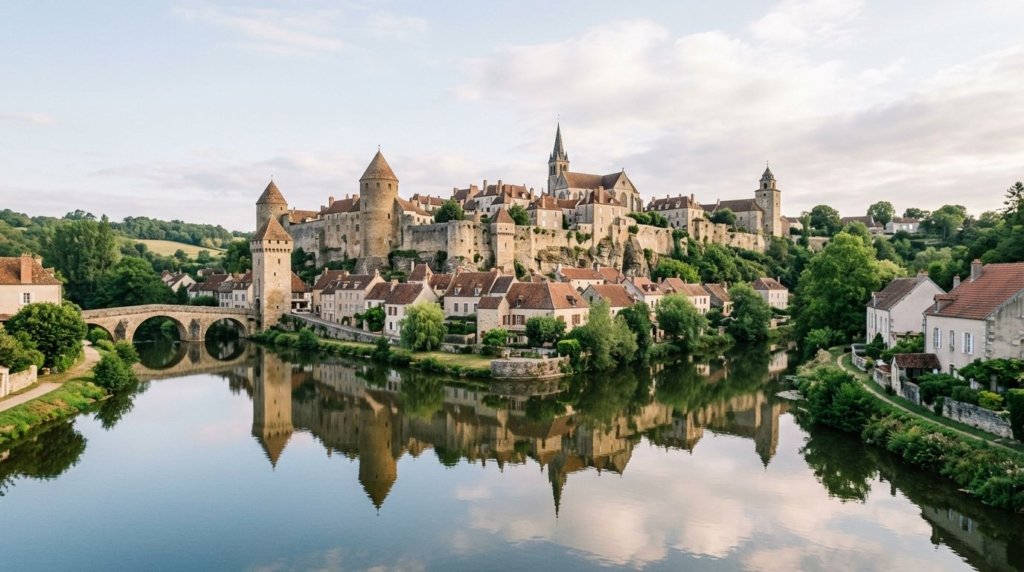
Semur-en-Auxois sits inside a tight bend of the Armançon river, on a granite-and-limestone promontory in Burgundy’s Côte-d’Or department, close to Vézelay but a genuinely different kind of place: where Vézelay draws pilgrims by the hundreds of thousands, Semur barely registers in any tourism dataset we could find at all. That absence is itself the most honest thing this section can tell you about how quiet it is.
The fortress at its center forms a roughly 75-by-50-meter rectangle anchored by four named towers — the Tour de l’Orle d’Or, 44 meters high on the river-facing side; the Tour de la Prison, which retains part of its original defensive wall; the Tour Margot, now attached to the town’s theater; and the Tour de la Géhenne, a former salt store later used as a butchers’ market. The Collégiale Notre-Dame, a 13th- and 14th-century Burgundian Gothic church with a flamboyant carved porch, sits nearby and is free to enter, with volunteer-led tours offered in summer. The whole historic core has been a protected heritage sector since 1998.
- Getting there: No train station in town. The nearest stations are Les Laumes-Alésia (15 km, TER to Dijon and Paris) and Montbard (18 km, TGV and TER), both requiring a connecting bus.
- Do you need a car? Realistically yes, unless you’re comfortable coordinating a train-plus-bus connection with limited frequency.
- What costs money: The Collégiale is free. The Tour de l’Orle d’Or is €5 flat, but it only opens for about six weeks a year — mid-July to late August — so time a visit accordingly if climbing it matters to you.
Who Should Skip It?
Anyone without a car and without flexibility on timing should think twice — the transit connections are workable but thin, and the one paid attraction with real presence, the Tour de l’Orle d’Or, is only open in high summer. If you’re already road-tripping through Burgundy near Vézelay or Avallon, though, Semur costs you almost nothing extra to add, and the town itself is free to walk.
5. Loches, Loire Valley: A Royal Fortress at a Third of Chambord’s Price
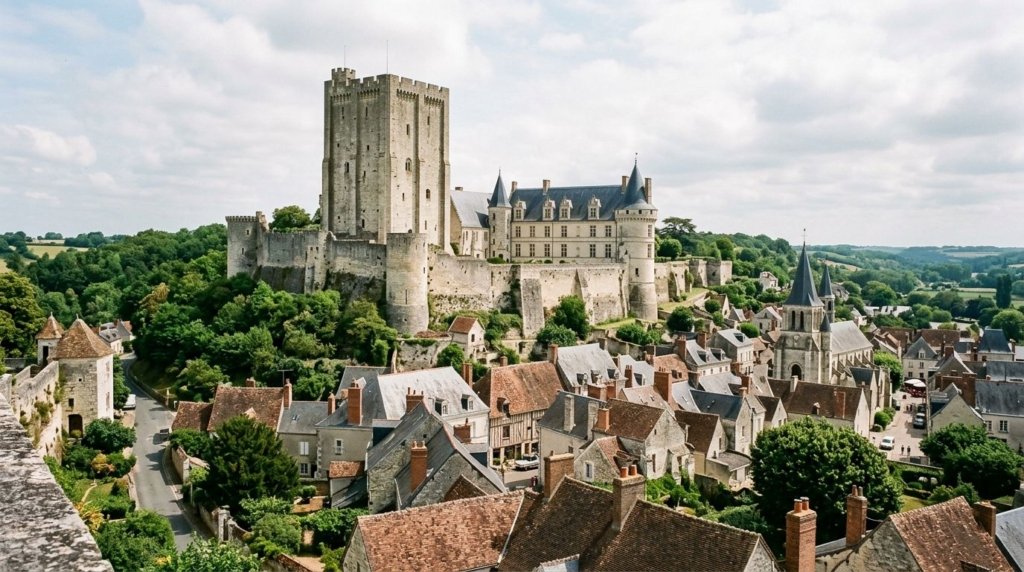
The Loire Valley’s fame runs almost entirely through a handful of names — Chambord, Chenonceau, Amboise — and Loches, 42 kilometers south of Tours, tends to fall outside that list despite a history that’s arguably more eventful than some of them. Its 11th-century keep, built by Fulk III, Count of Anjou, is considered one of Europe’s best-preserved examples of early medieval military architecture. Henry II of England and Richard the Lionheart held it during the Angevin period; Philip II of France took it in 1204. In 1429, Joan of Arc met Charles VII here after her victory at Orléans and persuaded him to travel to Reims for his coronation, a meeting still commemorated on-site. Charles VII’s mistress Agnès Sorel, the first woman formally recognized as an official royal favorite, later lived and is entombed here. For centuries after, the keep held state prisoners, including the Duke of Milan and, in the early 1700s, a woman who tried to escape disguised as a man — prisoner graffiti from that era is still visible in the cells.
The Michelin Green Guide recently awarded Loches its top three-star rating, credited specifically to how well the site’s heritage has been preserved — a mark shared by only a handful of French sites. What Loches doesn’t have is Chambord’s crowds or its price tag:
| Full-price admission | 2025 visitors | |
| Cité Royale de Loches | €12.50 | No published figure |
| Château de Chambord | €21 (EEA) / €31 (non-EEA) | 1,218,055 |
- Getting there: Direct TER from Tours, under an hour, multiple daily departures, around €10 standard fare.
- Do you need a car? No — both the station and the fortress sit within central Loches.
- Recommended stay: The keep, royal lodgings, collegiate church, and ramparts together run about 1.5 to 2.5 hours at a comfortable pace.
- Seasonal note: The Médiévales de Loches festival runs August 15–17, 2026, with medieval encampments and jousting — a bigger draw if you want the spectacle, a reason to visit other weeks if you want the site quiet.
Best For
Travelers doing a Loire Valley circuit who want one substantial château experience without Chambord-level crowds or pricing, and who don’t mind a smaller site with fewer on-site amenities as the trade-off.
6. Conques, Occitanie: A Village of a Few Hundred People, Reachable Mainly by Seasonal Bus
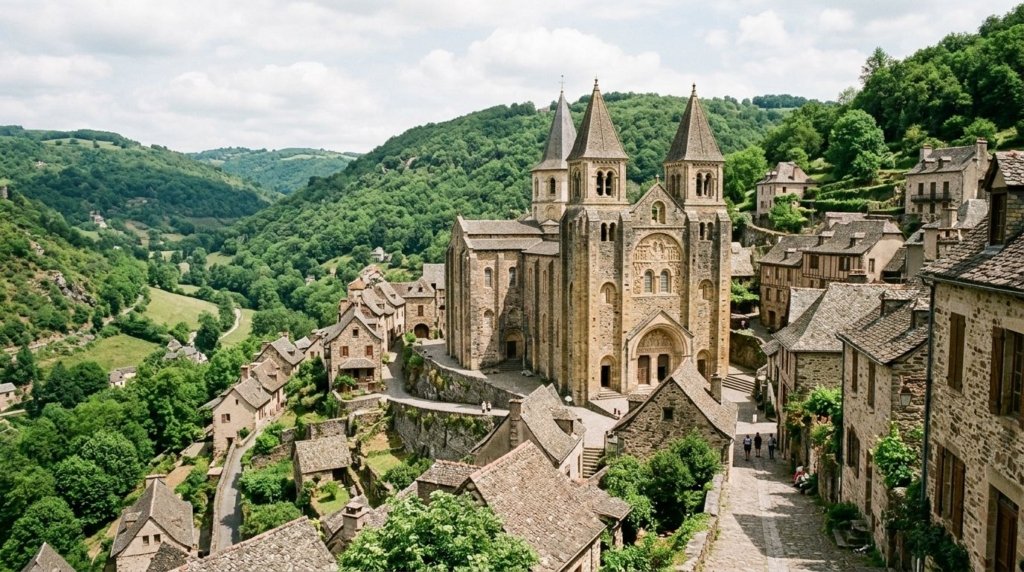
Conques, in the Aveyron department, is one of the smallest and most physically remote places on this list, and its access reflects that directly: there’s no train station in the village, and outside a seasonal bus line running April through October between Rodez and Conques, reaching it without a car means relying on a taxi or private shuttle. That friction is precisely why it’s stayed this quiet.
The Abbey Church of Sainte-Foy is the reason to make the trip: an 11th- and 12th-century Romanesque building with a carved tympanum of the Last Judgment above its west door and around 250 sculpted capitals inside, plus modern stained glass designed by Pierre Soulages. Conques’ own tourism office ties its UNESCO recognition to the 1998 “Routes of Santiago de Compostela in France” listing, a serial designation covering dozens of pilgrimage-related sites across the country. The Treasury normally houses one of Europe’s significant collections of medieval reliquary goldsmith work, including the gold and gem-covered “Majesty of Sainte Foy” — as of this writing, though, the Treasury is closed for safety reasons, which materially changes what’s currently on view, so confirm its status before building a visit around it.
- Getting there: Nearest train stations are Rodez (38 km) and Saint-Christophe-Vindrac (23 km). The seasonal Line 223 bus runs Rodez station to Conques daily, April through October; outside that window, plan on a car, taxi, or private shuttle.
- Do you need a car? For most of the year, yes.
- What costs money: The Treasury, when open, is €6.50 full / €4.50 reduced — check current status before you go, given the closure noted above.
Worth Knowing Before You Go
This is the most logistically demanding stop on the list, and it’s worth planning around deliberately rather than as a spontaneous add-on. If the Treasury’s closure hasn’t been resolved by the time you’re traveling, the abbey church and its tympanum alone are still a legitimate reason to come, but it’s a different, smaller visit than the one built around the reliquary collection.
7. Albi, Occitanie: A UNESCO City an Hour From Toulouse
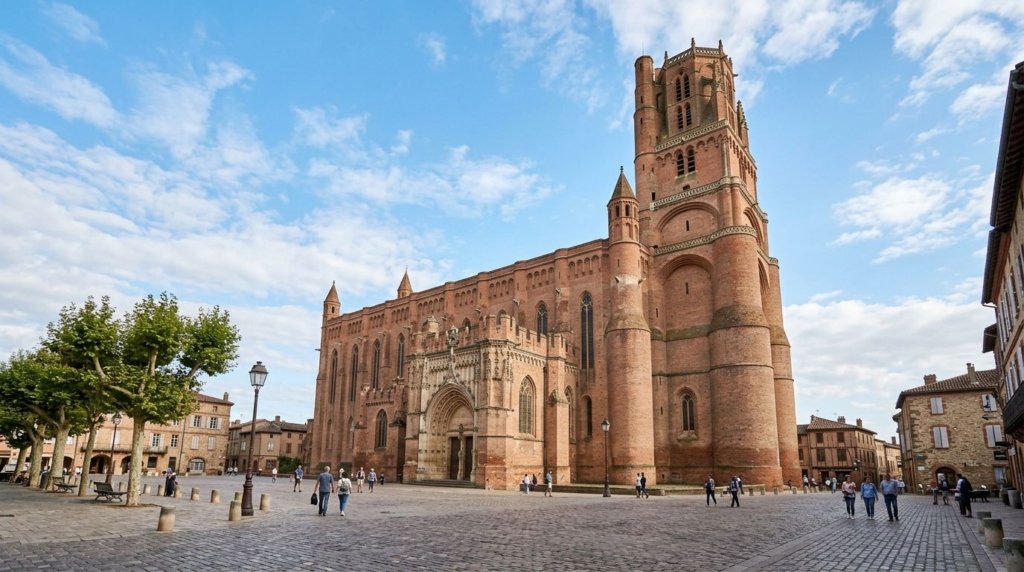
Albi’s “Episcopal City” was inscribed as a UNESCO World Heritage Site in 2010, and its centerpiece, the Cathédrale Sainte-Cécile, is what the local tourism board describes as the largest brick cathedral in the world — a claim that comes from Albi’s own tourism site rather than from UNESCO’s inscription text, worth noting since it’s the kind of superlative that’s easy to repeat without checking where it originates. What UNESCO’s own listing does confirm is the building’s significance as an “exceptional architectural and decorative example” of Gothic style adapted to southern France, built almost entirely from local brick rather than the stone used further north.
The other major draw is more straightforward: the Toulouse-Lautrec Museum, housed in the Palais de la Berbie next to the cathedral, holds what its own site calls the world’s largest public collection of the painter’s work, including all 31 of the posters he designed. Albi itself was Toulouse-Lautrec’s birthplace. Both sights sit within an easy walk of each other in a compact old town, and the city is a genuine day trip from Toulouse rather than a full detour.
- Getting there: TER trains from Toulouse, about an hour, roughly 20 round trips a day.
- Do you need a car? No — it’s a straightforward rail day trip, and the old town is walkable.
- What costs money: The cathedral’s choir and treasury, with audioguide, run €6 full / €5 reduced, free under 14; the Toulouse-Lautrec Museum is €10 full / €5 reduced, free under 18.
- Recommended stay: A full day covers the cathedral, museum, and old town without rushing.
Is It Worth the Detour?
Yes, especially if you’re already in Toulouse and only have a day to spare — the train connection makes this one of the easiest additions on this entire list. It’s a lighter pick if you’re not interested in either Gothic architecture or Toulouse-Lautrec specifically, since those two sights carry most of the visit.
One Town We Left Off: Collioure
Collioure, on the Mediterranean coast near the Spanish border, came up early in our research for its Fauvist art history — Matisse and Derain painted there together in 1905 — and its Vauban-fortified château. It’s not on this list because it doesn’t fit the premise: French viewers voted it “Village préféré des Français” in 2024, and regional press has since reported figures like 35,000 visitors a day in peak summer, along with a 2026 municipal debate over restricting tour buses in the town center. That’s a legitimate, well-loved destination, but calling it “underrated” alongside these seven would not be honest.
Planning Around These Seven
These towns don’t connect into one route — they sit across six different regions, from Brittany’s coast to the edge of the Pyrenees. Realistically, each works best as an addition to a trip you’re already building: Dinan alongside a Brittany or Mont Saint-Michel itinerary, Troyes as a different kind of Paris day trip, Vézelay and Semur-en-Auxois together as a Burgundy pairing, Loches folded into a Loire Valley chateau circuit, and Conques or Albi worked into a trip through southern France. If you’re planning a wider trip built around skipping the busiest stops, our guide to underrated travel destinations around the world covers similar ground outside France, and our roundup of overlooked corners of Europe covers a broader continental list.
Frequently Asked Questions
Which of these is the easiest day trip from Paris?
Troyes, by a clear margin — it has frequent direct trains from Paris Gare de l’Est and a compact, walkable old town. The other six require either a longer train journey, a regional connection, or a car.
Are any of these actually well known within France, even if they’re overlooked internationally?
Vézelay is the clearest example — nearly a million visitors a year and described by its own regional tourism board as the area’s top site. It’s genuinely popular domestically; what it lacks is the international profile of comparable pilgrimage or hilltop landmarks.
Do I need a car for most of these?
It depends which ones. Troyes, Loches, and Albi are all straightforward without a car. Dinan works without one from Rennes. Vézelay, Semur-en-Auxois, and Conques are all realistically easier with one, given limited rail and bus service.
Is Conques worth the extra effort to reach?
If Romanesque architecture and a genuinely remote, low-traffic village are what you’re after, yes. If the Treasury closure mentioned above hasn’t been resolved and that collection was your main reason for going, weigh that before committing to the trip.
Research & Sources
This guide was compiled through desk research using official and primary sources rather than an in-person visit. Key sources used:
- Dinan: Dinan-Cap Fréhel Tourisme, official site; Dinan-Cap Fréhel 2023 tourism observatory report; Saint-Malo Tourisme, 2023 key figures; Château de Dinan, official site; SNCF TER, Rennes–Dinan.
- Troyes: Troyes Champagne Tourisme, official site; Aube Champagne, official tourism board; Cité du Vitrail, official site; SNCF Connect, Paris–Troyes.
- Vézelay: UNESCO World Heritage Centre — Vézelay, Church and Hill; INSEE, Vézelay population data; Département de l’Yonne, official visitor figures and restoration update; Basilique de Vézelay, official visiting hours.
- Semur-en-Auxois: Ville de Semur-en-Auxois, official site; Office de Tourisme des Terres d’Auxois.
- Loches: Cité Royale de Loches, official site; Château de Chambord, official tariffs; Château de Chambord, 2025 attendance press release; SNCF TER, Tours–Loches.
- Conques: UNESCO World Heritage Centre — Routes of Santiago de Compostela in France; Office de Tourisme Conques-Marcillac, official site.
- Albi: UNESCO World Heritage Centre — Episcopal City of Albi; Albi Tourisme, official site; Musée Toulouse-Lautrec, official site; SNCF TER, Toulouse–Albi.
- Collioure (context, not featured): Office de Tourisme de Collioure, official site.
Prices, hours, and transport schedules above reflect the most recent information available at the time of research and can change — particularly Conques’ Treasury closure, which is worth confirming directly before you travel.