

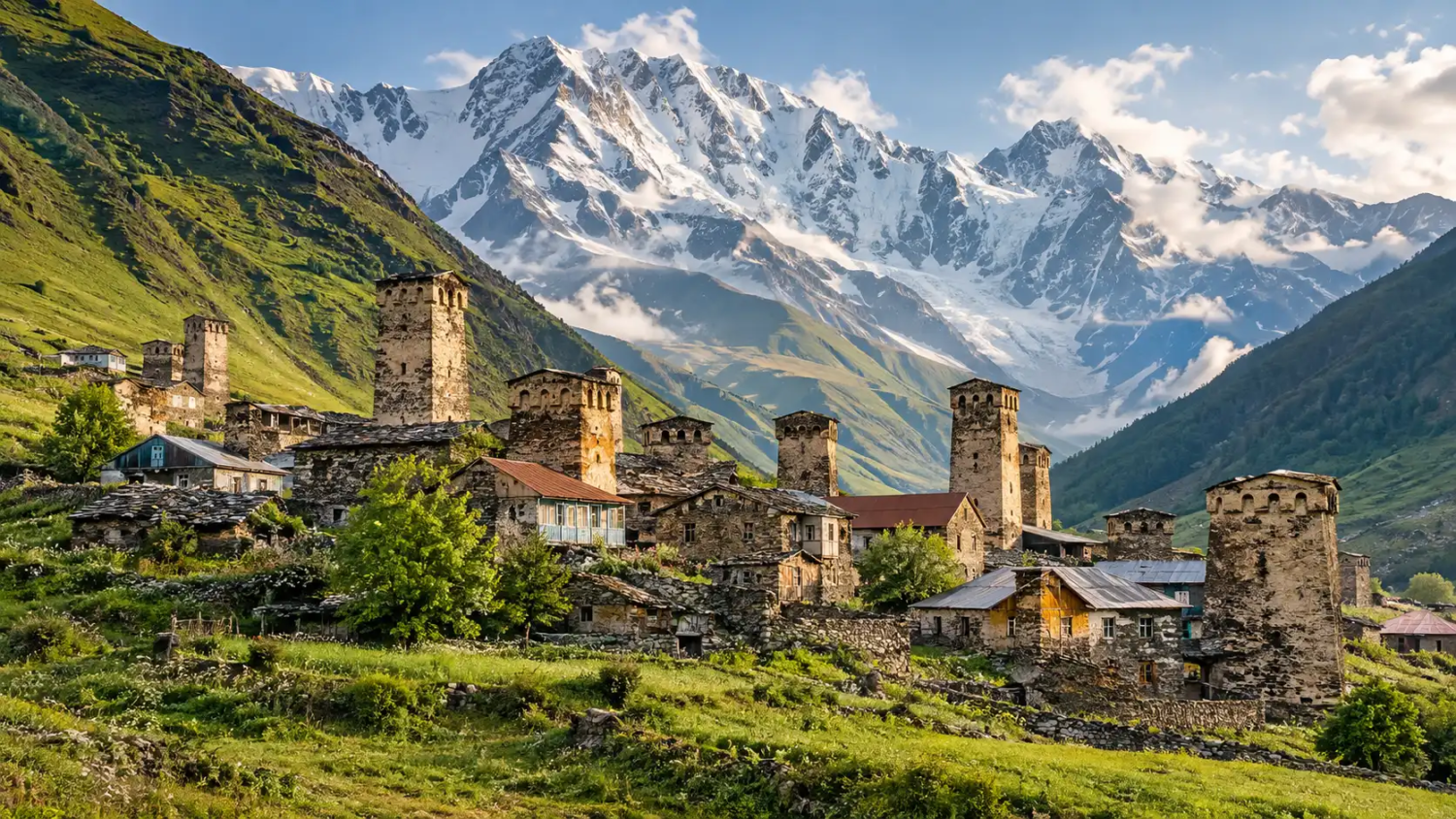
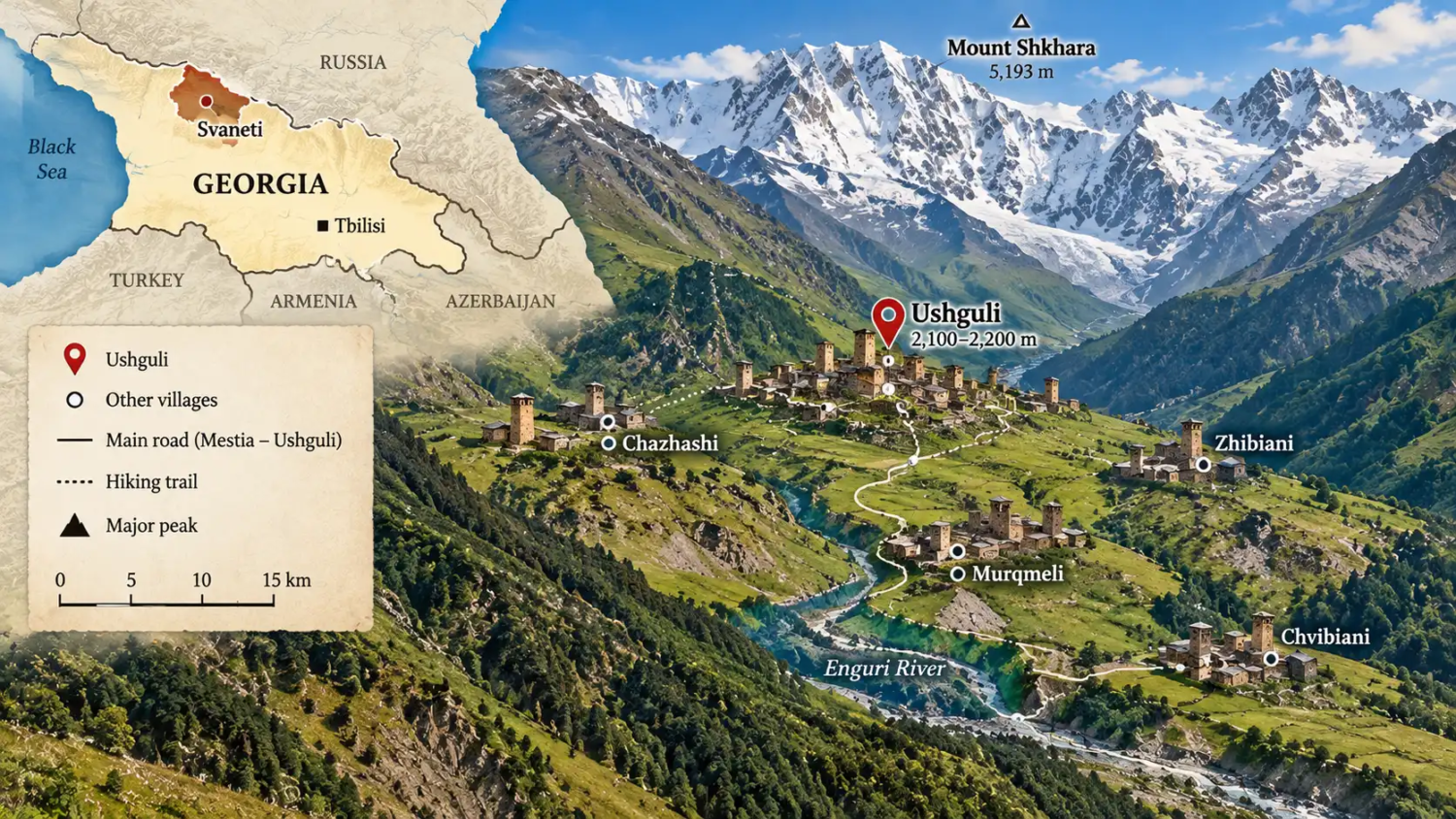
Ushguli sits at the head of the Enguri gorge in Upper Svaneti, in the Caucasus mountains of northwest Georgia, at roughly 2,100 metres (Wikipedia). Slate-roofed stone towers rise from its hillsides under the snowfields of Mount Shkhara, and many of them were built between the 9th and 12th centuries. The result looks less like a village that was preserved than one that was never entirely rebuilt, and that is the story worth telling carefully.
Last verified: October 2026. Fees, road conditions and opening arrangements below are reported by travel sources and can change, so confirm them before you travel.
How this guide was built: this is desk research from UNESCO’s World Heritage listing, an encyclopedia entry and several travel-guide sources, read in October 2026. Nothing here is a first-hand visit report. Where sources disagree, we give ranges and name the source.
Image disclosure: the images in this article are AI-generated illustrations, not photographs, and they are not a record of an actual visit.
First, a Correction to the Headline
The phrase “Europe’s last tower-house time capsule” is a good hook but not a claim we can verify. Tower-house traditions survive in other mountain regions too, and whether the Caucasus counts as Europe depends on which boundary convention you use. What the sources do support is narrower and still remarkable: UNESCO inscribed Upper Svaneti in 1996 for “highly preserved villages with unique defensive tower houses” (UNESCO), and Ushguli’s Chazhashi is described as having more than 200 medieval tower houses, churches and castles.
At a Glance
- Where: Upper Svaneti, northwest Georgia, near the foot of Shkhara, at about 2,100 m. Some sources give a slightly higher figure.
- What it is: a community of medieval villages, usually described as four or five (Zhibiani, Chvibiani, Chazhashi and Murqmeli are the names that recur), rather than a single village. Counts differ between sources.
- People: the 2014 census recorded 228 residents, and other descriptions say roughly 200 (Wikipedia).
- Heritage status: part of the Upper Svaneti UNESCO World Heritage site, inscribed in 1996 under criteria (iv) and (v).
- Season: the hiking season is roughly June to October. Snow usually arrives around October and can last until about April, and winter access is difficult (Backpack Adventures).
- “Highest inhabited village in Europe”: repeated widely, but the claim is hedged even on Wikipedia (“one of the highest continuously inhabited settlements in Europe”). Treat it as a popular label rather than a measured ranking.
Why Anyone Built Towers Here
A Svan tower was a family’s refuge. Guides describe feuds and blood vengeance that ran for generations, and raids from outside the valley, which is why each household wanted a place it could defend (Madloba). Towers also expressed a clan’s strength and honour. Researchers still debate how far each tower served as a home, a defensive post, a signal point or a status symbol, so no single explanation should be treated as settled.
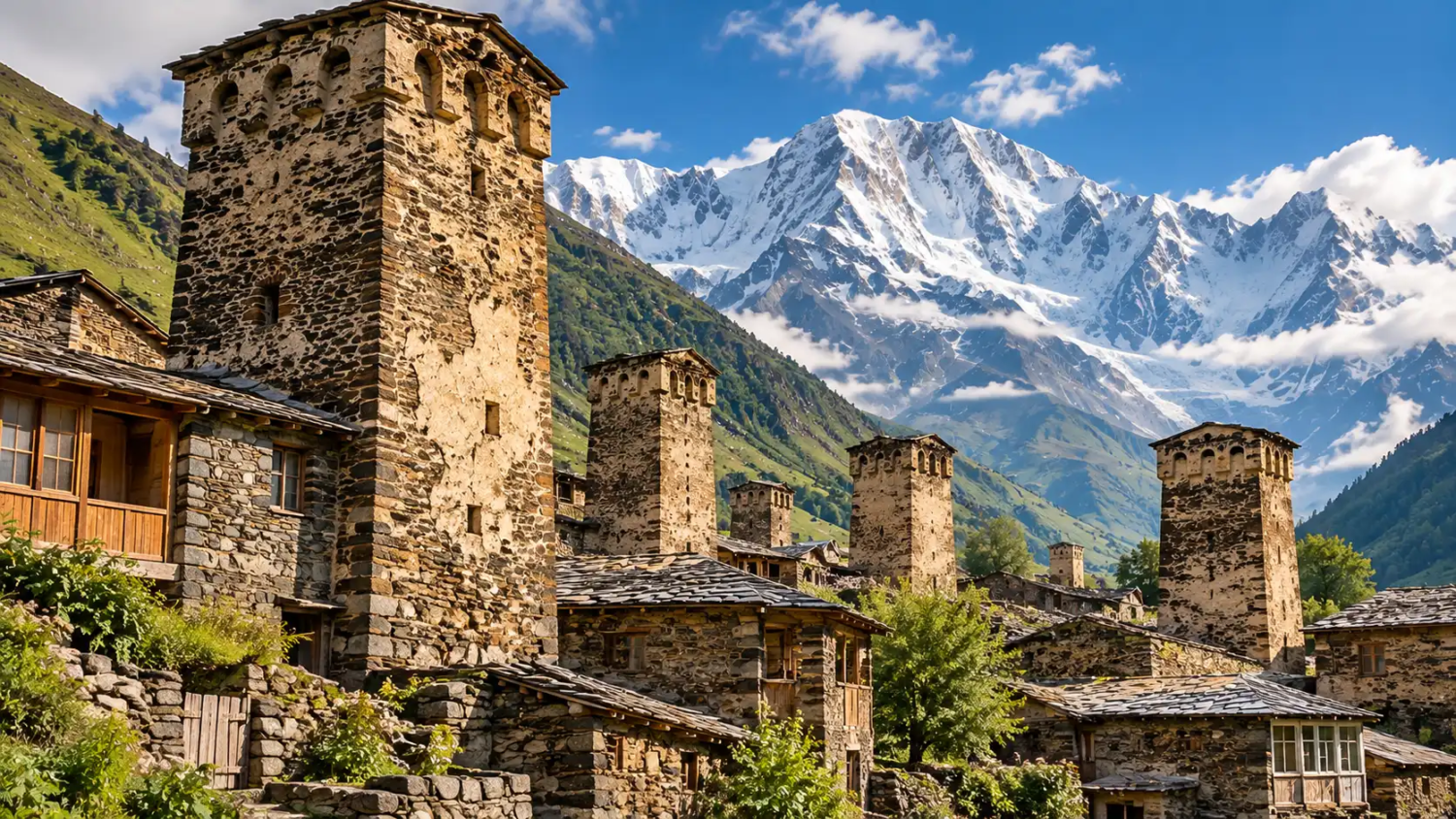
The building itself follows a pattern. Towers are often described as 20 to 25 metres tall with four or five floors, dry-stone walls that taper toward the top, a blind ground floor and an entrance on the second floor reached by a removable wooden ladder. Families usually lived in the adjoining hall house, called a machubi, especially in winter, because the tower itself was unheated. The heights and details come from a tourism guide, so read them as typical rather than exact. Stories of whole villages helping each family build its tower, or of fires passed tower to tower as warnings, are traditions without firm sources.
Queens and Legends: What Is Documented and What Is Told
Tamar, the medieval Georgian monarch, appears all over Svaneti’s folklore. In Chazhashi, ruins on a hill are called Queen Tamar’s Castle, and local lore says she kept a summer residence there. One travel source notes that the ruin is too small to look like a royal residence and cites no documentary evidence (Eurasia Travel). A similar legend says Tamar’s burial place may be at the Lamaria church, which the same sources say has no supporting evidence and has never been excavated (Eurasia Travel). Enjoy these as living folklore, and do not repeat them as history.
What the Time Capsule Really Is
The phrase fits in some ways and misleads in others. The towers and the stone-and-slate layout are genuinely old, and UNESCO credits the landscape with keeping its medieval appearance to a remarkable degree, helped by long geographic isolation. But Ushguli is also a place where about 200 people live, farm, host guests and renovate their houses.
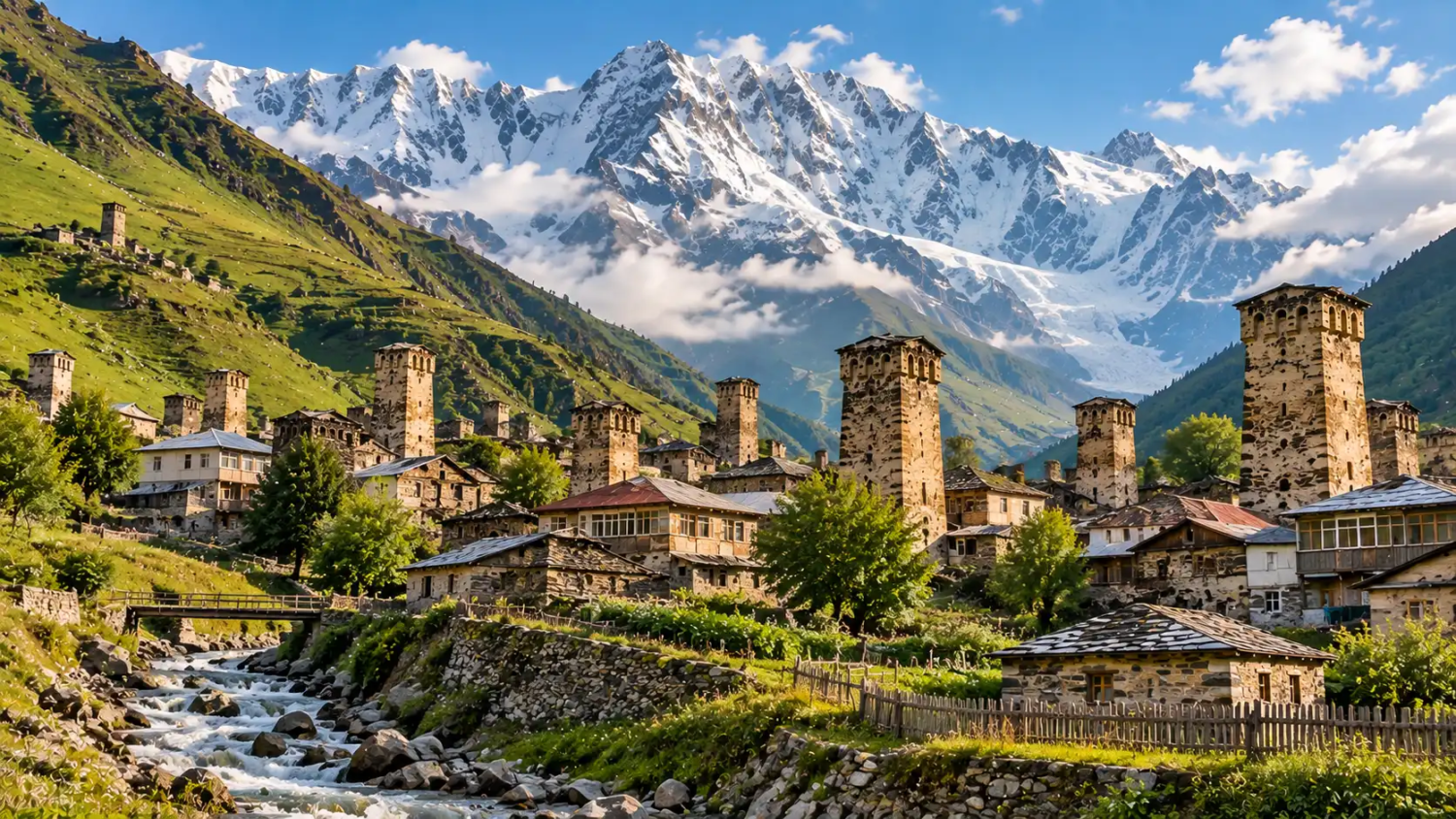
UNESCO is candid about the fragility. Its listing says the property has insufficient conservation and management capacity, that harsh winters make regular monitoring difficult, and that inappropriate repair techniques threaten authenticity (UNESCO). The listing does not place the property on the in-danger list. In short, the village is real and inhabited, and the “capsule” survives because of continuing local effort as much as because of isolation.
Getting to Ushguli
Most visitors start from Mestia. Sources put the road at roughly 46 to 50 km and the trip at about 1.5 to 2 hours. One 2025 guide describes the first stretch as newly paved and the last 15 km or so as gravel with potholes and stream fords, so a high-clearance vehicle is preferable, especially after rain (Loudavym Krokem). Road conditions change, so ask locally before you go.
Shared minivans (marshrutkas) run mostly in the morning. A travel blogger reports getting a seat in October by arriving around 8 AM, and advises booking ahead in summer (Backpack Adventures). Getting to Mestia is a separate journey: reported options include marshrutkas from Zugdidi (about 4 hours) and Tbilisi (about 9 hours) and a daily bus from Kutaisi (about 6 hours). Walkers can take the multi-day Mestia–Ushguli trek of roughly 56 km over the Chkhunderi Pass at 2,719 m. Schedules and fares change, so treat all of these as starting points.
What to See and How to Behave
The Lamaria church above Zhibiani is the most visited single building. Architectural dating places it in the 9th or 10th century, and the interior preserves fresco layers from roughly the late 10th or early 11th century and the 12th to 13th centuries, though much has faded (Eurasia Travel). Its name is the Svan word for the Virgin Mary. A belief that it continues an older pre-Christian goddess is tradition without documentary backing.
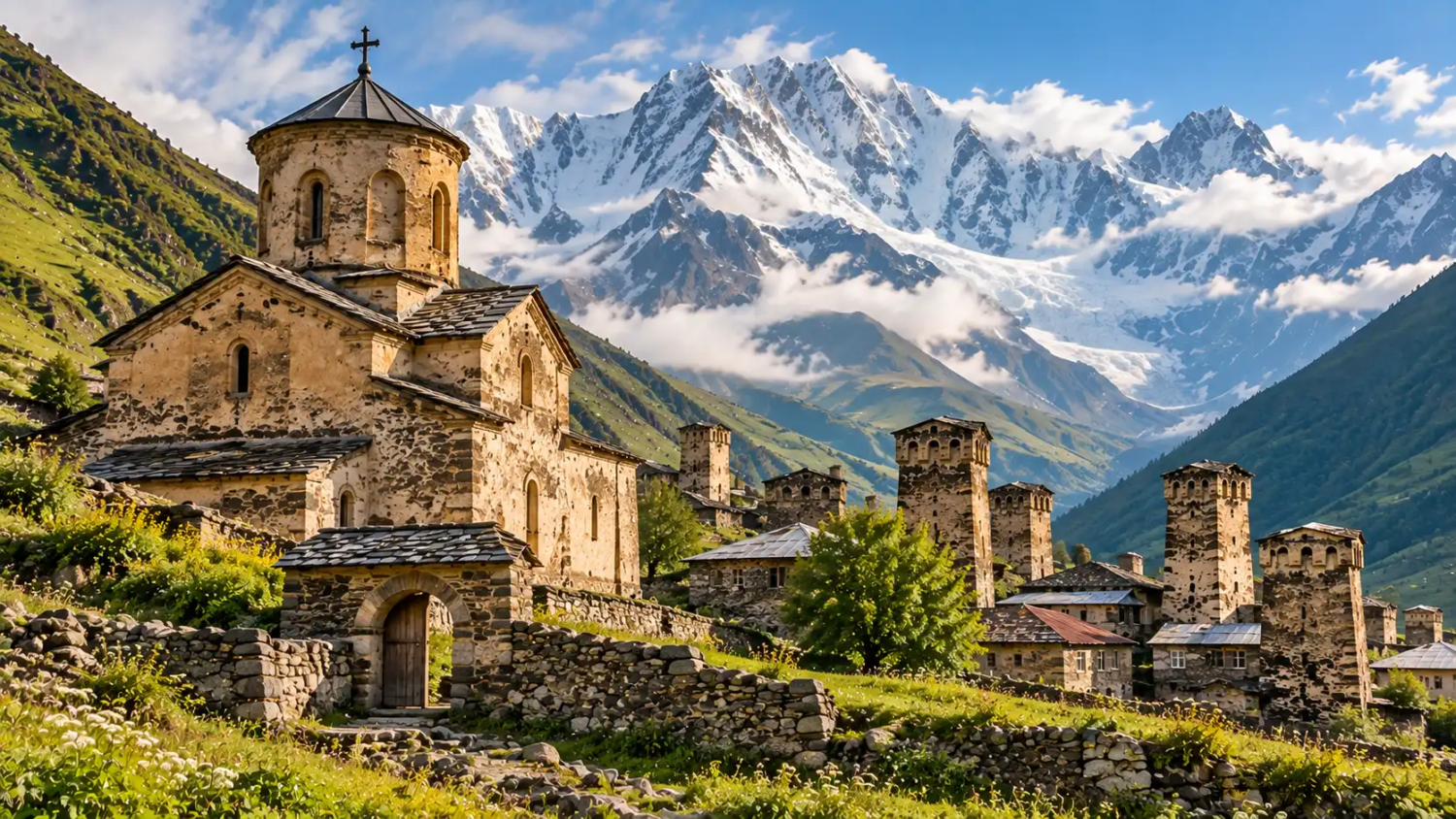
Other stops that sources mention are Chazhashi’s concentration of towers, a small tower museum near its crossroads, an ethnographic museum near Lamaria, and the walk toward the Shkhara glacier. The glacier trip is reported as about 8 km each way, roughly 5 to 6 hours return on foot, and clouds often cover the peak by afternoon. Entry fees, museum charges and horse-ride prices quoted in 2025 (a few lari for the museums, around 50 GEL or more for a guided horse ride) may be out of date.
Behave as a guest. Dress modestly in the church, ask before photographing people, and do not climb towers without permission because some are private or derelict. Be cautious around the large shepherd dogs near livestock. A folk belief that women may not enter Lamaria exists, but one source says covered shoulders and knees are recommended and that this is no longer strictly applied.
The Honest Downsides
Ushguli is not a quick or comfortable day out. The road is long and rough in places, and a mid-summer day trip from Mestia leaves limited time at the village itself. Sources report crowds and full guesthouses in July and August, basic accommodation, patchy mobile signal and Wi-Fi, and free-roaming dogs and livestock.
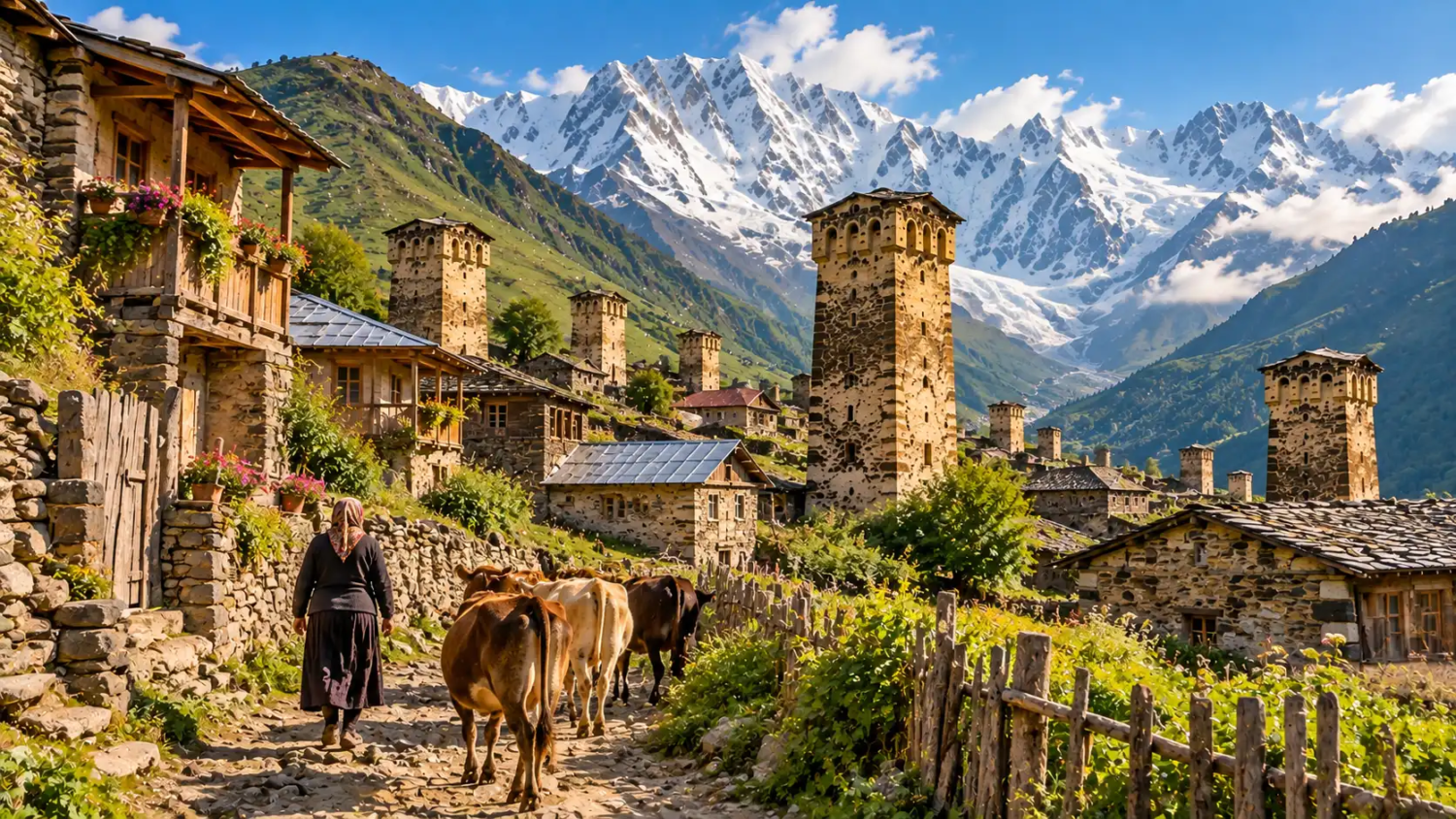
- Weather and season: snow arrives around October and can last to April, which can cut off the road. Plan flexibility, not a fixed schedule.
- It is a living community: residents are going about their lives, so some towers are private and photography calls for courtesy.
- Pressure on a fragile place: UNESCO itself lists limited management capacity and repair-quality concerns. Growing visitor numbers add to this.
- Information ages quickly: many prices, schedules and guesthouse names online come from 2021 to 2025 and may not match what you find.
FAQ
Is Ushguli really the highest inhabited village in Europe?
It is often called that, but sources hedge the claim, and it depends on how settlements and Europe’s boundaries are defined. “One of the highest continuously inhabited settlements in Europe” is the safer wording.
Is it worth staying overnight?
One travel blogger recommends at least one night for sunrise and sunset light, and accommodation is mostly small and basic. A day trip from Mestia is possible but leaves little time.
When is the best time to go?
The walking season is roughly June to October, with summer busiest. Early autumn can be quieter but the first snow often falls in October.
Can I visit in winter?
Sources describe snow cover for several months and say the road to Mestia can be impassable. Check current conditions locally before planning a winter trip.
Is Ushguli a UNESCO World Heritage site?
It is part of the Upper Svaneti site, inscribed in 1996. Ushguli is not a separate listing.
Research & Sources
Sources used: Wikipedia: Ushguli; UNESCO World Heritage Centre: Upper Svaneti; Madloba: Svan towers; Loudavym Krokem: Ushguli; Backpack Adventures: Mestia to Ushguli; Eurasia Travel: Lamaria church; Eurasia Travel: Queen Tamar’s Castle. Several are tourism or blog sources and are cited for practical detail, not as primary history.
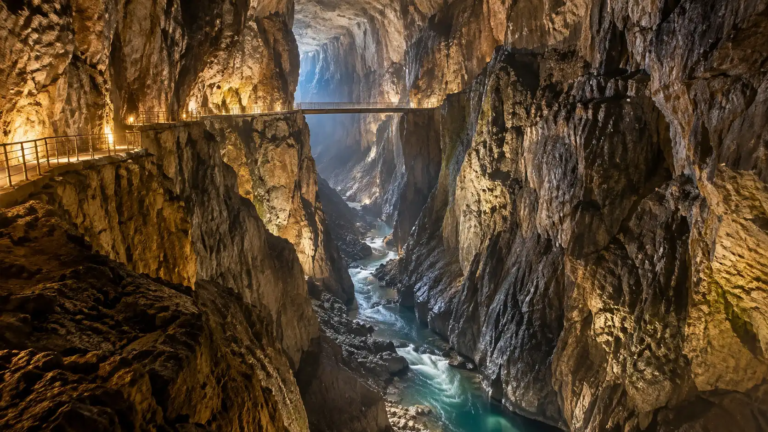
[…] The site has pressures of its own. UNESCO’s documentation notes that water quality has varied because of industrial, sewage and agricultural pollution, that walkways, bridges and lighting have affected parts of the cave system, and that tourism needs careful planning and monitoring. It also says there is limited cooperation between site managers and the tourism industry. The same tension between access and fragility shows up at Ushguli in Georgia. […]