
San Francisco’s headline attractions get a lot of airtime: the Golden Gate Bridge, Alcatraz, the cable cars, Fisherman’s Wharf. All genuinely worth seeing, and none of them are what this list is about. These three spots barely register on most “top things to do” roundups, yet each one gives a visitor something the postcard sights can’t: the sound of the bay itself turned into music, a residential staircase transformed into a community art piece, and a Gilded Age building most San Franciscans have never set foot inside. None require a ticket booth or a timed-entry reservation.
Quick Answer: Three low-key San Francisco spots that skip the lines entirely —
The Wave Organ: San Francisco’s Only Instrument Played by the Bay
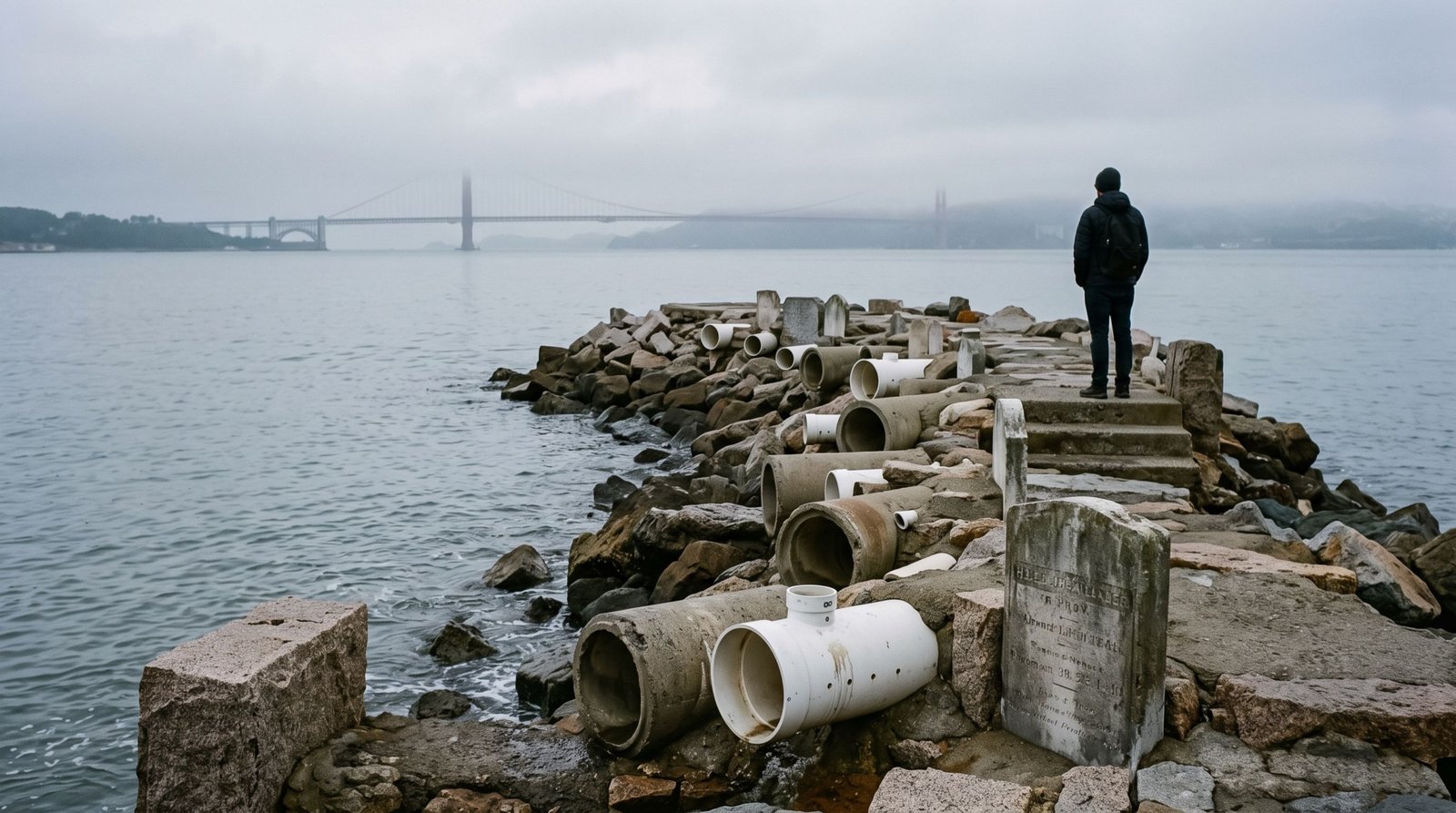
At the end of a small jetty in the Marina District, 25 concrete and PVC pipes disappear into San Francisco Bay. Built in 1986 by artist Peter Richards and stonemason George Gonzalez as an offsite project for the nearby Exploratorium, the pipes act like a pan flute: rising and falling water inside each one pushes air through the opening, producing gurgles, low booms, and the occasional hollow whistle depending on the tide. Richards has explained that shorter air columns at high tide push the pitch higher, while low tide produces deeper, sparser tones — so the “music” genuinely changes by the hour.
The jetty itself is built from recycled granite, including stone salvaged from the 1906 earthquake and headstones pulled from early-1900s cemetery relocations — some still bear faint carved lettering if you look closely at the benches near the pipes. It sits directly across from the Palace of Fine Arts, with the Golden Gate Bridge visible in the distance on a clear day.
- Address: 1 Yacht Road, San Francisco — at the end of the jetty past the St. Francis Yacht Club in the Marina District.
- Getting there: No dedicated parking lot; street parking along Marina Boulevard or Yacht Road is typical. Muni bus lines 30 and 43 stop within a 10–15 minute walk.
- Cost & hours: Free, outdoor, unstaffed, open around the clock.
- Best time to visit: High tide produces the clearest tones — check a NOAA tide chart for San Francisco Bay before heading over, since the pipes can go nearly silent at dead low tide.
Why It’s Worth Your Time
It’s genuinely unlike anything else in the city — a working sound instrument rather than a static viewpoint — and it costs nothing to experience. The catch is honesty: at the right tide with a few other visitors and fishermen already there, it’s not a secret exactly, just a spot most tourist itineraries never mention.
16th Avenue Tiled Steps: A Staircase Built One Sponsored Tile at a Time
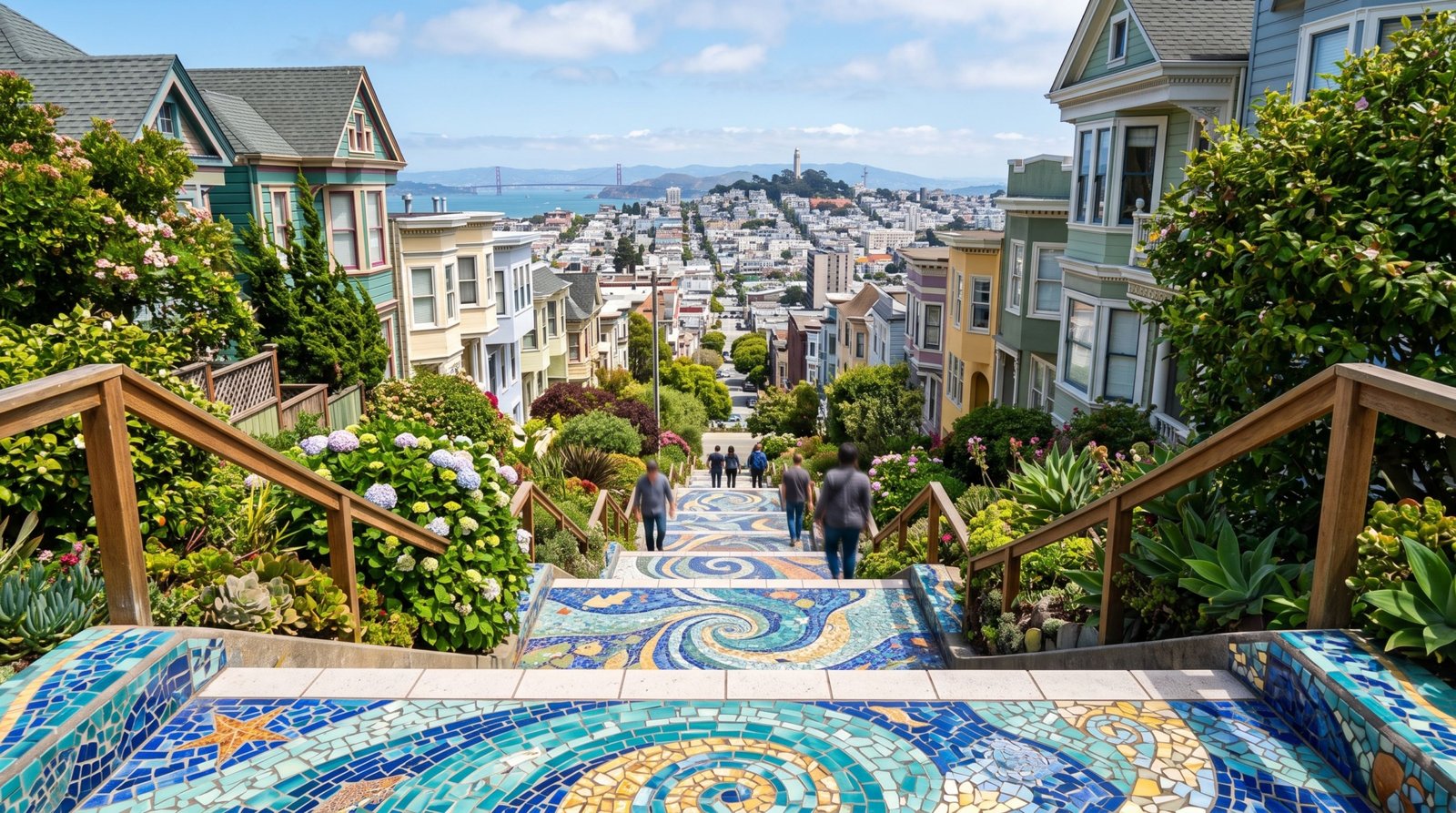
In 2003, two Golden Gate Heights neighbors, Jessie Audette and Alice Yee Xavier, pitched an idea inspired by Rio de Janeiro’s Escadaria Selóron: turn a plain concrete staircase into public art. Designers Aileen Barr and Colette Crutcher ran community workshops to shape the design, and over 220 residents sponsored individual tiles — many bearing their names worked into the sea-creature and star motifs. The steps opened in August 2005; the mayor declared it “16th Avenue Tiled Steps Day.”
The finished staircase runs 163 steps up roughly 90 feet of elevation, built from more than 2,000 individually designed mosaic panels made of over 75,000 glass fragments — Fodor’s has called it possibly the largest mosaic staircase in the world. Native plants and succulents line both sides, supporting a small population of endangered green hairstreak butterflies. At the top, the steps connect to Grandview Park, which delivers a 360-degree view over the Sunset District, Golden Gate Park, and the ocean beyond.
- Address: 16th Avenue between Moraga and Lawton Streets, Golden Gate Heights.
- Getting there: Street parking on surrounding residential blocks is realistic on weekdays; the Muni N-Judah line stops within about a 10-minute walk.
- Cost & hours: Free, open at all hours — a quiet residential street after dark.
Worth Knowing Before You Go
This isn’t a secret to everyone — its popularity got real enough that a 2016 wave of car break-ins specifically targeted vehicles left parked near the steps while owners were climbing them. It’s not on most mainstream San Francisco itineraries, but locals and photographers know it well, so don’t leave valuables visible in a parked car here any more than you would anywhere else in the city.
San Francisco Columbarium: A Gilded-Age Rotunda Almost Nobody Visits

Built in 1898 by architect Bernard J.S. Cahill, the San Francisco Columbarium is the last structure standing from what was once a 30-acre cemetery — the rest was removed after the city banned burials within its limits in 1902. Its copper dome and neoclassical facade, inspired by Chicago’s 1893 World’s Fair architecture, sit over a 64-foot rotunda rising roughly 45 feet, ringed by four floors of memorial niches — more than 8,500 in total — with stained glass windows some historians attribute to Louis Comfort Tiffany or John La Farge. The Neptune Society bought and restored the building starting in 1980, and it was named a San Francisco landmark in 1996.
It’s still an active columbarium today — families can and do place ashes here — and the ground-floor rooms are named for mythological winds, with upper-floor rooms named for constellations. Walking through feels less like a tourist stop and more like stepping into an unusually beautiful building most San Franciscans drive past without ever noticing.
- Address: One Loraine Court, Inner Richmond District, near Stanyan and Anza, just north of Golden Gate Park.
- Getting there: Office hours are Monday–Friday, 9am–5pm; the site describes itself as open seven days a week for visitors. Calling ahead (415-771-0717) is the reliable way to confirm same-day access.
- Cost: Free, no admission fee.
Who Should Visit
Anyone who likes quiet, unusual architecture, or has an interest in San Francisco’s Gilded Age history. It’s not a stop for anyone uncomfortable being inside a working columbarium — this is a functioning memorial space, not a museum exhibit, and visitors should behave accordingly.
One Thing We Left Off, and Why
The Sutro Baths ruins came up constantly in research as a classic “hidden gem” pick, and they’re a genuinely striking place — the collapsed concrete foundations of a 19th-century bathhouse perched over the Pacific at Lands End. But San Francisco’s own official tourism site, SF Travel, actively promotes them as a must-see attraction, and its own visitor guide notes the ruins “can become fairly crowded on weekends.” That’s the opposite of underrated — it’s a mainstream stop that happens to look atmospheric in photos, which is exactly why it shows up on nearly every SF hidden-gems list despite not being hidden at all.
Planning a Visit to All Three
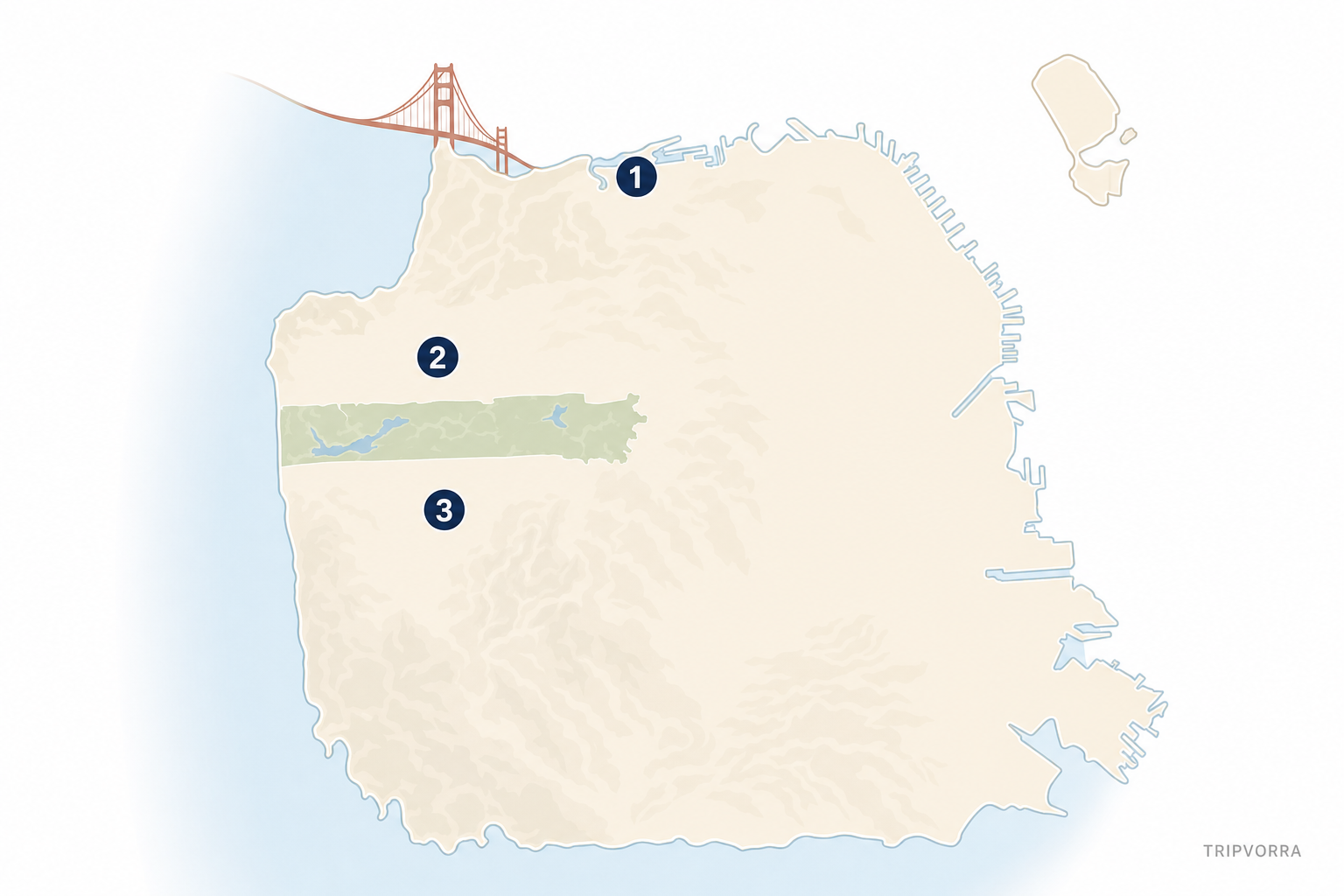
These three sit in different corners of the city — the Marina in the north, Golden Gate Heights in the southwest, and the Inner Richmond just north of Golden Gate Park — so there’s no single walking route between them, though the Columbarium and the Tiled Steps are a reasonable rideshare or bus connection apart, both within a mile or two of Golden Gate Park’s western half. None of the three require booking ahead or paying an entrance fee, which makes any of them an easy add-on to a longer day already built around the park or the Marina waterfront. If you’re building a broader offbeat-California itinerary around this trip, the same research-first approach carried through our towns and trails worth the detour elsewhere in California and our underrated towns in Ireland — real sourcing, no invented superlatives, and honest tradeoffs stated plainly.
Frequently Asked Questions
Is the Wave Organ worth visiting at low tide?
It’s still visitable — the jetty and views are unaffected — but the sound itself is much fainter and can go nearly silent. Checking a tide chart before going is worth the extra step if the sound is the main reason for the trip.
Can you actually go inside the San Francisco Columbarium?
Yes — it’s open to the public during business hours as both a working columbarium and a landmark building, and there’s no admission fee. Calling ahead is the safest way to confirm access on a given day, since it’s an active facility rather than a museum with fixed public hours.
Is 16th Avenue Tiled Steps the only mosaic staircase in San Francisco?
No — the Hidden Garden Steps at 16th Avenue and Kirkham Street are a separate, similarly tiled staircase a short walk away, completed a few years later by the same design team. Most visitors only have time for one; the 16th Avenue Tiled Steps at Moraga is the better-known and taller of the two.