
Most first-time Paris itineraries cover a surprisingly small footprint: the Eiffel Tower, the Louvre, Notre-Dame, Montmartre, maybe a Seine cruise, all within a few kilometers of each other. That’s not a criticism — those sights earned their reputation. But it means the vast majority of visitors never cross into the neighborhoods where most Parisians actually spend their weekends: a former village that escaped Haussmann’s rebuilding, an elevated garden built on an abandoned railway, a quiet residential pocket of cottage-style houses. This guide covers five of them, chosen specifically because each is easy to reach on public transit, genuinely distinct from the others, and holds up on its own merits rather than as a footnote to a bigger sight nearby.
Last verified: August 29, 2026. This guide was built from desk research against the City of Paris’s own site (paris.fr), the official Paris tourism board (parisjetaime.com), the relevant arrondissement town halls, and RATP transit data — not from a personal visit. Where official sources disagreed or a detail couldn’t be confirmed, it’s noted in the text or left out.
| Corner | Arrondissement | Nearest Metro | Time to Allow |
| The Covered Passages | 2nd | Grands Boulevards | 1.5–2.5 hours |
| Butte-aux-Cailles | 13th | Corvisart | 1.5–2.5 hours |
| Coulée Verte René-Dumont | 12th | Bastille | 1–1.5 hours |
| Quartier de la Mouzaïa | 19th | Danube | 30–60 minutes |
| Village de Charonne | 20th | Gambetta | 30–60 minutes |
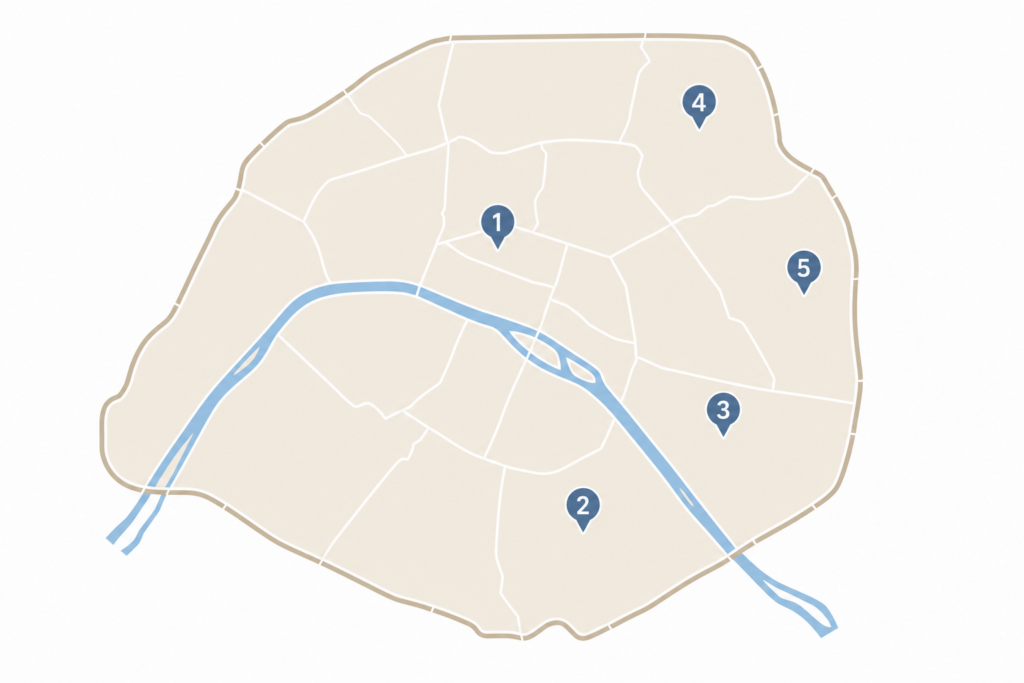
Map key: 1. The Covered Passages • 2. Butte-aux-Cailles • 3. Coulée Verte René-Dumont • 4. Quartier de la Mouzaïa • 5. Village de Charonne
1. The Covered Passages: Paris’s 19th-Century Shopping Arcades
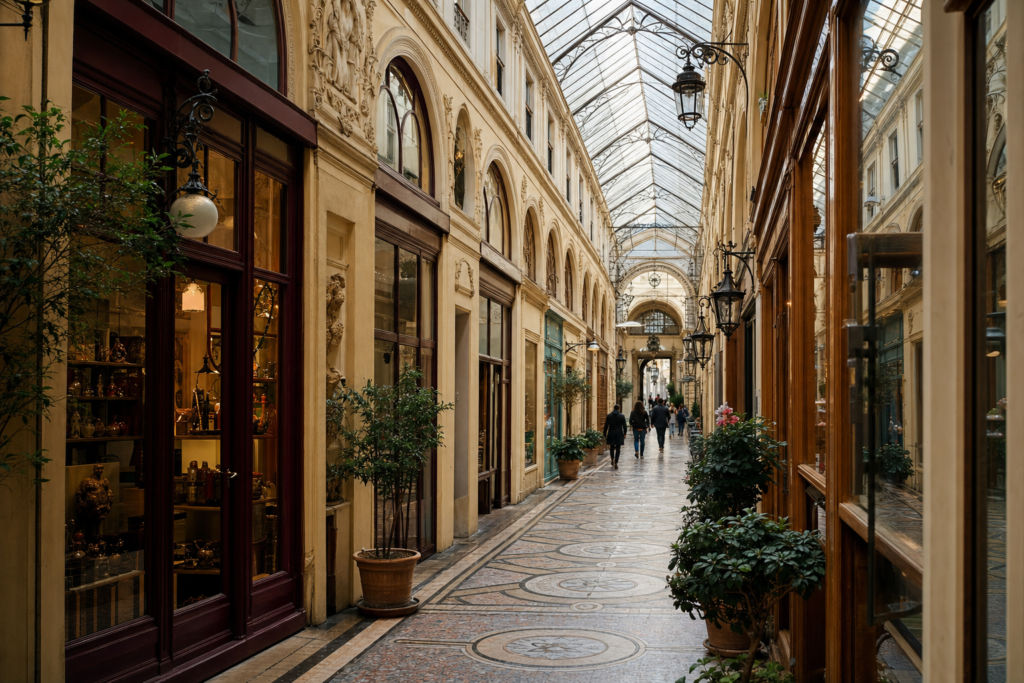
Clustered around the Grands Boulevards in the 2nd arrondissement, Passage des Panoramas, Galerie Vivienne, and Passage du Grand Cerf are glass-roofed, iron-framed shopping arcades built between 1799 and 1825, designed to let pedestrians browse under cover, away from mud and horse traffic — effectively the prototype for the department store. Passage des Panoramas, opened in 1800, gets called “the oldest covered passage in Paris” in some marketing copy, and it is one of the oldest of this particular trio; but the more precise claim, made by several Paris heritage writers, is that Passage du Caire (built a year earlier, in 1798, in a different part of the 2nd) is the oldest surviving passage overall, since the two that predated even that one are long gone. Panoramas has its own claim to fame regardless: the American inventor Robert Fulton operated panoramic paintings in its twin rotundas while waiting for Napoleon’s response to his steamboat proposal, and it was among the first spaces in Europe lit by gas lamps, in 1817.
Galerie Vivienne, built in 1823 and a listed historic monument since 1974, is the most architecturally polished of the three — mosaic floors, a domed glass roof, neoclassical reliefs — and today houses roughly 56 businesses spanning fashion, home goods, and an antiquarian bookshop. Passage du Grand Cerf, a fifteen-minute walk away near the Montorgueil market street, was built for craft workshops rather than retail and today leans toward design and jewelry boutiques. Worth being honest about: Panoramas and Vivienne are not undiscovered. Vivienne’s own regional tourism promotion cites 6.4 million annual visitors, a genuinely large number for a small arcade, and both show up in most Paris guidebooks. Grand Cerf, a little farther from the main tourist axis, tends to stay quieter, though no visitor count confirms this by how much.
- Getting there: Métro Grands Boulevards (lines 8, 9) for Panoramas; Bourse (line 3) for Vivienne; Réaumur-Sébastopol (line 3) or Étienne Marcel (line 4) for Grand Cerf.
- Cost: Free — all three are public pedestrian passages, no entry fee.
- Hours: Panoramas’ gates run roughly 6 a.m.–midnight daily; Galerie Vivienne 8:30 a.m.–8 p.m. daily; Grand Cerf 8:30 a.m.–8:30 p.m. Monday–Saturday, closed Sundays. Individual shop hours are shorter and less consistent than the gate hours.
- Best time: A weekday afternoon before 5 p.m., when the most boutiques are open.
Who Is This Best For?
Anyone who wants a change of pace from open-air sightseeing, or a rainy-day plan that isn’t a museum. It’s a weaker pick on a Sunday, when Grand Cerf’s gates are closed entirely and many Vivienne shops are shut too — the architecture is still there, but the shopping-arcade atmosphere that makes these worth visiting depends on the boutiques actually being open.
2. Butte-aux-Cailles: The Village That Escaped Haussmann
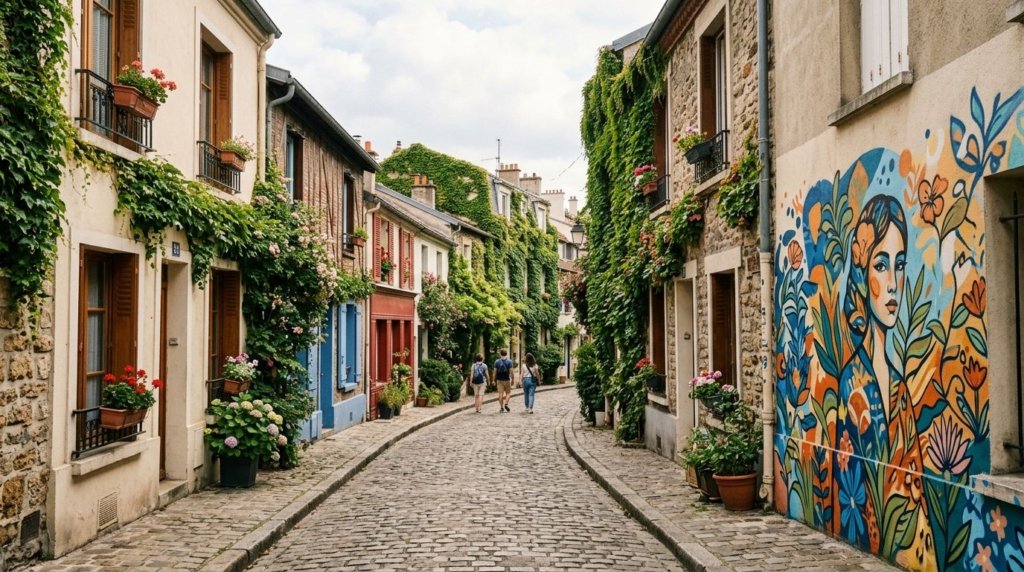
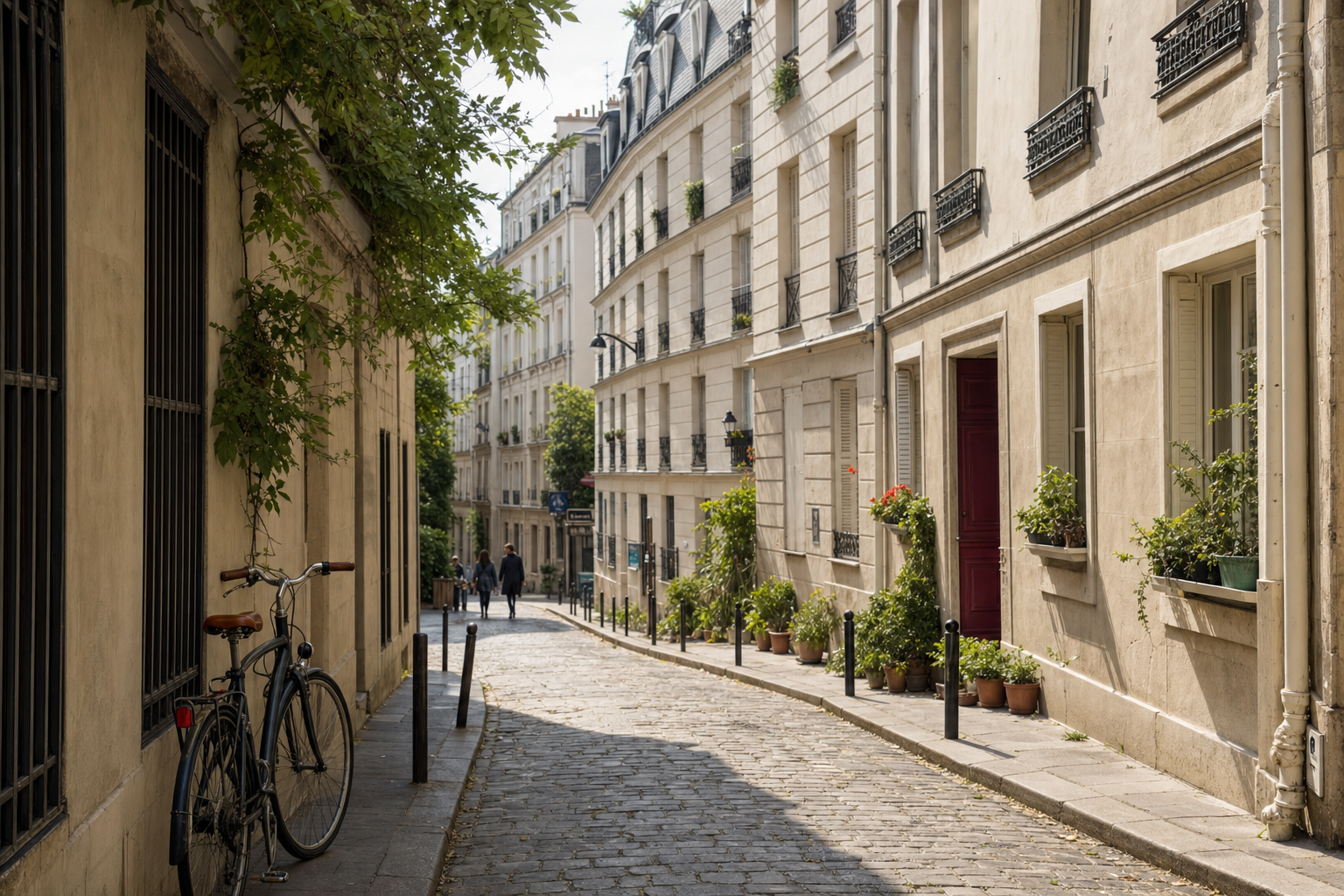
Butte-aux-Cailles, in the 13th arrondissement between Place d’Italie and Parc Montsouris, was annexed into Paris from the commune of Gentilly in 1860 — but unlike most of the city, it was never rebuilt into wide Haussmannian boulevards. The reason is underground: old limestone and gypsum quarries left the ground too unstable for large-scale construction, so the district kept its narrow cobbled streets and low-rise houses, some still covered in ivy and flowering vines. The area is also, per a local historical marker, roughly where the Montgolfier brothers’ first manned balloon flight came down on November 21, 1783, after launching from the Bois de Boulogne — the general claim is well documented, though the precise street corner is sourced only to a plaque and local histories.
Today the draw is atmosphere rather than a single sight: street art from artists including Miss.Tic and Jef Aérosol, a cluster of independent bars and restaurants along rue des Cinq Diamants, and the Piscine de la Butte-aux-Cailles, an Art Deco public pool from 1924, listed as a historic monument since 1990. The pool is popularly said to be fed by the district’s artesian well, and that’s true historically — but the City of Paris’s own page on the pool states the well now surfaces only at a public fountain nearby, and the pool’s basins are separately heated. There’s no official data on how many international visitors make it here versus Parisians, but English Wikipedia and multiple Paris-focused outlets describe the crowd at its bars as young and local rather than tourist-heavy.
- Getting there: Métro Corvisart (line 6) or Place d’Italie (lines 5, 6, 7).
- Cost: Free to walk; the outdoor pool basins are open to the public for a standard municipal pool admission.
- Best time: Daytime for the street art and architecture walk, evening for the bar scene on rue des Cinq Diamants.
- Recommended stay: 1.5–2.5 hours, longer if you’re stopping for a meal.
Best For
Travelers who want to see how Parisians actually spend an evening, without a single must-see monument driving the visit. The honest trade-off: there’s genuinely little “to do” here in the checklist sense — the neighborhood is the attraction — so it’s a weaker stop on a tight itinerary that needs a defined sight at the end of it.
3. Coulée Verte René-Dumont: An Elevated Garden Older Than the High Line
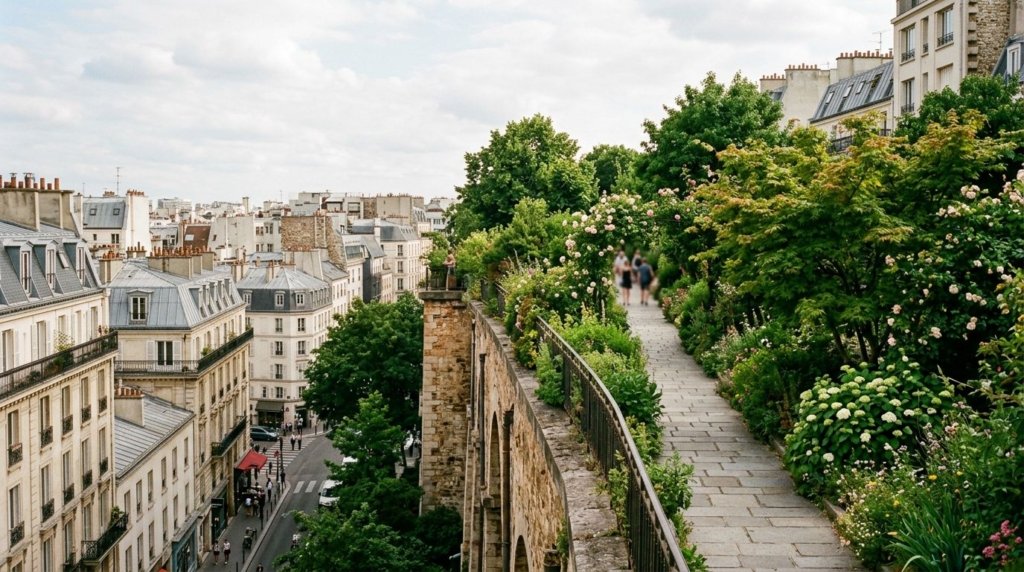
Also known as the Promenade Plantée, this roughly 4.5-kilometer path runs from just behind the Opéra Bastille to the Bois de Vincennes, built along a viaduct that once carried trains on the Vincennes line until service stopped in 1969. The City of Paris dates the conversion project to 1988, with the elevated promenade and its adjoining gardens completed in phases through the mid-1990s. It’s genuinely the first elevated park built on a disused rail viaduct anywhere, predating New York’s High Line by roughly fifteen years; reporting on the High Line’s own history describes its founders as having known and admired the Paris project, though there’s no documented account of it being a direct, formal template.
Underneath the elevated western stretch, arched vaults house the Viaduc des Arts — around 41 craftspeople and designers working in furniture restoration, textiles, and glasswork, each vault doubling as workshop and storefront. Further along, the path threads through four garden sections and past roses, bamboo, and grapevines planted as a nod to the hill’s former vineyards. It’s free, and unlike the Tuileries or Luxembourg Gardens, it doesn’t draw dense tourist crowds — several independent travel writers describe it as a locals’ favorite that’s easy to walk past without noticing the entrance.
- Getting there: Métro Bastille (lines 1, 5, 8) at the western end; Montgallet or Dugommier (line 8) partway along; Porte Dorée (line 8) near the eastern end.
- Cost: Free.
- Hours: Vary by season and by section — garden portions are gated and close earlier in winter, roughly 8 p.m. in summer and 5:30 p.m. in winter per the Paris tourism board; check paris.fr before an evening visit.
- Accessibility note: The city’s own listing flags that some elevators serving the elevated sections are currently out of service, so step-free access isn’t guaranteed at every entry point.
- Recommended stay: About an hour to walk the full 4.5 km at an easy pace; longer with stops at the Viaduc des Arts shops.
Worth Knowing Before You Go
This works well paired with a Bastille-area morning or as a quieter alternative to a Seine walk. The honest limitation is the inconsistent gate hours and occasional broken elevator — it’s not a fully predictable, always-open path the way a normal city street is, so it rewards checking ahead rather than showing up at random in the evening.
4. Quartier de la Mouzaïa: Cottage Streets Above a Metro Station No One Uses
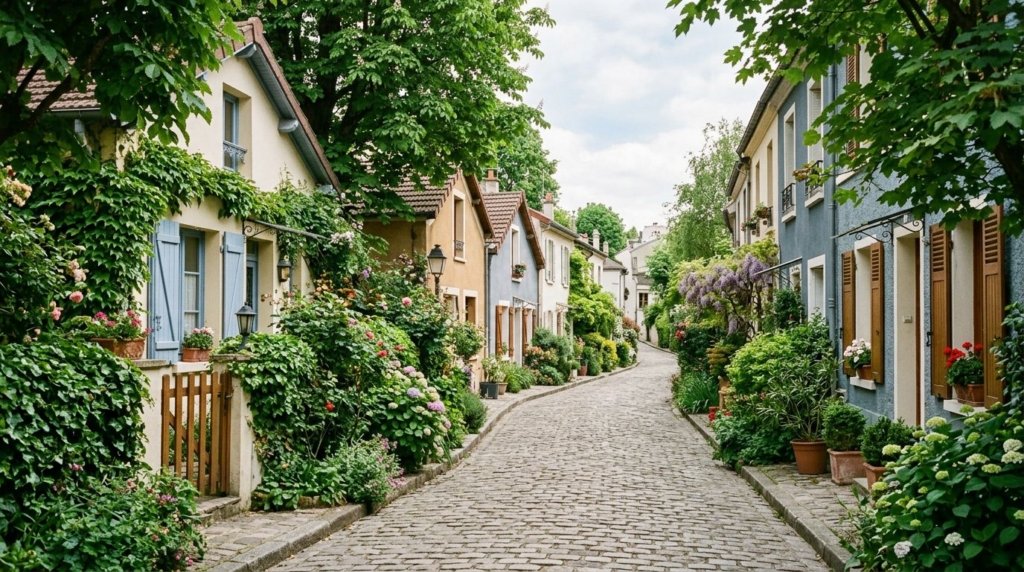
The Quartier de la Mouzaïa, in the 19th arrondissement near Place des Fêtes, is a pocket of roughly 250 small, garden-fronted cottage houses along narrow lanes — a genuinely unusual sight in a city built mostly of Haussmannian apartment blocks. The reason, again, is underground: this area sat atop gypsum quarries mined until the 1860s, and building agreements from 1889 onward capped new construction here at a single story to avoid subsidence. Its metro station, Danube, is by RATP’s own published ridership data one of the least-used stations in the entire network — about 548,000 annual entries in 2019, ranking 297th of 302 stations — and is itself an engineering oddity, its platform box resting on 220 columns sunk more than 30 meters to bedrock because of the same unstable ground.
This is worth being direct about: it’s a real, lived-in residential neighborhood, not a curated attraction, and the Paris tourism board’s own page on it says as much, noting residents value it precisely for its quiet. The adjoining Hameau du Danube, a related cluster of 1920s cottages, is private property closed to anyone without a resident’s invitation — don’t wander in. What you can do is walk the public lanes, see the architecture, and continue on to Parc des Buttes-Chaumont, a short walk away via Botzaris station.
- Getting there: Métro Danube or Botzaris (both line 7bis).
- Do you need a car? No — it’s a short, flat walk from either station.
- Recommended stay: 30–60 minutes, easily combined with a Buttes-Chaumont visit.
- Etiquette: Keep voices down and stick to public lanes — people live here.
Who Should Skip It?
Anyone looking for shops, cafes, or a defined “thing to do” should skip this one or treat it purely as a short architectural detour on the way to Buttes-Chaumont. There’s nothing to buy or enter here — the appeal is entirely the streets themselves, and a visitor expecting more than that will be disappointed.
5. Village de Charonne: A Church and Cemetery Père Lachaise Overshadows
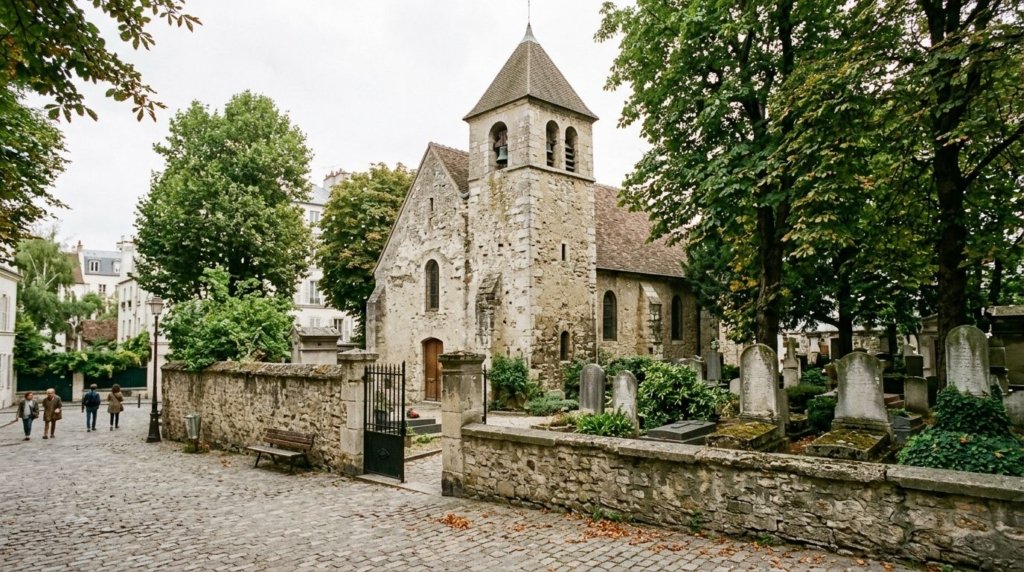
Tucked immediately beside Père Lachaise — officially billed by the Paris tourism board as the most visited cemetery in the world — is a much smaller, much quieter survivor of the original village of Charonne, annexed into Paris in 1860 along with the rest of the 20th arrondissement. Église Saint-Germain-de-Charonne dates to the 12th century in its oldest sections and is, per both the parish’s own site and the official Paris tourism board, one of only two churches remaining within Paris that still has its own surrounding cemetery, the other being Saint-Pierre de Montmartre. The church closed for structural repairs in 2009 after cracking was discovered, and archaeological work during the 2014–2016 renovation turned up burials dating back over a thousand years before it reopened.
The adjoining Cimetière de Charonne is tiny — about 0.41 hectares and 650 graves, one of the two smallest cemeteries in Paris — and includes a memorial to nearly 800 Fédérés, Paris Commune fighters executed in 1871 and found in a mass grave here in 1897. The surrounding streets, particularly rue Saint-Blaise, kept an 18th- and 19th-century village character that city planners nearly demolished in the 1960s before preservation policy took over after 1975. There’s no visitor data for Charonne itself, but the contrast with Père Lachaise next door is stark enough to make the point on its own: one draws crowds from around the world, and the other, sharing several of the same metro stations, draws almost no promotion at all.
- Getting there: Several metro stations sit within a short walk — Gambetta and Porte de Bagnolet (line 3), Philippe Auguste (line 2), or Alexandre Dumas (line 2).
- Hours: The church has no consistently published visiting hours; the cemetery is open daily, roughly 8 a.m.–6 p.m., seasonal.
- Accessibility: The church is not accessible to visitors with reduced mobility, per the city’s own listing, and has no on-site restrooms.
- Recommended stay: 30–60 minutes, naturally combined with a Père Lachaise visit.
Is It Worth the Detour?
Yes, if you’re already visiting Père Lachaise and want ten extra minutes of contrast — a village church and cemetery instead of a monumental one. It’s a lighter pick as a standalone destination, since the site itself is small and has essentially no visitor infrastructure; this is a quiet coda to a bigger visit, not a reason to cross the city on its own.
One Corner We Left Off: Rue Crémieux
Rue Crémieux, a short pastel-painted residential street near Gare de Lyon, came up early in our research for its visual character — candy-colored houses often compared to Burano or Portobello Road. It’s not on this list because the evidence points the other way from “overlooked”: 2019 coverage from Fox News, Refinery29, and other outlets documented over 30,000 Instagram posts tagged to the street, residents describing crowds of roughly 200 people outside their windows on weekends, and a formal request to the city for gates to restrict access, which the city has not granted. As of the most recent reporting we found, residents have resorted to posted no-filming signs and closed shutters rather than any official access restriction. That’s a legitimate, well-loved street, but calling it an overlooked corner would not be honest.
Planning Around These Five
These corners don’t sit near each other — they’re spread across five arrondissements on opposite sides of the city — so plan them as additions to whatever else you’re already doing in that part of Paris, rather than one continuous route. The Covered Passages pair naturally with a Grands Boulevards or Louvre-area morning. Butte-aux-Cailles works best as its own southern-Paris outing, possibly combined with the 13th’s Chinatown district. The Coulée Verte fits well right after a Bastille visit. The Mouzaïa and Charonne are each best treated as short add-ons — the Mouzaïa alongside Parc des Buttes-Chaumont, and Charonne alongside Père Lachaise. If you’re building out a wider trip beyond the capital, our guide to underrated travel destinations around the world and our look at overlooked corners of Europe cover more ground outside Paris itself.
Frequently Asked Questions
Do I need a car to visit any of these?
No — all five are accessible by Paris Métro, and none requires a car. The Métro is genuinely the easiest way to reach all of them, including the Mouzaïa, whose one real drawback is that its station, Danube, has infrequent-feeling service simply because so few people use it.
Which of these is easiest to combine with a major Paris sight?
Village de Charonne, by a wide margin — it sits immediately next to Père Lachaise and shares several of the same metro stations, so it costs almost nothing extra to add on. The Coulée Verte is a close second for anyone already near Bastille.
Are any of these actually well known, just not to international visitors?
The Covered Passages, especially Galerie Vivienne, are the clearest example — the regional tourism board itself cites 6.4 million annual visitors to Vivienne, and both Vivienne and Passage des Panoramas appear in most Paris guidebooks. They’re overlooked only relative to the Louvre/Eiffel Tower tier of sights, not in any absolute sense.
Is Butte-aux-Cailles worth visiting during the day, or only at night?
Both, for different reasons: daytime is better for the street art and architecture, while the bar scene on rue des Cinq Diamants is an evening thing. Visiting only during the day on a quiet weekday may undersell the neighborhood’s actual character.
Reasearch & Sources
This guide was compiled through desk research using official and primary sources rather than an in-person visit. Key sources used:
- The Covered Passages: Paris tourism board, Passage des Panoramas; Paris tourism board, Passage du Grand Cerf; Galerie Vivienne, official site; Un Jour de Plus à Paris, on the Passage du Caire “oldest passage” question; Visit Paris Region, covered passages visitor figures.
- Butte-aux-Cailles: Paris tourism board, Butte-aux-Cailles; Ville de Paris, Piscine de la Butte-aux-Cailles; Mairie du 13e, pool centenary.
- Coulée Verte René-Dumont: Ville de Paris, official listing; Paris tourism board; Viaduc des Arts, official site.
- Quartier de la Mouzaïa: Paris tourism board, Quartier de la Mouzaïa; Danube station ridership data, sourced to RATP open data; Mairie du 19e, Danube quarter.
- Village de Charonne: Ville de Paris, Église Saint-Germain-de-Charonne; Ville de Paris, Cimetière de Charonne; Paris tourism board, Charonne village walk; Paris tourism board, Père Lachaise; Mairie du 20e, rue Saint-Blaise history.
- Rue Crémieux (context, not featured): Refinery29, on Rue Crémieux overtourism; Fox News, resident complaints.
Hours, seasonal access, and transit details above reflect the most recent information available at the time of research and can change — particularly the Coulée Verte’s seasonal gate hours and elevator status, which are worth confirming on paris.fr before an evening visit.