

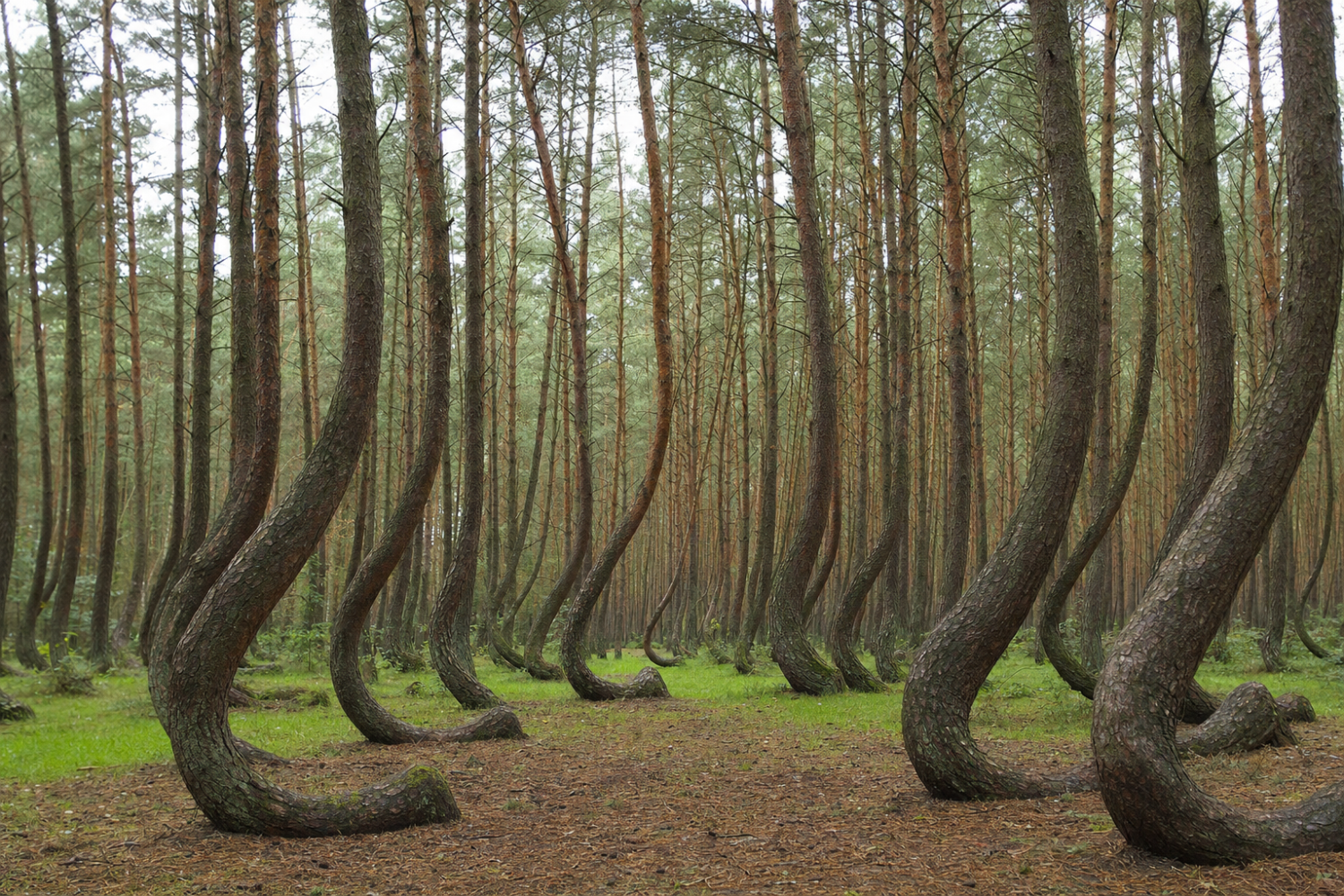
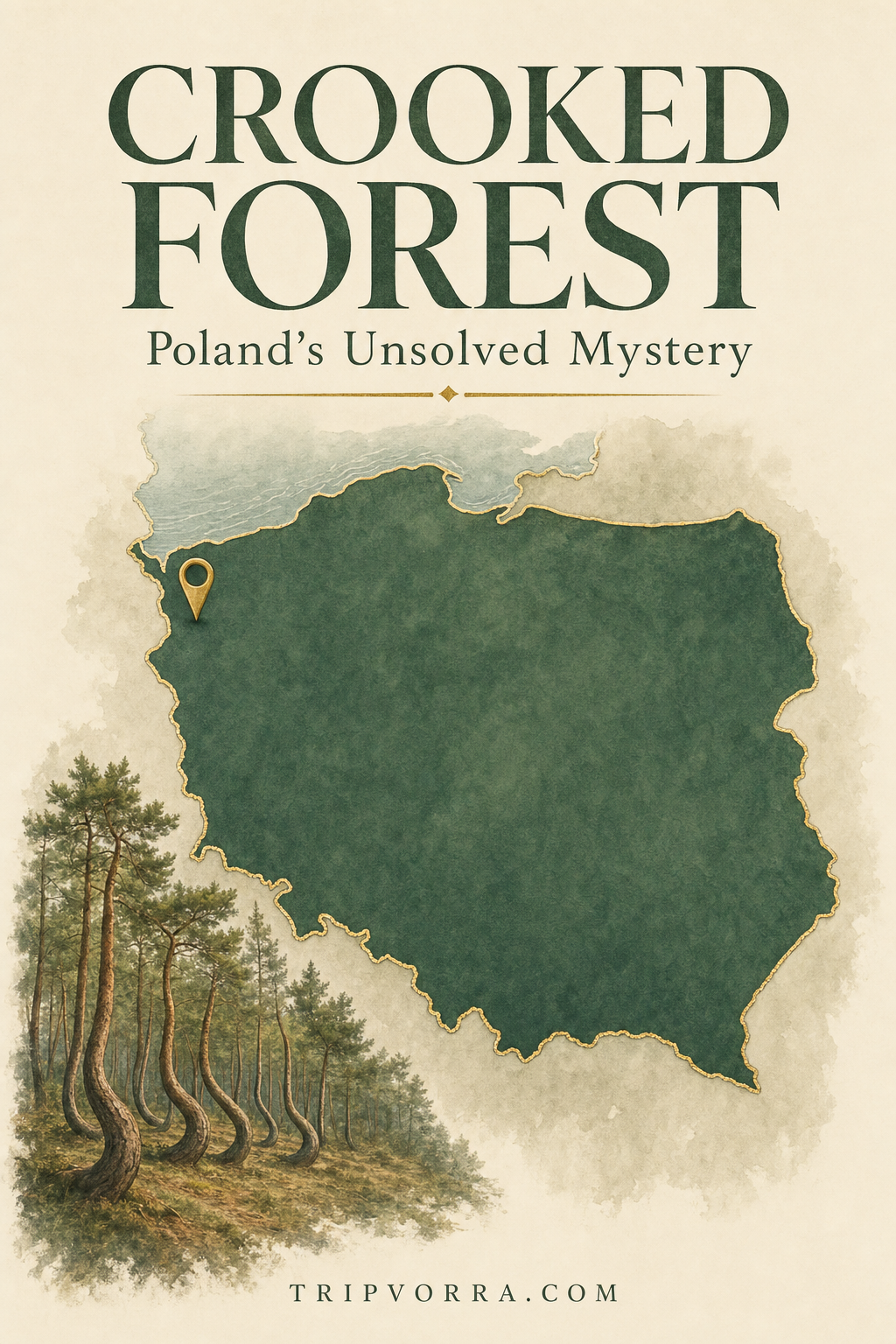
About 400 pine trees outside the village of Nowe Czarnowo, near Gryfino in northwestern Poland, all bend the same way. Not a scattered handful — the entire grove. Each trunk grows straight out of the ground for less than a foot, hooks sharply sideways to the north, travels three to nine feet like that, then curves back upright and grows normally for the rest of its roughly 50-foot height. They’re surrounded on every side by ordinary straight pines of the same age and species. Nobody who could explain why is still alive to ask, and no record survived to answer for them.
Last verified: September 2026, against the forest’s protected-monument records, forestry and plant-science sources, and the historical accounts cited throughout.
| Location | Near Nowe Czarnowo, Gryfino County, West Pomeranian Voivodeship, Poland |
| Local name | Krzywy Las (“Crooked Forest”) |
| Tree count | Approximately 400 Scots pines affected |
| Planted | Around 1930, when the area was German territory |
| Bend age | Trees were roughly 7–10 years old when the bend was formed |
| Status | Protected natural monument, open to visitors |
What the Crooked Forest Actually Looks Like
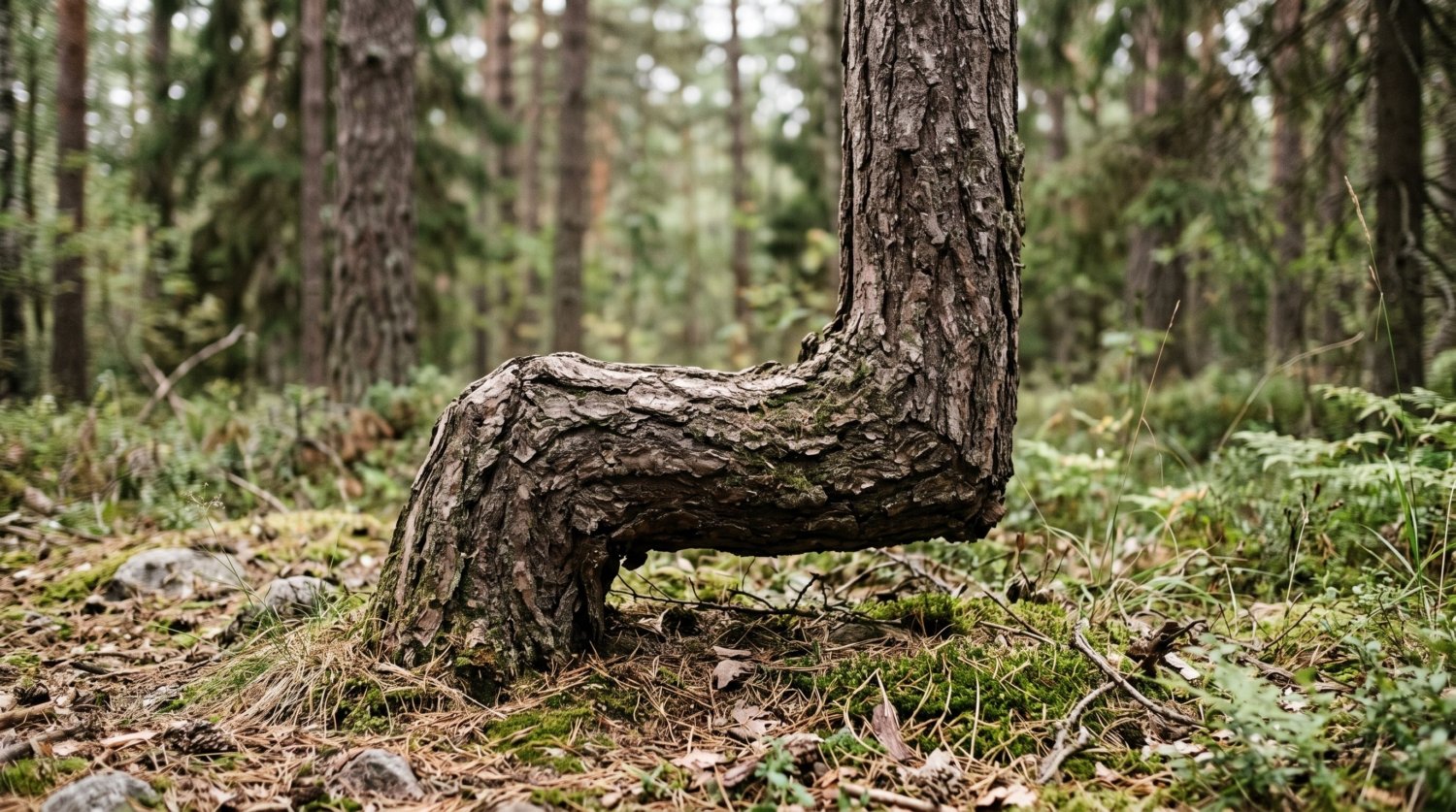
The bend itself is oddly precise. Each affected trunk grows vertically for roughly 10 to 50 centimeters above the ground, then turns close to 90 degrees and runs sideways — almost always to the north — before curving back upward into a normal, straight trunk that reaches full height. Seen from the side, a single tree looks like a lowercase “j” drawn by a very steady hand. Seen from above or from a distance, a whole stand of them looks less like a forest and more like a room full of identical furniture.
What makes the shape hard to explain away as ordinary storm damage or disease is its consistency. Wind-thrown or snow-crushed trees bend at different heights, in different directions, and to different degrees, because the damage depends on where each tree happened to be standing when the weather hit. These trees bend at almost the same height, to almost the same degree, in almost the same direction — and the straight pines standing directly next to them, planted at the same time in the same soil, show no bend at all.
The Leading Theory: Someone Did This on Purpose
The explanation most forestry and horticulture writers land on isn’t mysterious at all in principle: someone bent these trees deliberately, while they were young and pliable enough to shape, in order to harvest curved wood later on. It’s not a novel idea. European shipbuilders spent centuries deliberately growing and training oak into naturally curved shapes — called compass timber — because a curve grown into the wood’s grain is stronger than a curve cut into straight timber. The same logic applies to cartwheel rims, barrel hoops, and curved furniture parts, all of which were easier to produce from wood that had already grown into roughly the right shape. A sapling pinned sideways to the ground for a few years, then released once the bend had set into the grain, would do the job.
The problem is that nobody ever wrote this plan down, or if they did, the record didn’t survive. The area was German territory called Pomerania when the trees went in around 1930; it became Polish territory after 1945, and the years in between included a world war that emptied and resettled much of the region. Whoever planted and shaped these trees — most likely a local farmer or forester experimenting with a small timber venture — had every reason to abandon the project once the war arrived, and no obvious reason for anyone else to pick up an unfinished business plan for oddly bent pine trees afterward. The theory is plausible specifically because it fits a pattern (farmers did this kind of thing elsewhere in Europe), not because anyone has found paperwork, a name, or a finished product made from this particular grove.
The Theories That Don’t Hold Up — and the One Real Science Fact That Gets Misused
A few explanations get repeated online and deserve a direct answer rather than a shrug. A popular claim is that German tanks or heavy military vehicles crushed the saplings flat during the Second World War, and the trees simply grew back around the damage. Foresters who’ve examined the bends point out the problem: the curve is too smooth and too uniform for that. A vehicle rolling over young trees produces broken, splintered, inconsistently damaged trunks, not four hundred nearly identical 90-degree hooks all opening the same direction. Heavy snowfall gets suggested too, but it runs into the same objection that undermines the tank theory — the untouched pines standing right next to the bent ones would have carried the same snow load and shown no effect at all.
Then there’s the claim that gets dressed up as the scientific one: that the site sits on some kind of gravitational anomaly, the same language used to market roadside attractions like Oregon’s “gravity hill” illusions. There’s no credible evidence for anything unusual about gravity at this location, and the framing borrows the tone of science without any of its substance. What’s genuinely real, and gets confused with that claim, is a plant-biology mechanism called negative gravitropism — the process by which a tree trunk that’s been pushed out of vertical will reorient itself and resume growing straight up, because plant cells respond directly to the pull of gravity. A University of Maryland plant scientist has described the Crooked Forest’s upward curve as a textbook example of exactly this response. But gravitropism explains why the trunks straightened back out after something knocked them sideways — it says nothing about what did the knocking in the first place. Even the one piece of real, uncontested science here only answers half the question.

Why “No One Really Knows” Is Still the Honest Answer
It would be tidier to say the mystery is solved: farmers bent the trees for curved timber, the war interrupted them, end of story. That’s the best-supported explanation, and it’s the one this article leans on. But “best-supported” isn’t the same as “proven.” No tool marks, harvest records, or firsthand account has surfaced that names who did this, exactly how, or what they intended to build. Every source covering the Crooked Forest, from casual travel writers to the plant scientists quoted on it, stops short of calling the case closed — and that includes this one. The honest version of this story isn’t a solved mystery with a satisfying reveal. It’s a well-reasoned guess sitting next to a permanent gap in the record, and the second part matters as much as the first.
Visiting the Crooked Forest Today
- Getting there: the grove sits just outside Nowe Czarnowo, a few minutes from Gryfino and roughly 40 minutes south of Szczecin by car; there’s no train station directly at the site.
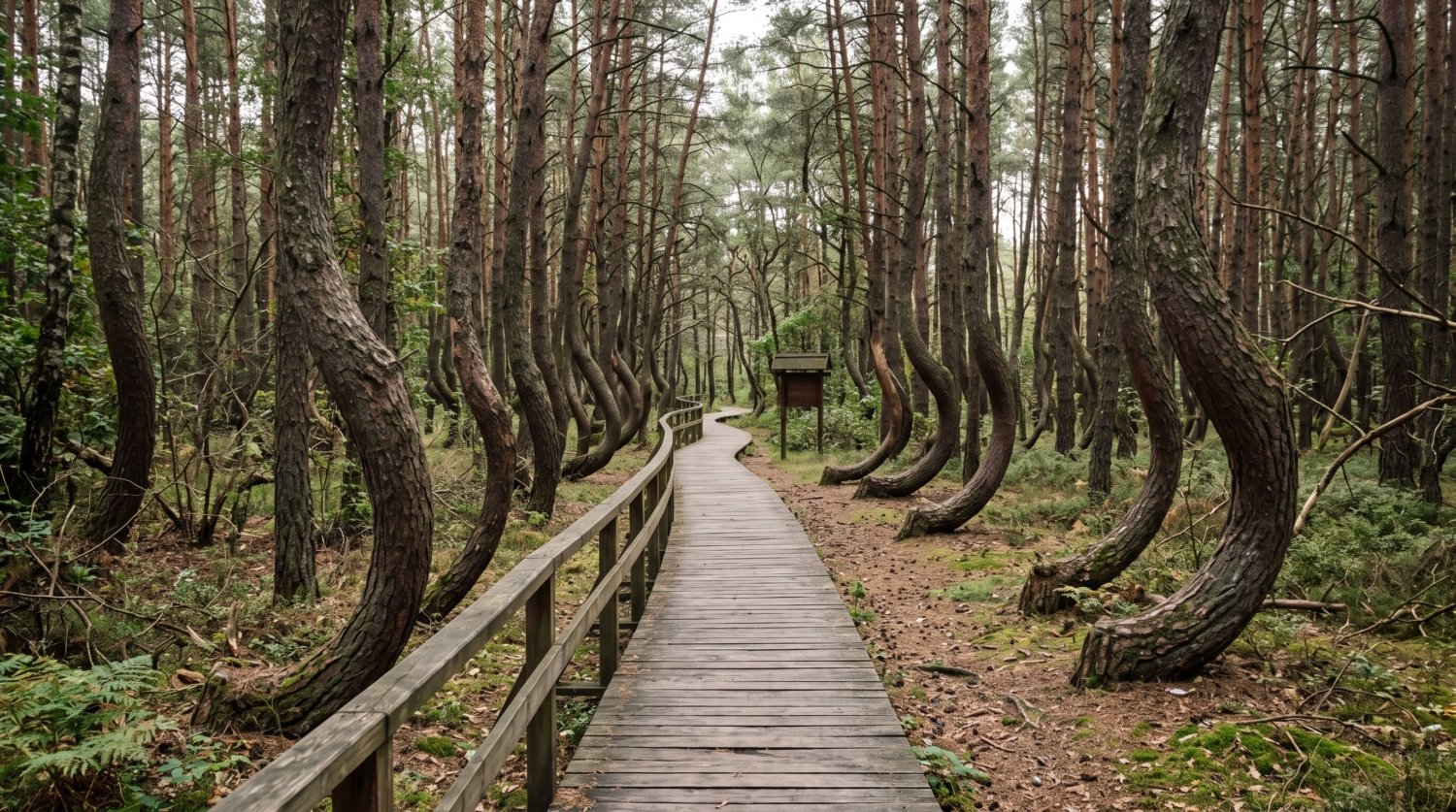
- What’s there: a marked path and viewing area around the bent trees, protected as a natural monument, with the straight pines of the surrounding forest as an immediate visual comparison.
- Best time to go: the site is outdoors and unstaffed, so any season works, though the bare winter branches make the trunk shapes easiest to see clearly.
- How long to stay: most visitors spend well under an hour — it’s a stop to build into a wider trip through West Pomerania rather than a destination on its own.
Frequently Asked Questions
Has anyone actually solved why the trees bend?
No. Deliberate human shaping for curved timber is the leading, best-supported theory, but no documentation has ever confirmed who did it or why. It remains an educated guess, not a solved case.
Is the gravitational anomaly theory real?
No credible evidence supports an actual gravitational anomaly at the site. The real science involved — negative gravitropism, the mechanism that lets a bent trunk reorient and grow straight again — explains why the trees curved back upward, not what pushed them sideways to begin with.
Did WWII tanks cause the bend?
Foresters consider this unlikely. Vehicle damage tends to be uneven and inconsistent, while the Crooked Forest’s bends are strikingly uniform in height, angle, and direction across roughly 400 trees.
Can you visit the Crooked Forest as a day trip?
Yes — it’s close enough to Szczecin and Gryfino to fit easily into a half-day or full-day trip through West Pomerania, and seeing the grove itself takes under an hour.
For another place where the real explanation turns out to be more interesting than the popular myth, see our piece on how a Sicilian fishing town became Europe’s quietest film backdrop, and for another landscape shaped by an unusual, hard-to-pin-down history, our profile of why Hallstatt is fighting its own fame covers a very different kind of mystery about identity and place.