
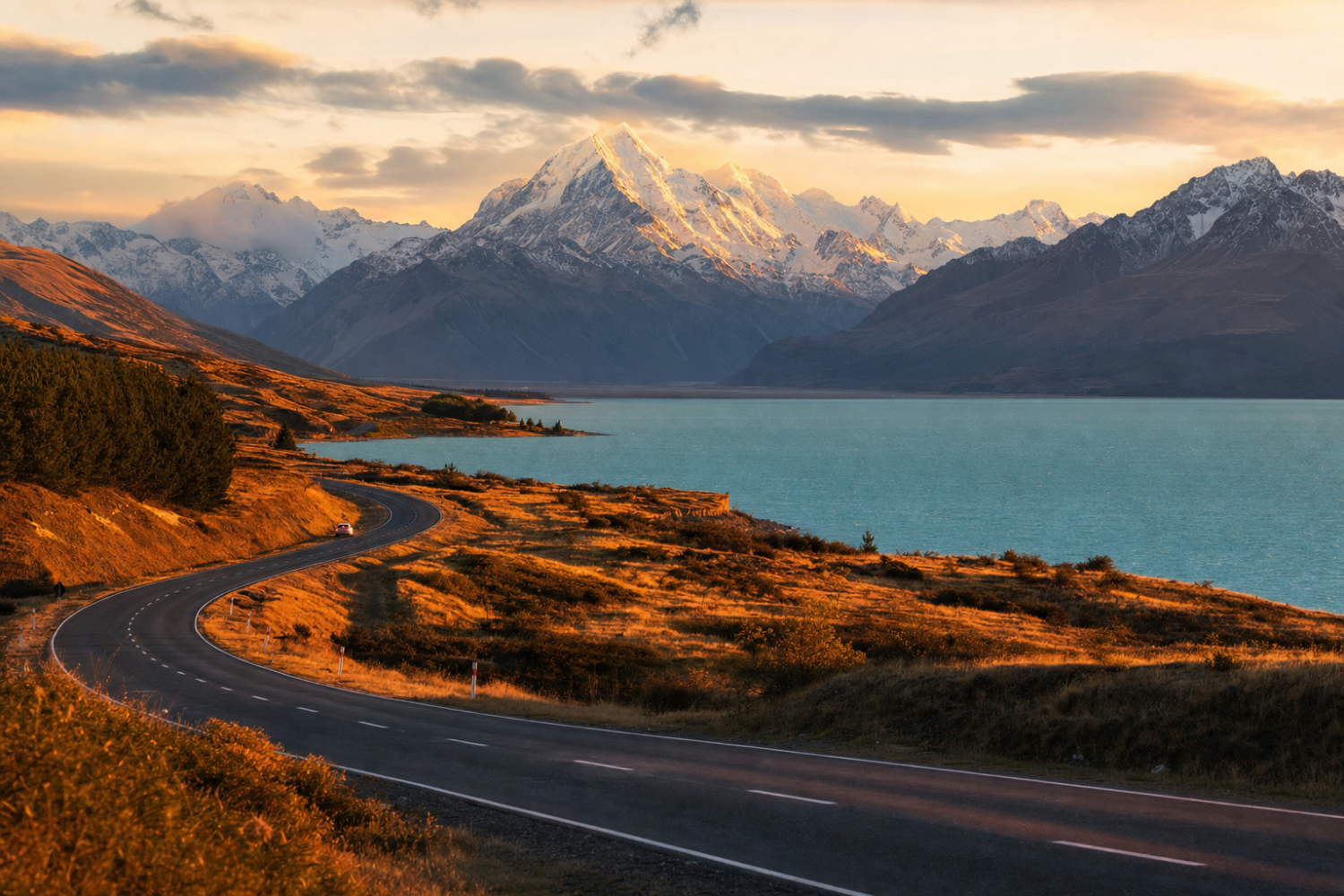
New Zealand’s South Island has one of the highest ratios of scenery to signage in the developed world, which is exactly the problem. The roads that make the postcard shots possible — one-lane bridges over braided rivers, alpine passes that close overnight, gravel spurs to trailheads — are also the roads most likely to catch a solo driver off guard. None of this makes the South Island dangerous in the way rental-car horror stories on forums suggest. It makes it a place where a bit of specific, pre-trip homework pays for itself many times over.
This is a prep guide, not a scenic itinerary. It covers the rules that actually apply to a solo, self-driven trip, the risks that are real versus the ones that are overstated, and the gear and habits that make travelling alone here noticeably safer without turning the trip into an exercise in anxiety.
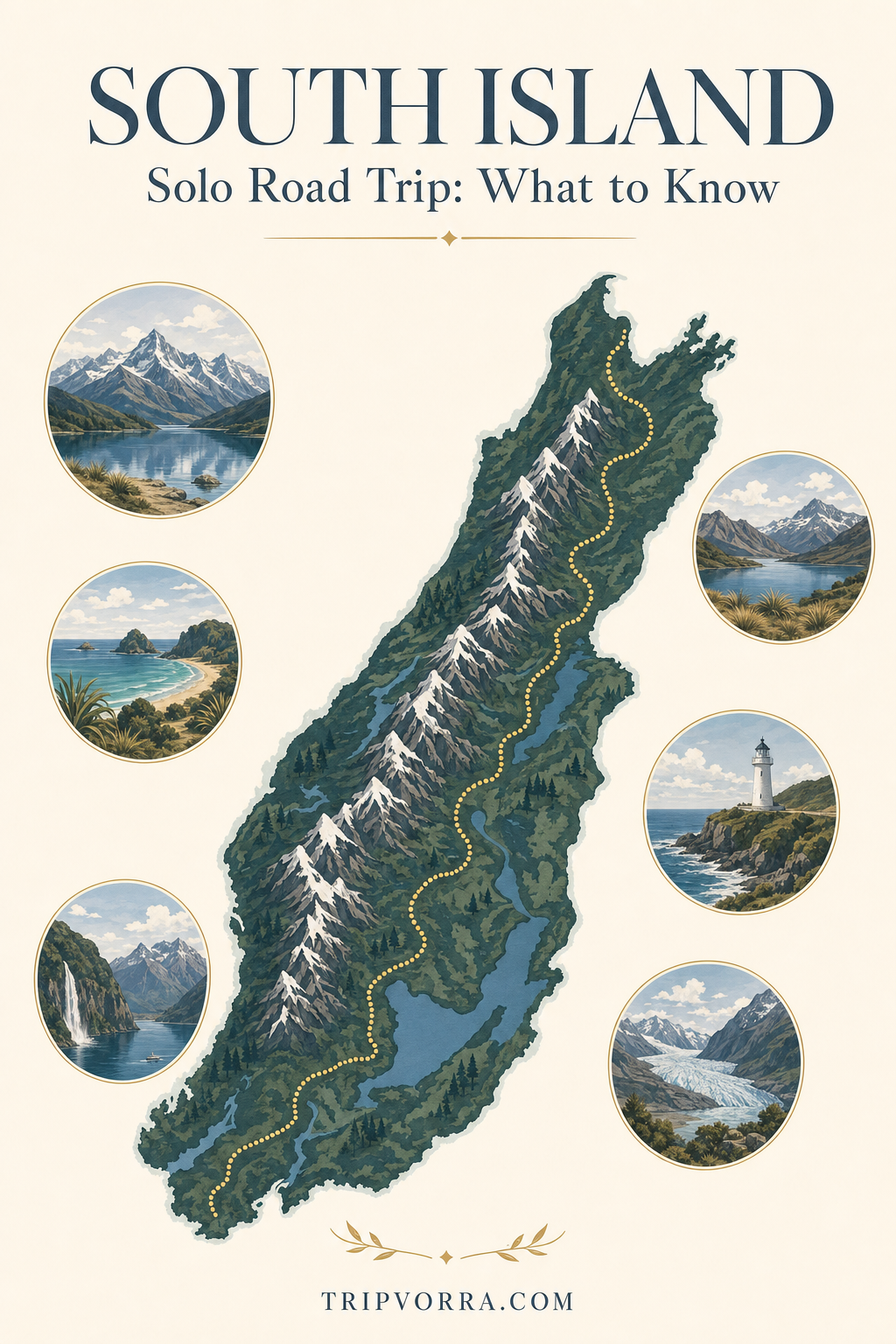
South Island Solo Road Trip: The Quick-Reference Table
The specifics below are covered in detail further down, but this is the version you’d want pinned to your dashboard.
| Driving side | Left-hand side of the road; most rental cars are right-hand drive |
| License requirement | Full, valid driver’s licence from home; an International Driving Permit (IDP) is required if your licence isn’t in English and is strongly recommended even when it is |
| Minimum driving age for rentals | 21 for most major rental companies; some require 25 for camper vans, and drivers under 25 often pay a young-driver surcharge |
| One-lane bridges | Give way to whichever direction has the arrow pointing toward it on the sign; if in doubt, stop and let the other vehicle go first |
| Freedom camping | Requires a certified self-contained vehicle (blue-and-white “Self Contained” sticker) in most council areas; non-self-contained vehicles are restricted to paid campgrounds or specific DOC sites |
| Mobile coverage | Patchy outside towns; do not rely on your phone for navigation or emergencies on remote routes |
| Realistic daily driving distance | 200–250 km on mountain roads is a full day, not a quick errand — distances on the map are deceptive |
The Risk That Gets the Headlines vs. the Risk That’s Actually There
Search “New Zealand tourist drivers” and the algorithm will hand you a stream of stories about rental cars in ditches and outrage over foreign drivers on narrow roads. It’s a real phenomenon — local frustration with unfamiliar drivers on unfamiliar roads is well documented — but the data doesn’t support the idea that visiting drivers are the primary danger on South Island roads.
New Zealand’s Ministry of Transport has tracked this specifically. In its analysis of crash data, overseas-licensed drivers were involved in roughly 4% of reported crashes nationally, and were found at fault in about 3% of crashes — a rate roughly in proportion to, or below, the share of driving they actually do as visitors. When overseas drivers were involved in a crash, the contributing factors looked much like those for local drivers: loss of control, misjudging a corner, poor observation — not some uniquely “tourist” failure mode.
The honest nuance is regional concentration, and it matters for South Island trip planning specifically. The same Ministry of Transport data shows overseas drivers involved in a much larger share of crashes in a handful of tourist-heavy areas: around 43% on the West Coast, 33% in the Queenstown-Lakes district, and 23% in Southland. Those are exactly the regions a South Island road trip runs through. The takeaway isn’t “tourists are dangerous everywhere” — it’s “the sections of your trip that already have the most rental cars per capita are also the sections where visitor unfamiliarity plays the largest relative role in the local crash picture.” That’s a reason to slow down and drive conservatively through Franz Josef, Haast, and the Queenstown approach roads specifically, not a reason to be nervous about the whole trip.
Licence Requirements and the International Driving Permit
You can drive in New Zealand on a valid overseas licence for up to 12 months, provided it’s current and, if it isn’t already in English, accompanied by either an International Driving Permit or an accurate English translation. In practice, almost every rental company will ask to see an IDP at pickup regardless of your licence’s language, and some will refuse the rental without one even though it isn’t strictly a legal requirement for English-language licences. Get one before you leave home — they’re inexpensive, take a passport photo and a same-day visit to the relevant issuing body in most countries, and cannot be obtained after arrival in New Zealand.
New Zealand drives on the left. If you’re coming from a right-hand-traffic country, the two moments that catch people out aren’t motorway driving — it’s roundabouts (give way to your right) and the first few minutes after fuel or coffee stops, when muscle memory defaults to the wrong side. Renting an automatic, if you’re not used to a manual, removes one more variable to manage while you’re recalibrating.
One-Lane Bridges, Alpine Passes, and Roads That Don’t Match the Map
The South Island has more than a hundred single-lane bridges, many of them combined road-and-rail crossings. The rule is straightforward once you know it: a triangular yellow sign shows two arrows, one long and one short. The long arrow points toward the direction of traffic that has the right of way; the short arrow marks the direction that must give way and wait at the marked pull-off. If you can’t tell who has priority, or if a vehicle is already on the bridge, stop and wait — there’s no cost to being cautious here and a real one to guessing wrong on a bridge with no shoulder.
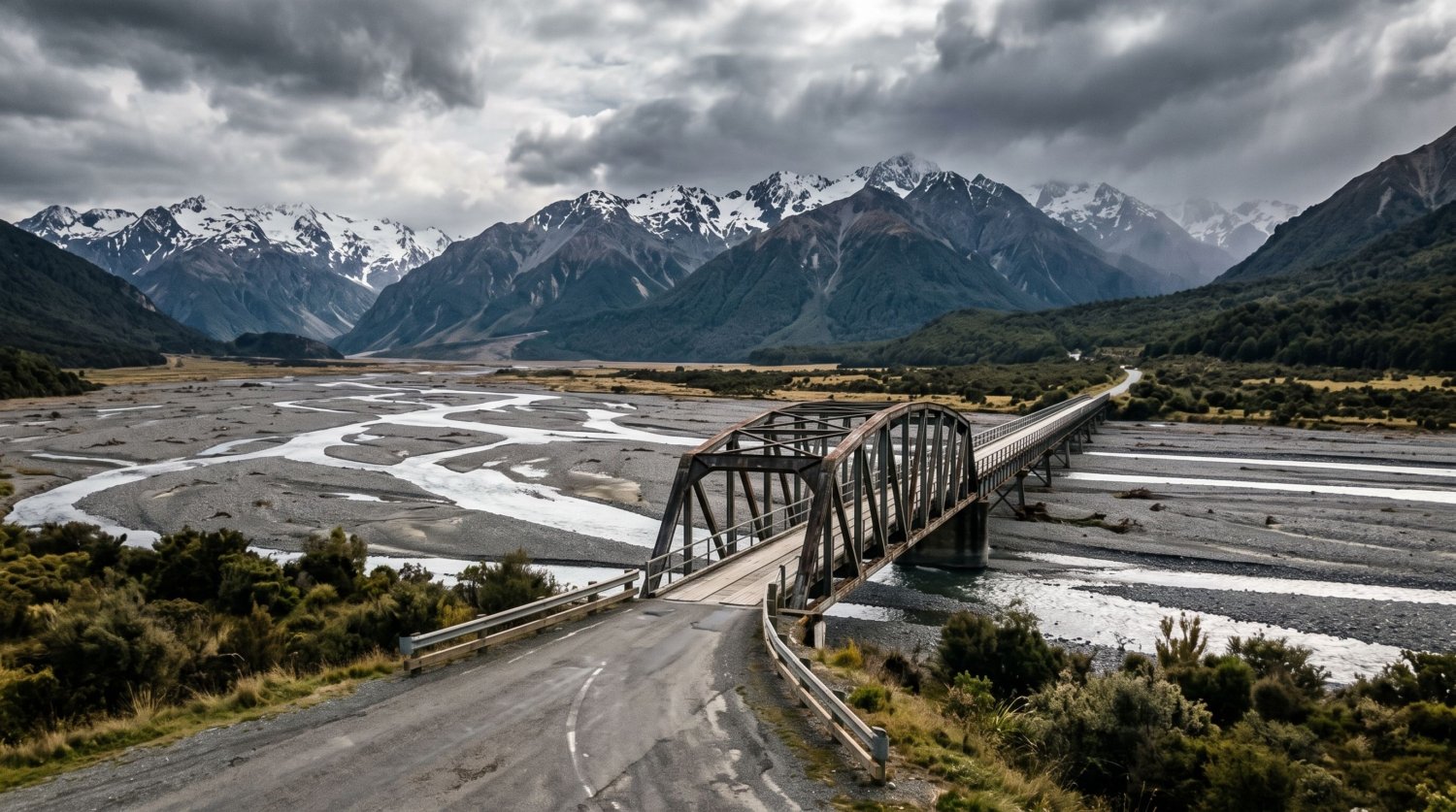
Alpine passes are the other category worth planning around specifically, and Milford Road (State Highway 94, the only road to Milford Sound) and Haast Pass are the two that come up most for South Island itineraries. Milford Road runs through some of the country’s highest-risk avalanche terrain in winter and is subject to scheduled closures for avalanche control work, chain requirements, and a seasonal Avalanche Programme that can close the road with little notice between roughly May and November. If you’re driving it outside peak summer, check the New Zealand Transport Agency’s live road status before you leave, carry chains if renting in that window, and build slack into your schedule — treating a Milford Road closure as “a delay” rather than “a crisis” is mostly a matter of not having booked something non-refundable for that exact afternoon.
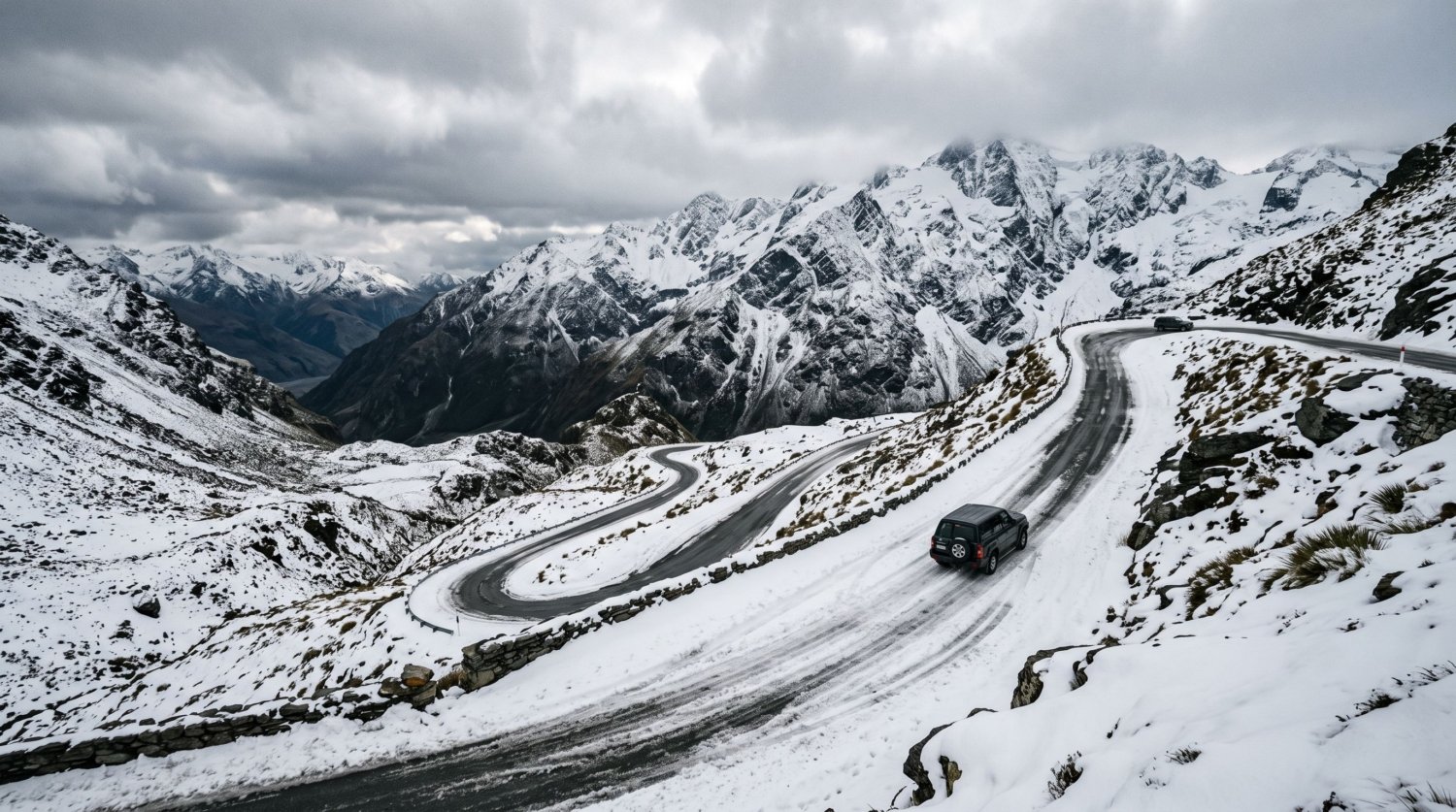
The broader lesson applies to gravel-road detours and GPS routing generally: Google Maps and phone GPS apps sometimes route through roads that are seasonal, 4WD-only, or simply not maintained to sealed-road standards, because the map data doesn’t always distinguish them clearly. Cross-check any route that looks unusually direct against the NZTA journey planner or a physical map before committing, particularly around Central Otago and the West Coast back-roads.
Freedom Camping: What Actually Changed
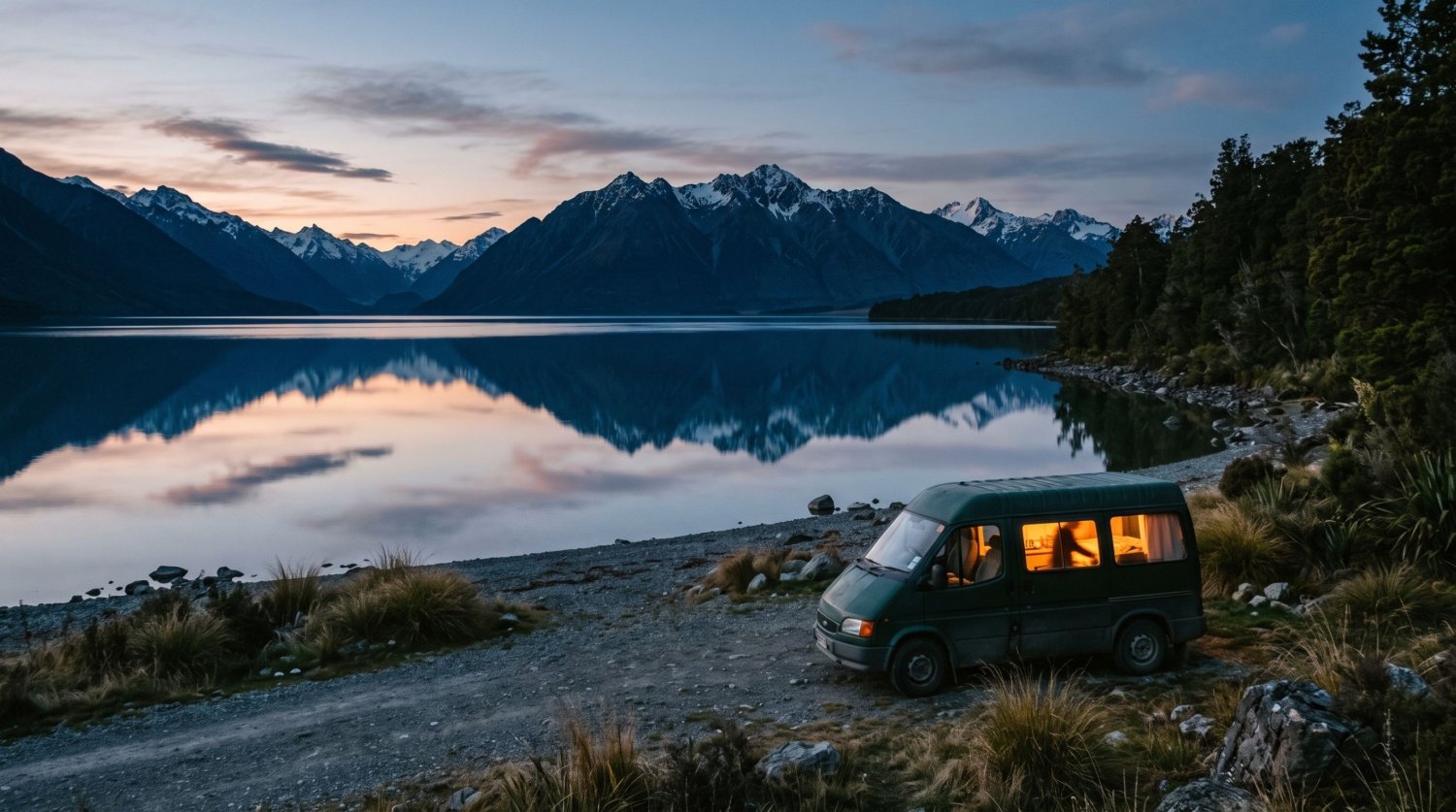
Freedom camping rules on the South Island are genuinely a patchwork — they’re set district by district, not nationally — and they’ve also been tightening. Most councils now require a Self-Containment Warrant of Fitness sticker (the blue-and-white “Self Contained” badge) before a vehicle can freedom camp outside a designated non-self-contained site, meaning it needs its own toilet, fresh and grey water tanks, and rubbish storage that meets the certified standard. A revised national certification standard took effect on 7 June 2026, tightening what counts as a compliant toilet setup in a certified vehicle; if you’re renting rather than bringing your own van, confirm directly with the rental company that the vehicle you’re booking carries current certification under the updated standard, since older certificates issued before the change are being phased out on a rolling basis.
Enforcement is real and inconsistent in a way that’s worth knowing about rather than discovering: infringement fines for freedom camping violations are typically in the NZ$400–$800 range depending on the council and the specific breach, and some popular areas (much of Queenstown-Lakes, parts of the Wanaka lakefront, several Otago coastal spots) have banned freedom camping outright regardless of certification. The Department of Conservation’s own campsite network, separate from council freedom-camping rules, is generally the most reliable fallback — DOC campsites are mapped in the DOC app and range from free basic sites to small-fee “standard” sites with more facilities.
Mobile Coverage: The Honest Version
New Zealand’s major carriers advertise geographic coverage figures in the 85–98% range depending on network and measurement method, and it’s easy to read that as “you’ll almost always have signal.” That figure describes population and land-area coverage in aggregate, not coverage on the specific roads you’ll actually be driving, which skew toward exactly the remote, mountainous terrain that coverage maps show as gaps. Milford Road, Haast Pass, much of the West Coast between Franz Josef and Haast, and long stretches of inland Otago back-roads have no reliable coverage on any network for extended periods.
The practical fix isn’t a specific provider switch — coverage gaps are largely geographic, not carrier-specific — it’s not depending on connectivity at all for navigation or emergencies. Download offline maps before you leave a town with signal. If you’re doing any of the more remote routes (Milford Road, the West Coast glaciers area, Molesworth, inland Otago), a satellite messenger or personal locator beacon (PLB) is a genuinely useful piece of solo-travel gear, not an overcautious one — it’s the one device that works in the exact places your phone doesn’t.
What Solo Actually Changes
New Zealand has a low violent-crime rate by international standards, and the honest risk profile for a solo traveller here is less “personal safety from other people” and more “isolation risk” — the practical consequences of something going wrong (a breakdown, an injury, a wrong turn onto a closed road) with no one else in the car to help or go for help.
- Leave your day’s rough route and expected return time with someone — a hostel front desk, a friend back home, or a booking you’re already sending confirmation messages to.
- If you’re doing a multi-day tramp or a remote drive, DOC visitor centres let you log intentions for backcountry trips specifically; use it even if your plan is just a short walk off a road you’re driving.
- Check tyre pressure, spare tyre, and fluid levels before you leave the rental lot rather than assuming a rental company caught everything — a flat on a gravel back-road with no signal is a very different problem alone than with a second driver.
- Carry a physical map or downloaded offline maps as a backup to phone GPS, and know before you leave signal range whether your route includes any of the passes or gravel sections covered above.
None of this is meant to make a solo South Island trip sound riskier than it is. The vast majority of solo road trips here go exactly as planned, on sealed roads, with working phones, and no drama. The preparation above is what closes the gap between “exactly as planned” and the small percentage of trips where something minor becomes something worse simply because no one accounted for it in advance.
Frequently Asked Questions
Do I need an International Driving Permit to drive on the South Island?
Legally, only if your home licence isn’t in English and you don’t have a certified translation. In practice, most rental companies ask for one regardless of your licence’s language, so it’s worth getting before you travel — it can’t be issued once you’re in New Zealand.
Are rental cars in New Zealand actually more dangerous for tourists?
National data doesn’t support that broadly — overseas-licensed drivers are involved in roughly 4% of crashes and are at fault in about 3%, in line with their share of driving. The nuance is regional: the West Coast, Queenstown-Lakes, and Southland see a disproportionately higher share of crashes involving overseas drivers, which lines up with exactly the routes a South Island trip covers, so extra caution on those specific stretches is warranted even though the national picture is not alarming.
Can I freedom camp anywhere on the South Island?
No. Freedom camping rules are set by individual district councils, most now require a certified self-contained vehicle, and some popular areas ban it outright regardless of certification. Check the specific district’s rules for where you plan to stop, and use the DOC campsite network as a reliable fallback.
What’s the biggest mistake solo drivers make on South Island road trips?
Underestimating how long mountain roads take. Map distance doesn’t account for one-lane bridges, gravel sections, tour-bus traffic, or the fact that 100 km of alpine road can reasonably take two hours. Planning 200–250 km as a full day, not a quick leg, avoids the rushed driving that causes most of the avoidable incidents.
If you’re pairing this trip with other car-free or car-light travel planning, our guide to spending a car-free weekend on São Miguel in the Azores covers a very different but equally logistics-dependent destination, and our piece on why the Wave in Arizona limits visitors to just 64 people a day walks through another trip where the paperwork matters as much as the scenery.