
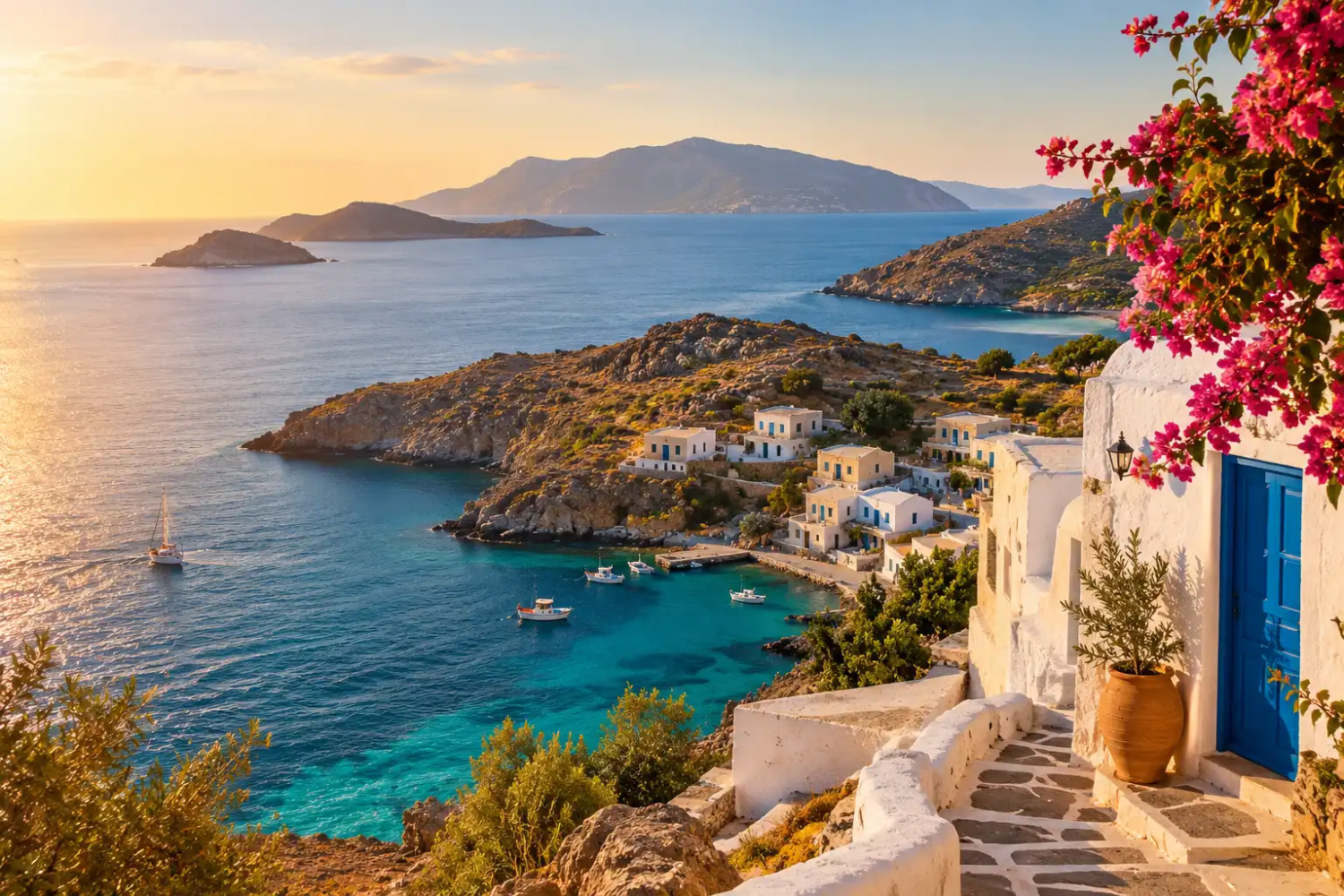
Santorini and Mykonos airports handled about 4.5 million passengers between them in 2024. Most of Greece’s other islands post nowhere near that, and a handful of them post nothing at all — because they don’t have an airport to count arrivals through in the first place. That absence of infrastructure is not an accident of neglect. On islands like Folegandros, it’s the reason the place still looks the way it does.
This is a guide to five islands that sit outside the Santorini/Mykonos gravity well for different reasons: volcanic geology on one, a food and pottery tradition on another, a bridge to the mainland on a third. None of them are secrets. Sifnos has a devoted following among Greek food writers; Karpathos has a fiercely protective relationship with its own traditions; Lefkada fills up with domestic road-trippers every July. What they share is that almost none of that attention comes from the international package-tour circuit that built Santorini’s caldera-view hotels and Mykonos’s beach-club economy.
Last verified: October 2026. Ferry schedules, airline routes, and prices in this guide change seasonally; the sources at the end link to the booking pages and authorities to check before booking.
Where These Five Sit
Milos, a volcanic island, and dry, water-scarce Folegandros are Cycladic neighbors a short ferry hop apart. Sifnos sits between them, older in its tourism history but still overwhelmingly domestic in its visitor base. Karpathos is a long way east, in the Dodecanese, closer culturally to Crete than to the Cyclades. Lefkada is the outlier: it isn’t reached by boat at all for most visitors, because a floating bridge connects it to the Greek mainland.
The five islands at a glance
| Island | Group | How you arrive | Car? |
| Milos | Cyclades | Small seasonal airport, or Piraeus ferry (about 2.5 hours fast, about 7 hours conventional) | Worth having |
| Folegandros | Cyclades | Ferry only (no airport); Piraeus crossing from about 3 hours 40 minutes | Not needed |
| Sifnos | Cyclades | Ferry only (no airport); Piraeus crossing from about 2.5 hours | Useful |
| Karpathos | Dodecanese | Airport with limited routes, plus ferries via Rhodes | Close to essential |
| Lefkada | Ionian | Road bridge from the mainland (about 5 hours by coach from Athens) | Necessary |
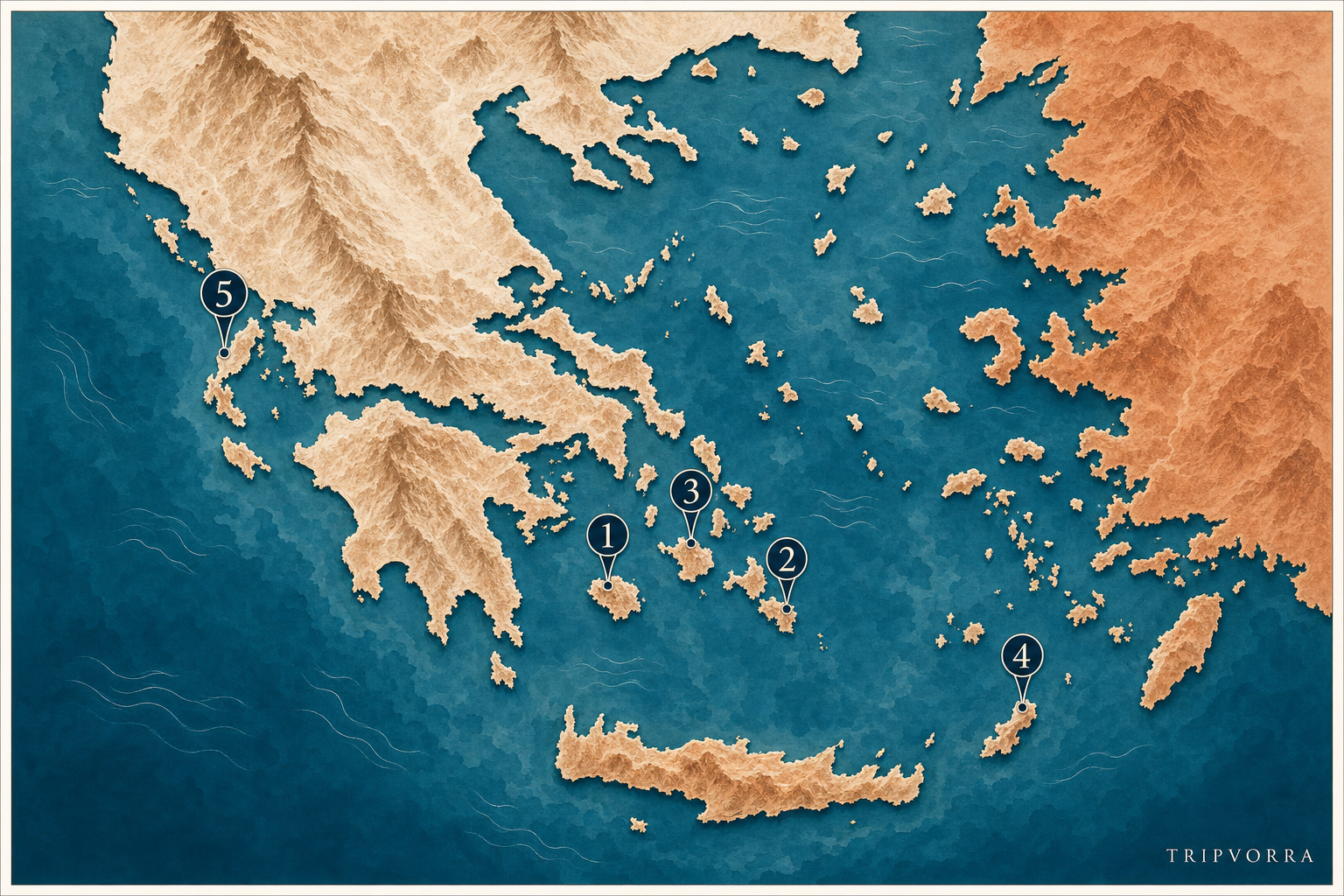
Map key: 1. Milos (Cyclades) — 2. Folegandros (Cyclades) — 3. Sifnos (Cyclades) — 4. Karpathos (Dodecanese) — 5. Lefkada (Ionian).
Milos: A Volcanic Coastline, Not a Postcard Beach
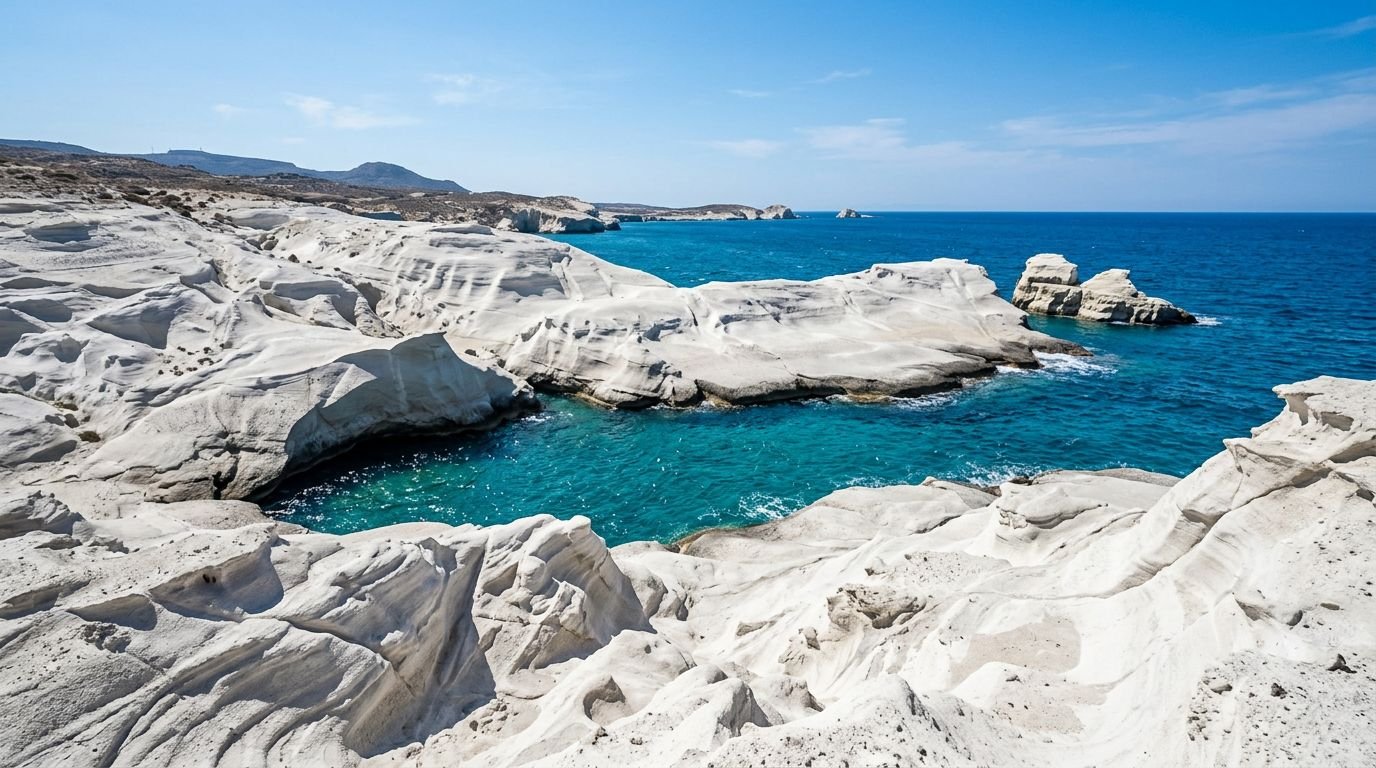
Milos is not a beach island in the usual sense. It’s a volcanic one, and the difference shows up the moment you reach Sarakiniko on the north coast: a stretch of bone-white pumice and tuff, wind-carved into folds and hollows, with no sand at all. It looks lunar because it is, geologically speaking, a very unusual rock rather than a scenic backdrop. The same volcanic chemistry gave the island a workable obsidian source in the Bronze Age, traded across the Aegean long before anyone called it a tourist destination.
The Venus de Milo was pulled out of a field near ancient Melos in 1820 and now lives in the Louvre, but the site where she was found, and the early Christian catacombs cut into the rock near Trypiti, which the island’s official tourism site describes as unique in size in Greece, can still be visited (check opening hours with the Milos tourist office). Neither gets the crowds a discovery of that scale might draw on a more visited island.
The numbers explain some of that gap. Milos’s small island airport handled around 118,000 passengers in 2024, against Santorini’s 2.9 million and Mykonos’s 1.6 million (Hellenic Civil Aviation Authority data, reported via GTP Headlines). That is a difference of more than an order of magnitude, and it tracks with what the island feels like outside of August: a working port town, Adamas, with tourism as one industry among several rather than the only one.
Getting to Milos
Milos’s airport takes only small turboprop aircraft and has seasonal domestic connections to Athens — check current carriers directly, since operators on this route change from year to year. By sea, Blue Star Ferries, Seajets, and several other lines run Piraeus–Adamas year-round; the fast boats do it in about two and a half hours, the conventional ones closer to seven, with deck fares from roughly €33 one-way. A rental car is worth having for the ring road and the trailheads, though buses reach the main beaches and villages.
May, June, and September are the calmer months here; August brings real crowding on the single coastal road near Sarakiniko and Kleftiko, and the island’s health center — not a hospital — means anything serious gets evacuated to Athens by boat or helicopter. That’s a fact worth knowing before you go, not a reason to avoid it.
Folegandros: An Island With No Airport, on Purpose or Not
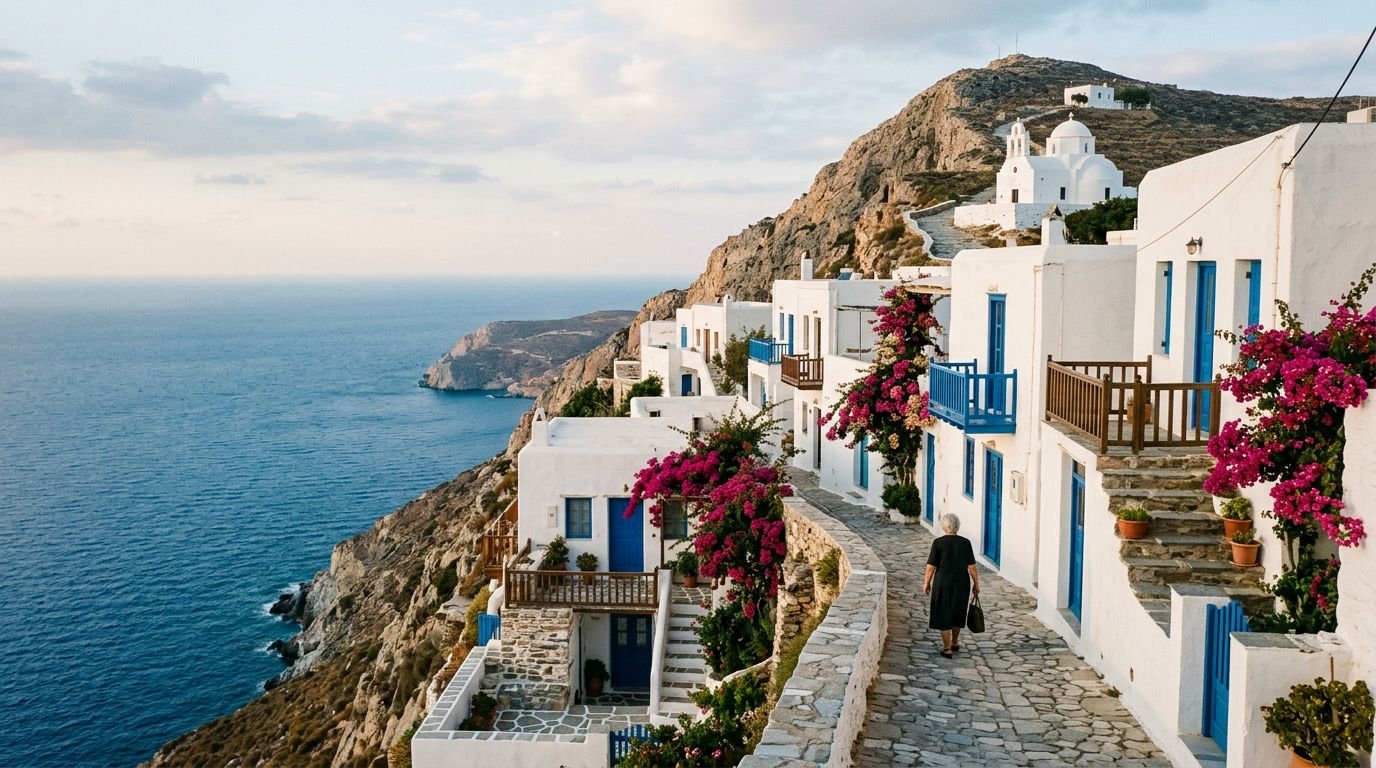
Folegandros has no airport, and that single infrastructure fact does most of the work of keeping it small. There’s no fly-in package tourism possible here at all — every visitor arrives by ferry, which is a real filter on volume even before anyone thinks about marketing an island as “unspoiled.” A Global Water Partnership field study puts the island’s permanent population at around 800, absorbing more than 40,000 visitors across a typical summer. That’s a sharp seasonal ratio, but the absolute numbers are tiny next to the 1.6 million passengers Mykonos airport handled in 2024.
Chora, the main town, sits on a cliff roughly 200 meters above the sea and is built directly onto the walls of a Venetian-era fortified Kastro — the outer house walls form what was once the settlement’s defensive perimeter, a specific structural detail rather than a generic whitewashed-village description. A switchback path climbs from town to the Church of Panagia above it, a route most visitors walk at sunset.
The island’s water scarcity is documented: Folegandros became a test site for solar-powered hydropanels that condense drinking water from air, under a Global Water Partnership Mediterranean program with the municipality, funded by the Coca-Cola Foundation. If you visit, use water sparingly.
Getting to Folegandros
Piraeus–Folegandros ferries run 4 to 7 times a week depending on season, from about 3 hours 40 minutes on the Seajets high-speed boat to roughly 6 to 7.5 hours on Fast Ferries’ slower ships, with fares starting around €48. There’s no airport alternative — the nearest are Santorini or Milos, with a further ferry leg from either. A car isn’t necessary; Chora and the nearby villages are walkable, and plenty of visitors go without one deliberately. Accommodation is limited in absolute bed count, so an August stay is worth booking two to three months out if you have a specific place in mind.
Sifnos: The Island Greek Food Writers Already Know
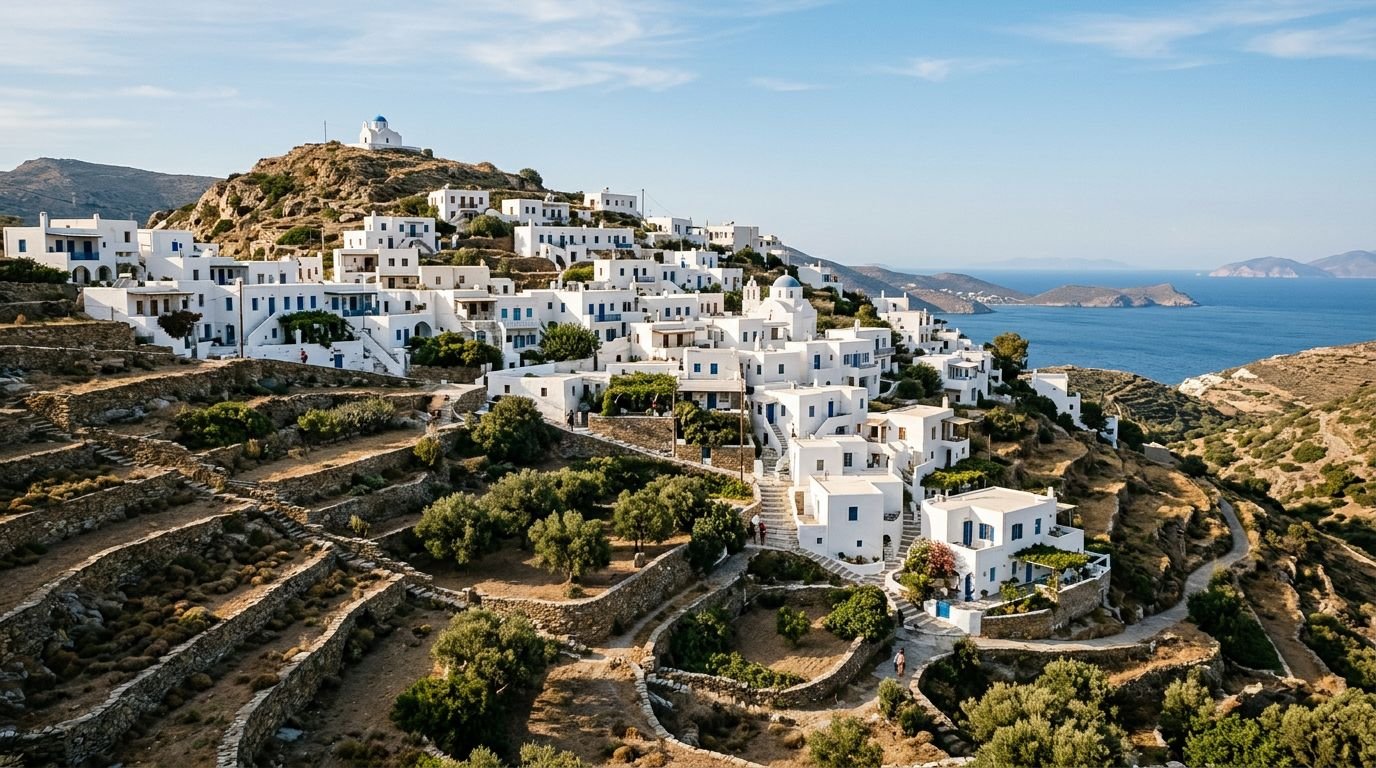
Sifnos isn’t unknown — it’s just unknown to a specific audience. Within Greece, it has a strong reputation among cooks and food writers, largely because of revithada, a chickpea dish traditionally slow-baked overnight in a clay pot in a wood-fired oven, and because the island has a centuries-old pottery tradition that still supplies working kitchens rather than just souvenir shelves. What it hasn’t built is the international profile of Santorini or Mykonos, and with no airport, every visitor arrives by ferry.
The hilltop Kastro settlement, a former medieval capital, is built in a defensive cluster of interconnected houses with almost no gaps between them — a fortification strategy rather than an aesthetic one, similar in logic to Folegandros’s Kastro but architecturally distinct in its execution. Inland villages like Artemonas and Apollonia sit on ridgelines with long views across terraced hillsides still used for agriculture.
Getting to Sifnos
Booking sites such as Ferryscanner list Piraeus–Sifnos crossings from about 2.5 hours on Seajets’ high-speed boats to nearly 5 hours on Fast Ferries’ conventional ships, with far more sailings in summer than in winter; check current times with the operators or the Piraeus Port Authority before booking. There’s no airport. A car is useful for reaching villages spread across the island’s interior, though the bus network covers the main routes.
Late spring and early autumn are the better windows for exploring the hillside paths between villages without midsummer heat; August is busy with both foreign and, notably, a large share of Greek domestic visitors, which changes the atmosphere from the international-crowd feel of Santorini.
Karpathos: Two Islands’ Worth of Culture in One Place
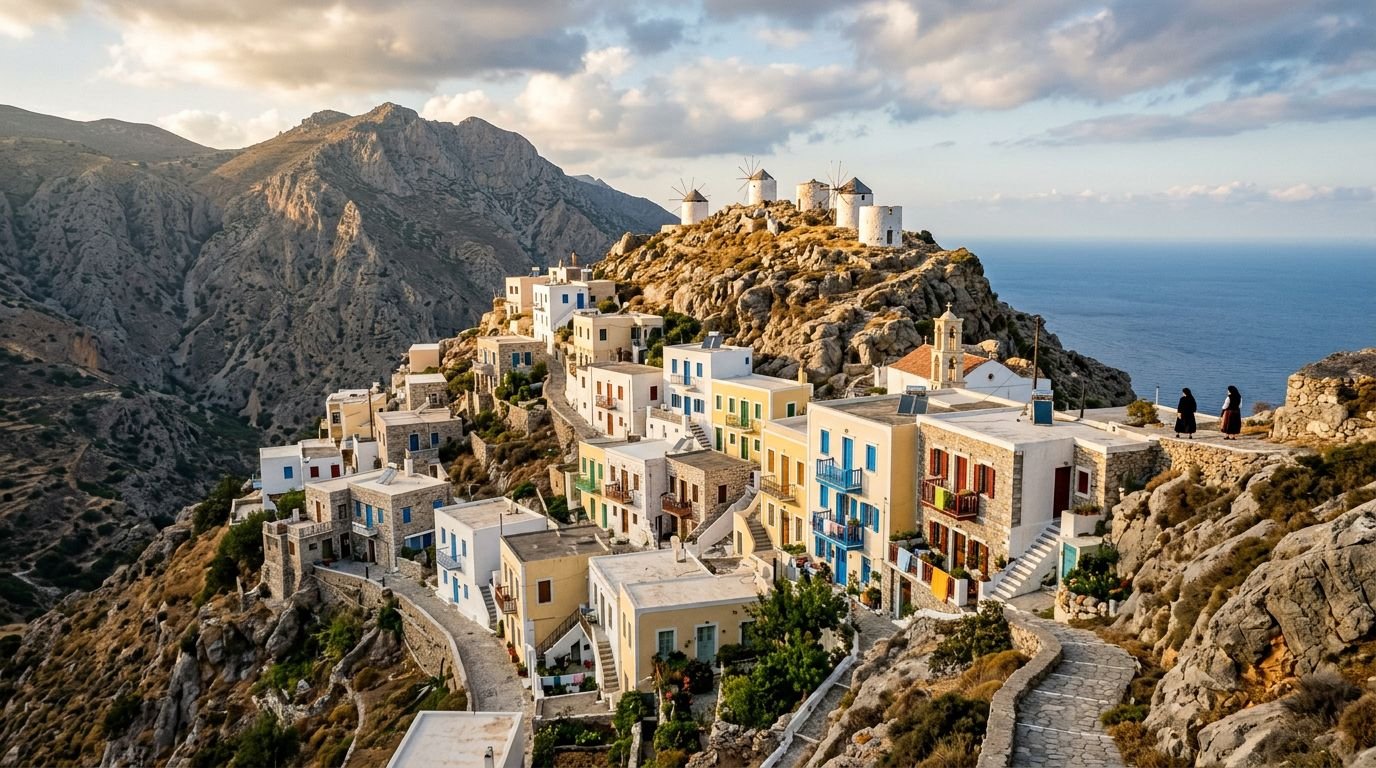
Karpathos sits in the Dodecanese, roughly equidistant from Rhodes and Crete, and its isolation shaped something more specific than just “fewer tourists.” The mountain village of Olympos, in the island’s remote north, kept a distinct dialect, embroidery and weaving traditions, and, among some older residents, traditional dress worn as daily clothing rather than performed for visitors.
That isolation is structural, not incidental: Karpathos has an airport, but it’s served by a limited number of routes compared with the dozens of international carriers flying into Santorini or Mykonos each summer, and getting to Olympos itself from the main town, Pigadia, still means a mountain drive of an hour or more. The south of the island, around the main town and Ammopi, is more developed and considerably easier to reach than the north.
Getting to Karpathos
Ferries connect Karpathos to Rhodes and, less frequently, to Piraeus on longer Dodecanese routes; flights from Athens and Rhodes are the faster option if time is limited. A car is close to essential for reaching Olympos and the island’s more remote beaches — public transport thins out considerably north of Pigadia. May through early October covers the practical visiting window; winter ferry and flight frequency drops sharply, and this is not an island to visit expecting shoulder-season infrastructure the way you might on a more developed Cycladic island.
The main caveat is pace, not risk: Karpathos rewards a slower visit built around two distinct halves of the island — south for beaches and infrastructure, north for Olympos and its culture — and rushing between them in a day trip from a cruise stop misses most of what makes the island distinct.
Lefkada: The Greek Island You Can Drive To
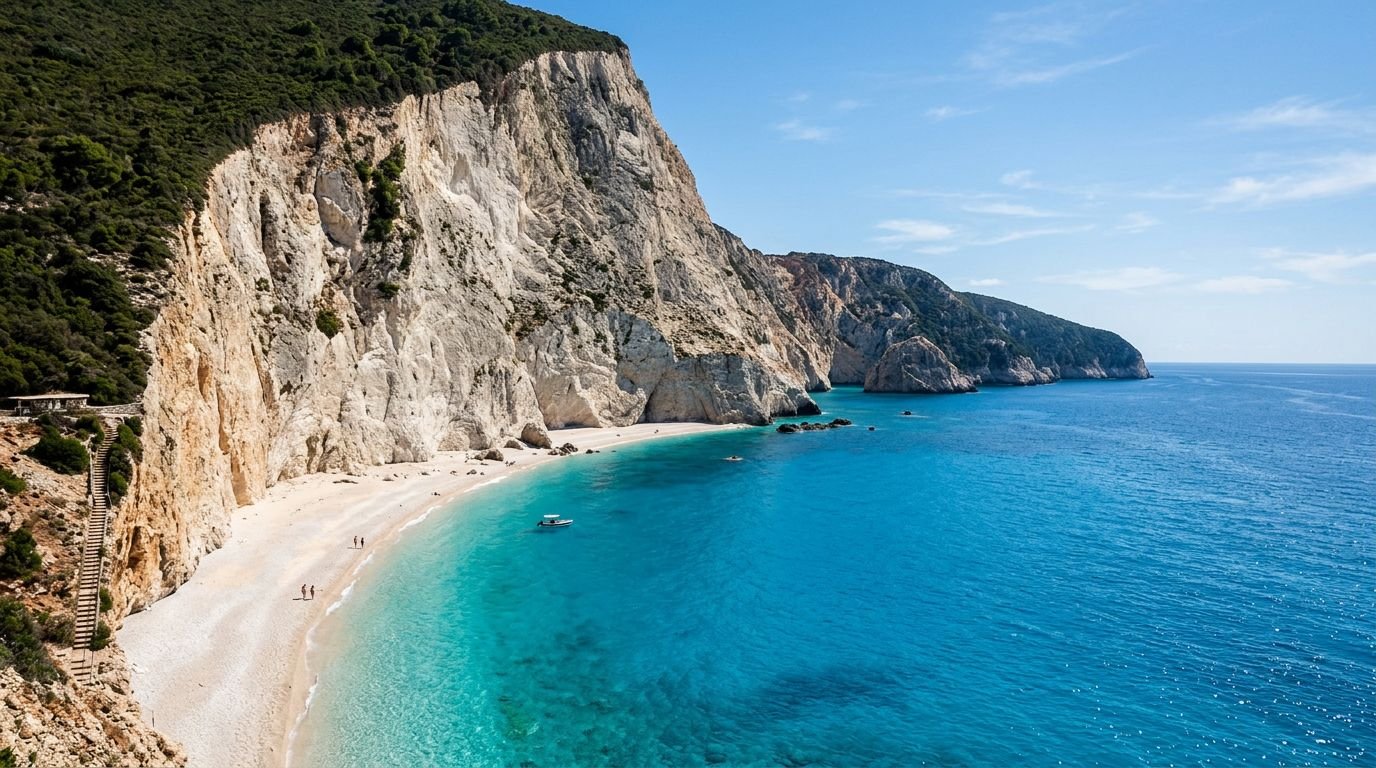
Lefkada breaks the pattern of every other island in this guide in one specific way: you can drive there. A floating pontoon bridge across the Agia Mavra strait connects it to the Greek mainland, carrying continuous road traffic and opening on a schedule to let boats through. From Athens it’s 378 kilometers by road (about five hours by coach) via the Rio–Antirrio bridge and the Aktio–Preveza undersea tunnel — no ferry required at all, which is a fundamentally different logistics profile from a fly-or-sail Cycladic island and one reason it doesn’t fit the usual “Greek island getaway” marketing template.
That accessibility has made it a strong domestic road-trip destination rather than an international fly-in one. Aktion National Airport, on the mainland near Preveza, does bring in seasonal European carriers, largely serving UK and European package travelers heading to the west-coast resorts — a different visitor profile again from either the Cyclades islands above or the mainland-drive crowd.
The island’s limestone cliffs at Porto Katsiki and Egremni are a different geological story from Milos: white limestone rather than volcanic tuff — and Vasiliki Bay has an established reputation among European windsurfers for its reliable thermal winds, a specific, verifiable draw rather than a generic “watersports” mention. Lefkada also grows Vertzami, an indigenous red grape used in local wines distinct from the Assyrtiko whites associated with Santorini.
A car is necessary here — the cliff beaches and inland villages are spread out, and there’s no ferry-town center to base a car-free stay around the way Folegandros or Sifnos allow. May, June, and September avoid the heaviest domestic and European holiday traffic; the island sits in an active seismic zone (a magnitude 6.5 earthquake in 2015 killed two people and damaged the Egremni cliff face and Vasiliki’s harbor), a fact worth knowing rather than dwelling on.
A Word on Tinos
It’s worth explaining why Tinos isn’t one of the five. It has no airport and a distinct identity — Greece’s marble-carving center, with villages like Pyrgos still producing sculptors, and Volax, a village set in a field of giant granite boulders unlike anything else in the Cyclades. But it’s also one of Greece’s largest domestic pilgrimage sites, built around the Church of Panagia Evangelistria, and draws enormous Greek crowds around August 15 each year. That’s a different kind of popularity than Santorini’s, but it isn’t an absence of attention — Tinos is a headline destination for Greek visitors, just not for the international market this list is written for.
Getting Between Them
These five don’t form a single practical route. Milos, Folegandros, and Sifnos are close enough for island-hopping within the Cyclades — a common pattern is Piraeus to one, a short ferry to the next, and a return leg from the third. Karpathos, in the Dodecanese, is a separate trip built around Rhodes rather than Athens. Lefkada, reachable by road, doesn’t connect to the other four by any practical ferry route and is better treated as its own mainland-adjacent trip, possibly combined with other Ionian islands like Kefalonia.
If you’re planning more Mediterranean trips, our towns beyond the obvious circuit in Spain and underrated towns in Italy pieces take the same approach away from the islands.
Research & Sources
Air-arrival figures for Santorini, Mykonos, and Milos are drawn from Hellenic Civil Aviation Authority data reported via GTP Headlines (news.gtp.gr). Ferry routes, durations, and indicative fares are from live Ferryhopper route pages for Athens–Milos, Athens–Folegandros, and Athens–Tinos, rechecked October 2026; confirm current schedules directly before booking, as operators and frequencies shift seasonally.
Folegandros’s water situation is documented by the Global Water Partnership Mediterranean. General island profiles for Milos, Folegandros, and Karpathos are cross-checked against Visit Greece, the official Greek National Tourism Organisation site. Lefkada’s road access and bridge schedule are documented by the Lefkada Slow Guide and Aktion National Airport’s own site. Current-season airline carriers for Milos and Karpathos could not be confirmed from a primary source, so the text does not name them.