
The rules for walking on Pamukkale’s white terraces are not described in exactly the same way by every official source. Türkiye’s Ministry of Culture and Tourism says visitors are allowed on major paths and must remove their footwear to stand on the calcium deposits. UNESCO, however, describes visitor access to the travertine terraces as prohibited. We could not verify an official map that resolves the difference or shows precisely where the permitted route ends.
The distinction matters because the white terraces are a protected natural feature. This guide explains how the travertine forms, why conservation matters, what the available sources establish, and what you should check before visiting.
Last verified: 24 October 2026. Hours, fees and rules change. Check the official sources linked below for your own visit date.
How this guide was built. Tripvorra is an independent, research-led publication. We did not visit Pamukkale for this article, and nothing here is a first-hand account. It draws on official, scientific and news sources, each linked where it is used. Where sources disagree, or where we found none, we say so.
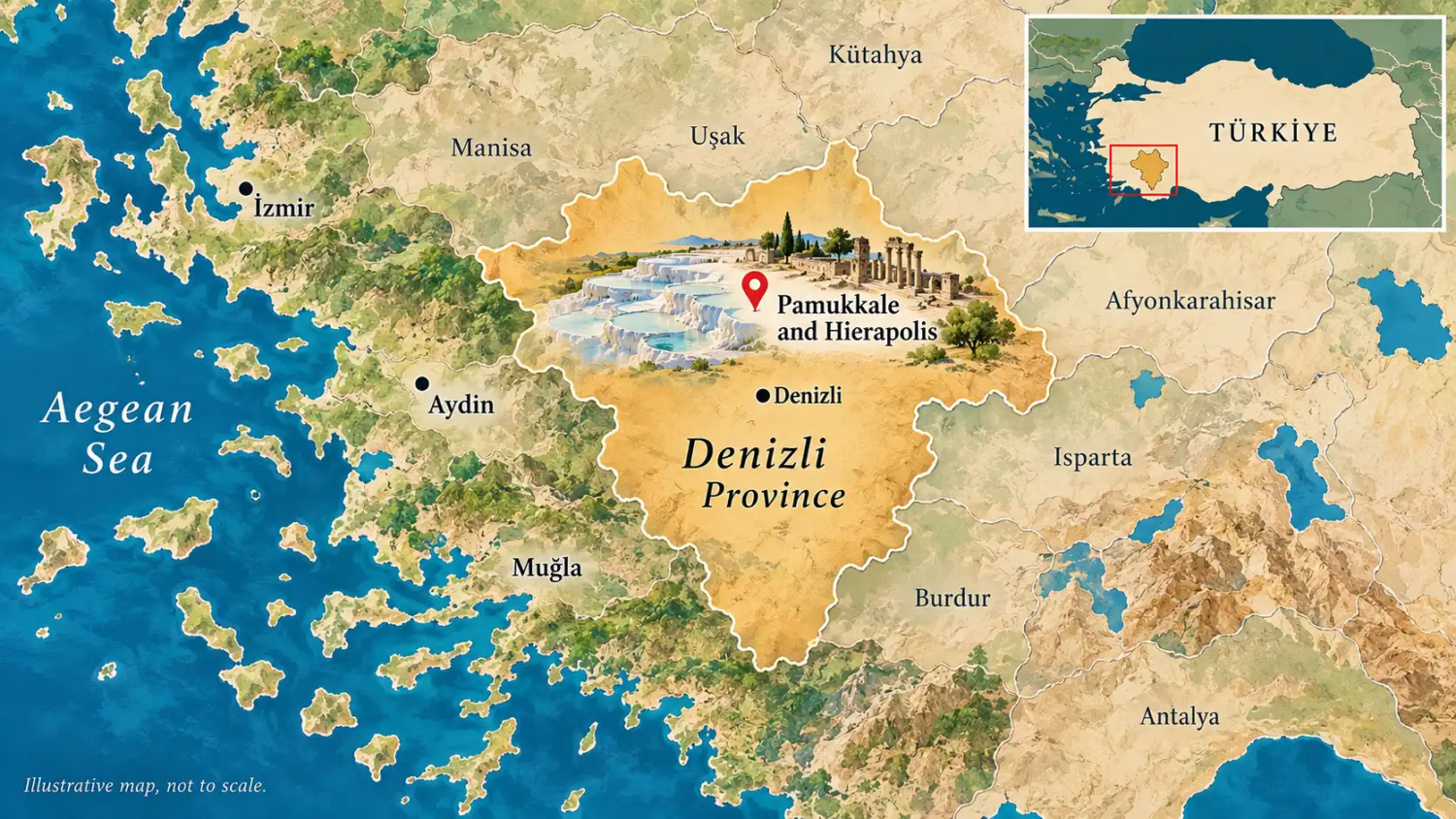
What makes Pamukkale’s terraces white?
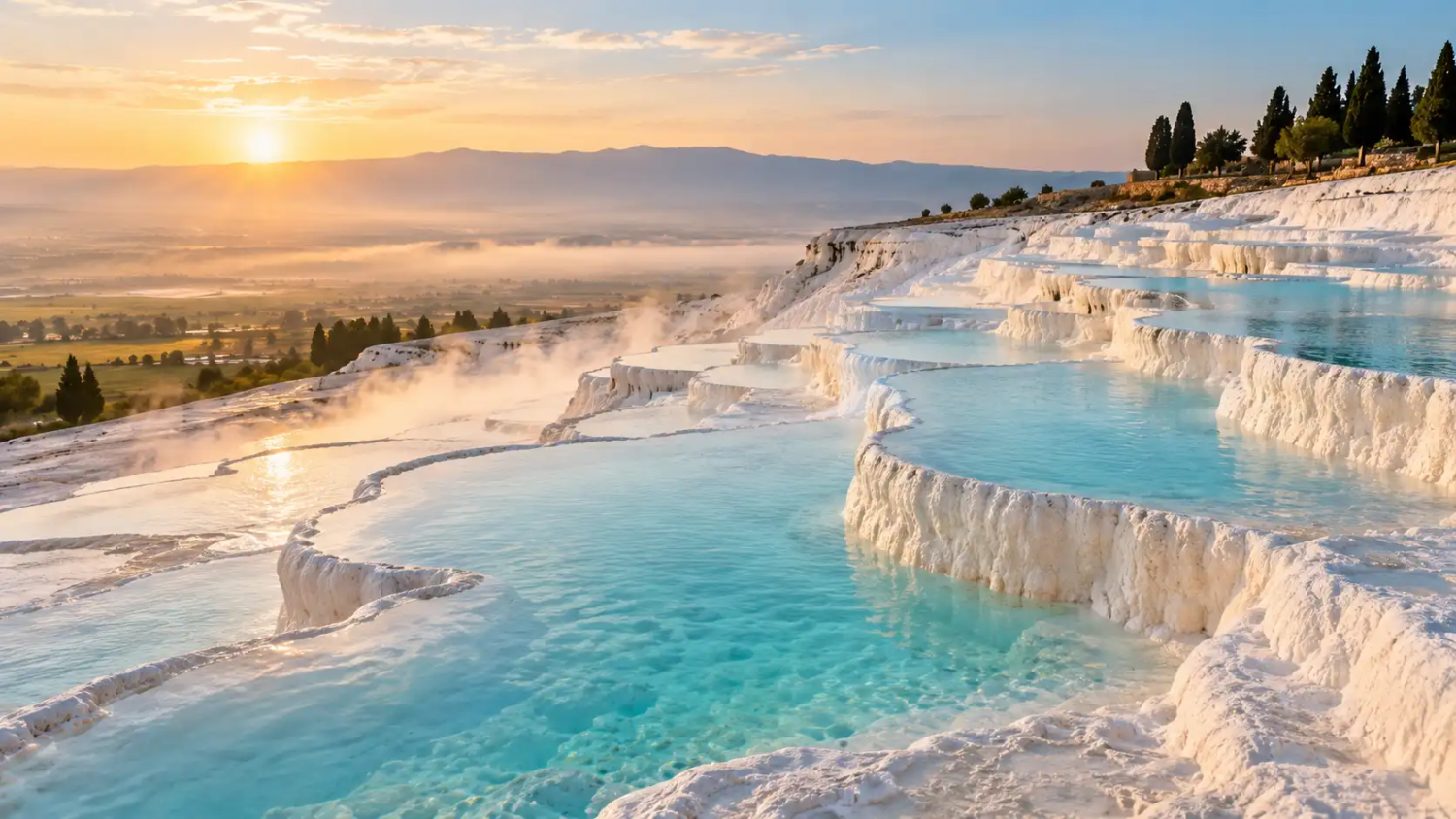
The white is calcite, a form of calcium carbonate. UNESCO says the calcite deposits give the formations “a dazzling white coating”, and that the name Pamukkale comes from this landscape.
The mineral is not the whole story. A 2000 study in Geothermics found that algae had discolored the terraces. Water carried to swimming pools in open channels, then discharged onto the terraces, made the algae grow faster. Leaking septic tanks added to the problem. The authors describe covered channels and a closed road as part of the response.
How the travertine terraces form
Travertine is a rock that forms where hot spring water leaves calcium carbonate behind. At Pamukkale, mineral-rich water rises from below, loses carbon dioxide at the surface, and deposits calcite as it flows.
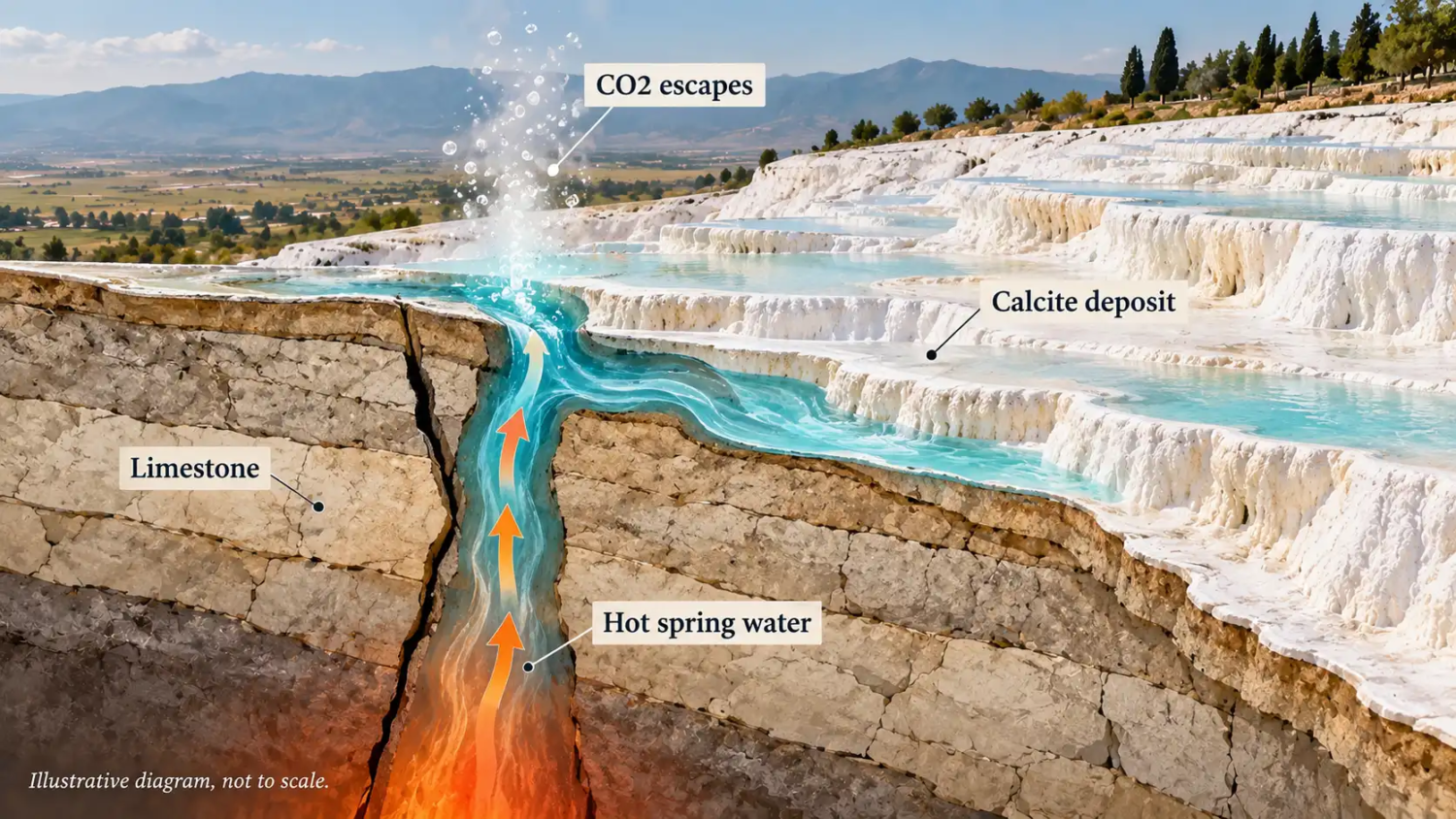
- Water takes up calcium. The International Union of Geological Sciences (IUGS) Commission on Geoheritage describes geothermal water warmer than 35 °C, sourced from a fault scarp (a steep slope made by a fault). Its path through limestone bedrock makes the water rich in dissolved calcite.
- The water reaches the surface and loses gas. A paper in the European Geologist Journal names the fall in carbon dioxide (CO₂) pressure as the key factor at Pamukkale. When CO₂ escapes at the surface, a process called degassing, carbonate comes out of the water as a solid.
- A soft deposit forms. Pamukkale University’s field guide describes the new calcium carbonate as a soft gel that hardens over time.
- The basins build up. In general, repeated deposition where the water flows builds the stepped basins over time. This last step is our plain-language summary, not a quoted finding.
The landscape is old, but the visible surface is not one object of one age. IUGS gives the geological period as Middle Pleistocene to Holocene and lists several travertine forms at the site, including terrace-mounds and fissure ridges. The European Geologist Journal paper reports a U-series age (a radiometric dating method) of at least 400,000 years for deposits of an early phase. That figure does not date any terrace you can see today. None of the sources we read dates a single visible terrace, and the terraces did not all form at the same time.
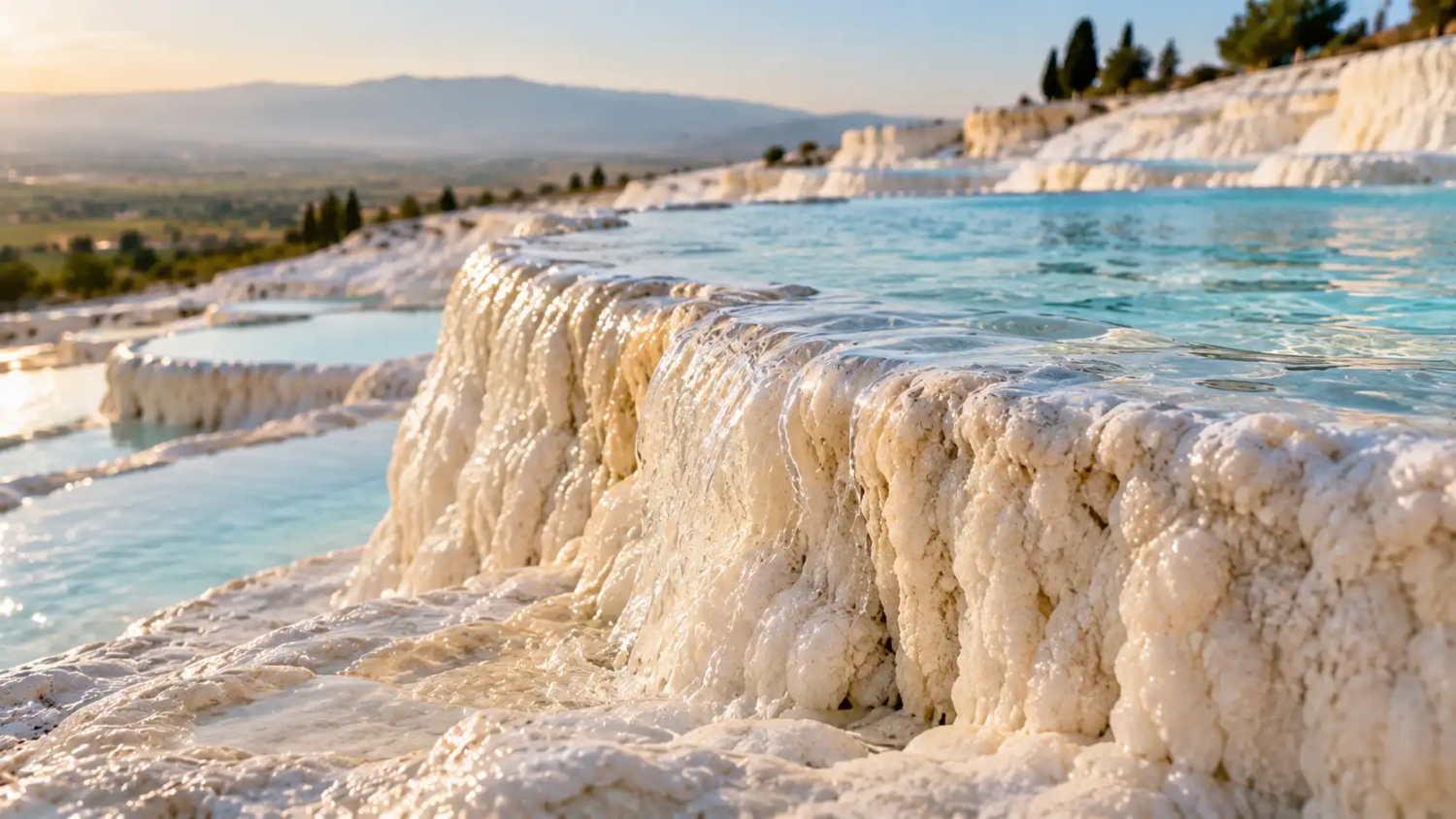
Calcium carbonate also comes out of spring water at Havasu Creek in Arizona. For a US example of terraces that keep rebuilding, see our guide to the science behind Havasu Falls.
Why conservation restrictions matter
UNESCO lists high visitor numbers as the main threat to the site’s integrity. The Ministry of Culture and Tourism says the water supply is now used for preservation and that some of the damaged calcium deposits have been strengthened.
IUCN’s World Heritage Outlook, finalised on 11 October 2025, rates the site “Good with some concerns”. It describes past measures, including limits on bathing in the pools and access limited to certain paths, and says the quality of the travertine deposit returned. It also says the thermal water flow that feeds the travertine has decreased compared with previous times, and it names climate change as a threat to the underground water that feeds it. IUCN gives no date for the flow statement, and the studies cited nearby include work from 2002 and 2009, so treat it as a concern, not a measurement of today’s flow.
IUCN does not say the terraces are drying up. It cites a 2017 consultation that found calcite deposits recovering, with enough water discharge for the terraces. It also states that visitor numbers still exceed the site’s carrying capacity, without citing a source for that sentence.
Where can visitors walk on Pamukkale’s terraces?
The main sources use different wording, and they do not fully match.
- The Ministry of Culture and Tourism says that visitors are only allowed on major paths around the site and must remove footwear to stand on the calcium deposits.
- UNESCO is broader. It says that visitor access to the travertine terraces is prohibited, to sustain the water flow and to protect the terraces’ colour and structure. It also says that areas where visitors can bathe in the hot springs have been established.
- IUCN describes bathing in the pools as prohibited and access as limited to certain paths. It presents these as measures that were taken, not as a current notice.
These statements point the same way: some access is allowed on designated paths, and access to the travertine more widely is restricted. But they are not worded alike, and we have not tried to merge them into one rule. None of the pages we could open says exactly where the permitted route ends, says that every terrace outside it is closed, or provides a current official map of open terraces.
Commercial sites add detail. Several tour and ticket pages say visitors walk barefoot along a marked route, that dry or worn terraces are fenced off, and that swimming is limited to the separate Antique Pool. See ExcursionMania for an example. These are commercial pages, not official policy, and we use them only to describe what visitors are told.
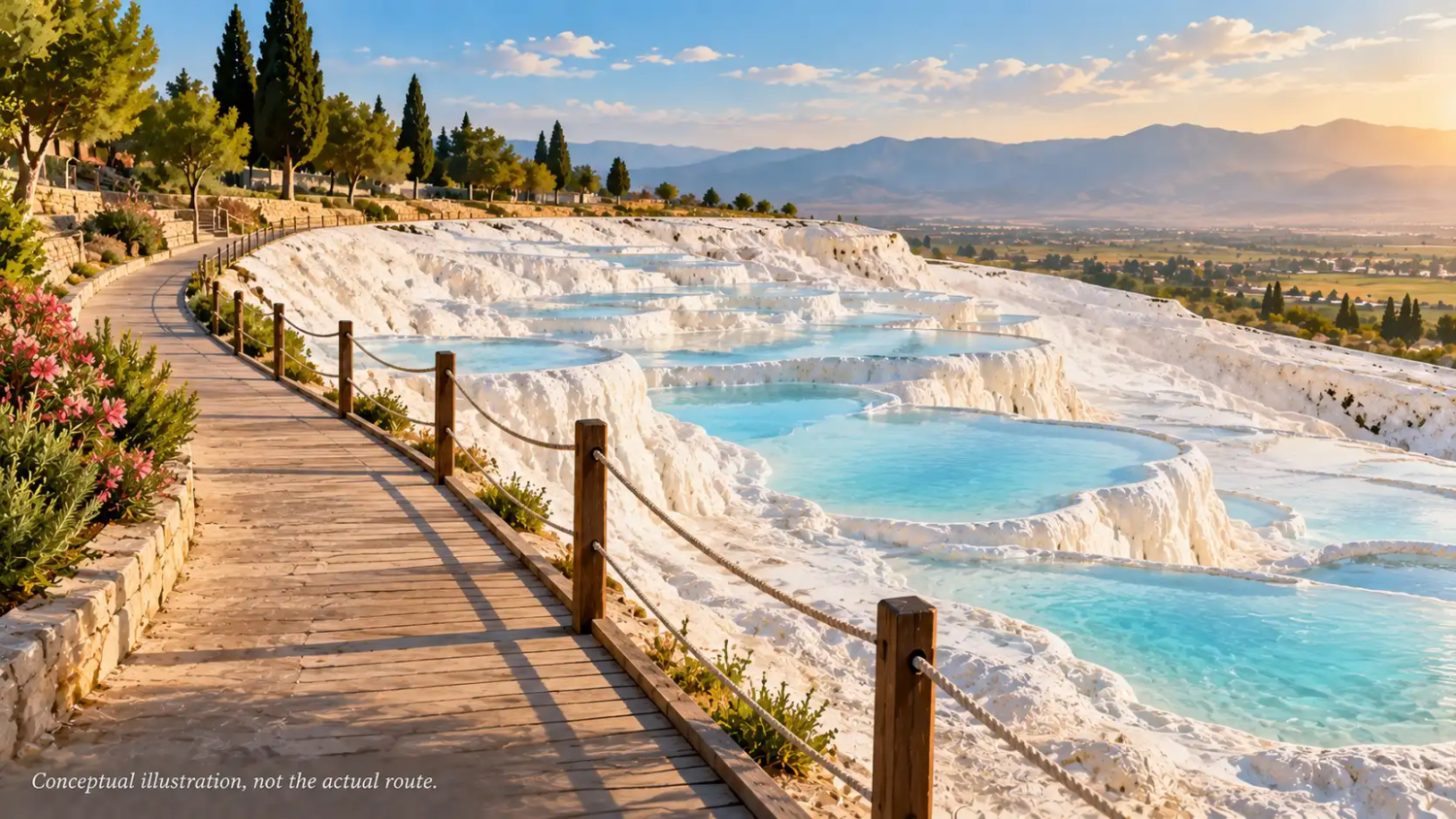
Wading is unconfirmed. We found no official text on whether visitors may wade in the shallow channels beside the route. Some commercial guides say they can. The Ministry page does not mention pools, and the UNESCO and IUCN wording concerns bathing. Do not assume that entering any pool or channel is allowed. Ask staff at the gate and follow the signs.
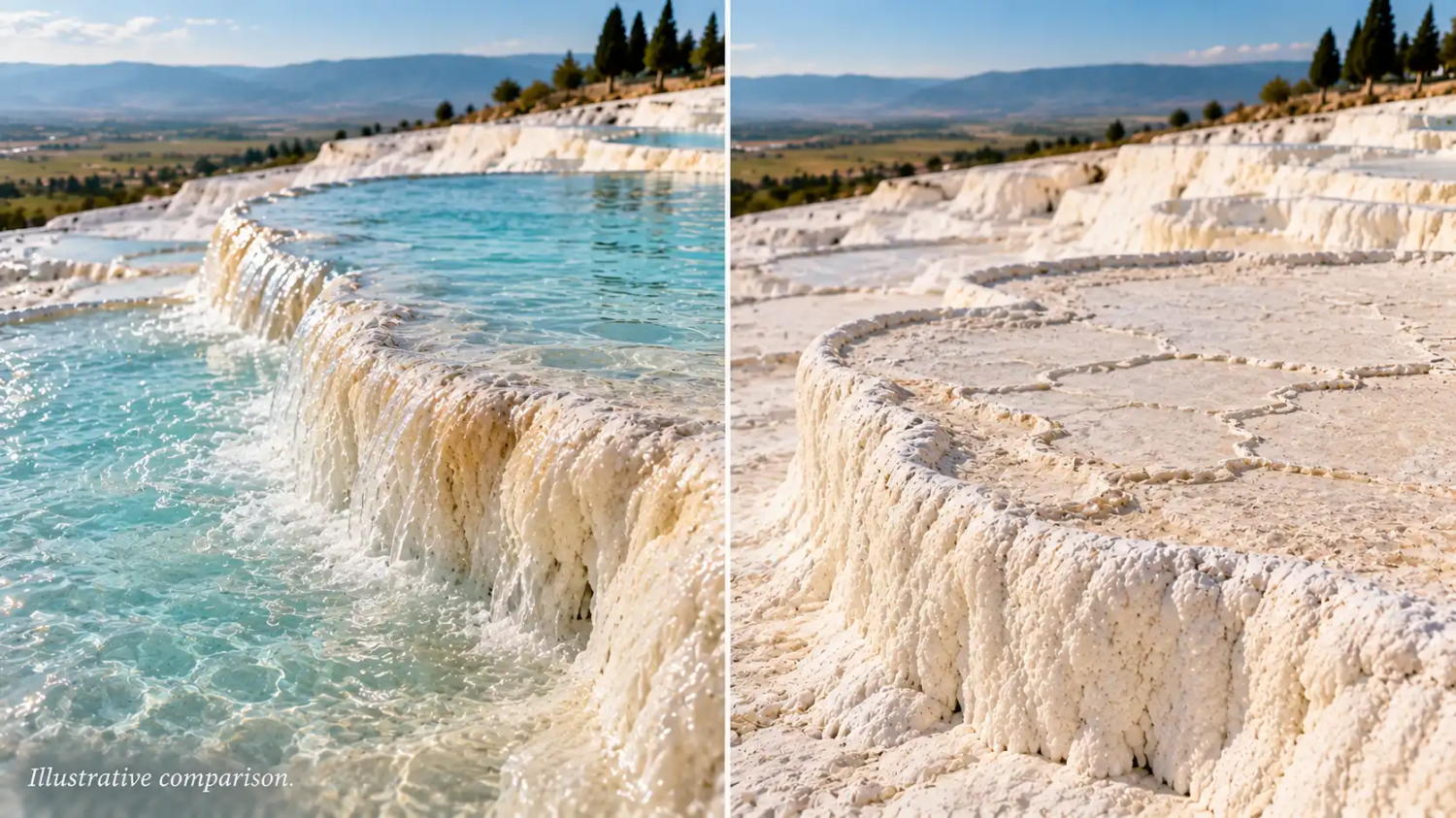
Why do some terraces look dry or different from photographs?
No source we found measures this directly, so this section stays with what the evidence supports.
Pamukkale University’s field guide says weather, heat loss, water flow and duration all affect how white the deposit stays. IUCN says thermal water flow has decreased compared with the past. Some travel sites, and Wikipedia citing the official tourism site, say water is managed between sections and that some sections are closed to recover. We found no official schedule for this, and no source supports a claim that water is rotated on a timetable.
A dry-looking terrace may be resting, restricted, or short of water. We cannot say which applies on a given day. Photographs show one moment, usually a good one, and a description written for another date may not match your visit.
How to visit responsibly
The barefoot rule. The Ministry says visitors must remove footwear to stand on the calcium deposits. The page gives no reason and does not say where on the route shoes must come off. Scientific sources show that new deposit is soft and that foot traffic can damage it, so the rule fits that evidence. That connection is our inference. In practice, take your shoes off where signs or staff say so.
Stay on designated paths. A terrace that looks dry, worn or easy to cross may still be restricted, and the sources do not let us tell you which ones. Follow the signs and staff instructions on the day, which may differ from anything written online, including this guide.
Opening hours. Two sources give different details, and neither is a substitute for checking your own date.
- Ministry museum page. On 24 October 2026 the Ministry’s museum page listed the site as open every day from 08:00 to 18:00, with the ticket office closing at 17:00, the north and south gates closing at 18:00 and the pedestrian entrance closing at 17:00. The page is undated and shows no season label.
- Local news report. Denizli 24 Haber, reporting an announcement by the Denizli Provincial Directorate of Culture and Tourism, said on 1 October 2026 that a winter schedule had started. It gave 08:00 to 18:00 for the gates and 08:00 to 17:30 for the pedestrian entrance and the Antique Pool.
The sources agree on the gates and differ on the pedestrian entrance: 17:00 on the Ministry page, 17:30 in the news report. We could not open the directorate’s own page, so we cannot say which is current. Plan for the earlier time. Reported summer hours were much longer, with a night programme from 1 June to 30 September 2026, so do not apply summer figures to other months.
Fees. Local news, citing the Ministry’s tariff, reported a foreign-visitor fee of €30 in April 2025. That is historical information, not a verified current price. A September 2026 report describes a rise to €35 from 1 April 2027, which is a reported future change, not a confirmed tariff. We did not verify what the current ticket includes or whether the Antique Pool costs extra.
Before You Visit: What to Check
- Opening hours for your date. Use the Ministry’s museum page and the Denizli Provincial Directorate’s visiting hours page. We could not open the second page, so we have not verified its contents. Check the closing times for the ticket office, gates and pedestrian entrance separately.
- Price and what the ticket includes. The Ministry’s hours-and-tickets notice is here. We could not open it either. Confirm the current price, what it covers, and whether the Antique Pool is charged separately.
- Which route and terrace areas are open. No public source we read lists them. Ask staff and follow signs.
- Whether wading beside the route is allowed. Ask. Do not assume.
- Where to remove footwear. The Ministry requires it to stand on the calcium deposits. Follow the signs for where that starts.
What we cannot answer from public sources
Four questions remain open in the public sources we could read: which terraces are open on a given day and where the permitted route ends, whether wading beside the route is formally allowed, how and when water is moved between sections (if it is), and the current ticket price and its inclusions on an official page. If a travel site states any of these as fact without citing an official source, treat it with the same caution.
Frequently asked questions
Can you walk on the Pamukkale terraces?
On part of them. The Ministry says visitors are only allowed on major paths, while UNESCO describes access to the terraces as prohibited. No source we read defines the exact boundary.
Why are the Pamukkale terraces white?
Calcite, a form of calcium carbonate, is deposited as hot spring water loses carbon dioxide at the surface. Algae discolored parts of the terraces in the past.
Can you swim or wade in the terraces?
Not confirmed. UNESCO says bathing areas have been established, and IUCN describes past limits on bathing in the pools. We found no official text on wading, so ask staff and follow the signs.
Are the terraces drying up?
No source we read says so. IUCN reports that thermal water flow has decreased compared with previous times, but it also cites a 2017 consultation that found the deposits recovering.
Do I need to take my shoes off?
Where signs or staff require it. The Ministry says visitors must remove footwear to stand on the calcium deposits.
Are the opening hours the same all year?
No. Reported schedules differ by season and year, and our two sources differ on the pedestrian-entrance closing time. Check the official sources for your date.