
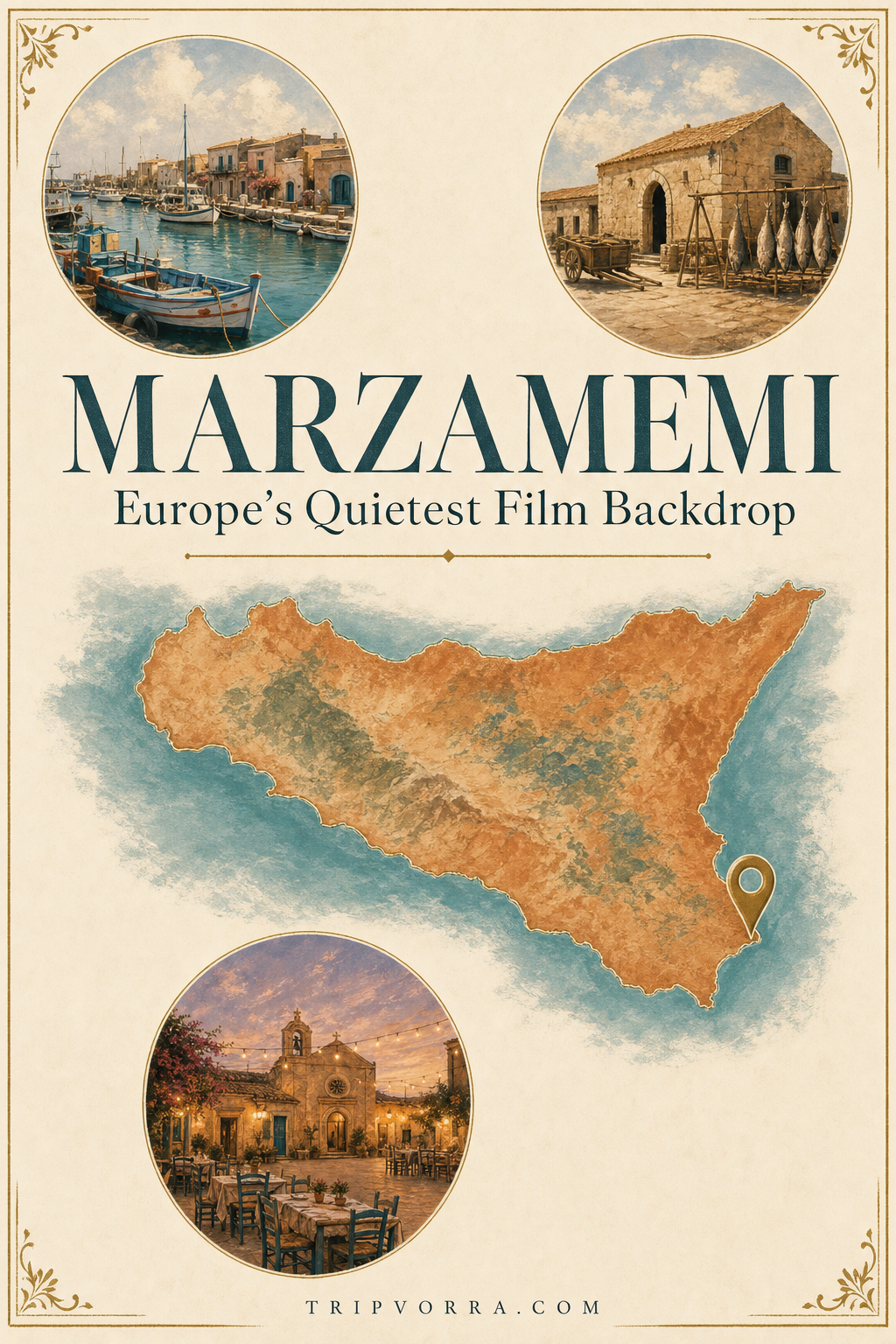
Marzamemi has fewer than 400 full-time residents, no train station, and a harbor small enough to walk around in ten minutes. It has also appeared on camera more often than towns a hundred times its size — a run of Italian films, a long-running television series, and at least one recurring international shoot, stretching back more than forty years. The honest version of that story isn’t “undiscovered paradise.” It’s a specific, well-documented reason a tiny Sicilian fishing village kept getting picked, and an equally specific reason it never turned into the kind of set-piece destination that outgrows itself.
Last verified: September 2026, against Sicilian regional press, the village’s own historical record, and film-location archives cited throughout.
| Location | Province of Syracuse, southeastern Sicily, near Pachino |
| Population | Under 400 (2011 census figure: 367) |
| Founded as a village | Formalized in 1752 under Prince Nicolaci di Villadorata to run the tuna fishery |
| Tonnara (tuna fishery) active | From the Arab period through 1969 |
| Confirmed film/TV productions | At least 10, from 1984 to 2010, plus an ongoing TV series |
| Nearest airport | Catania (roughly 1 hour by car) |
A Village Built Around a Tuna Fishery
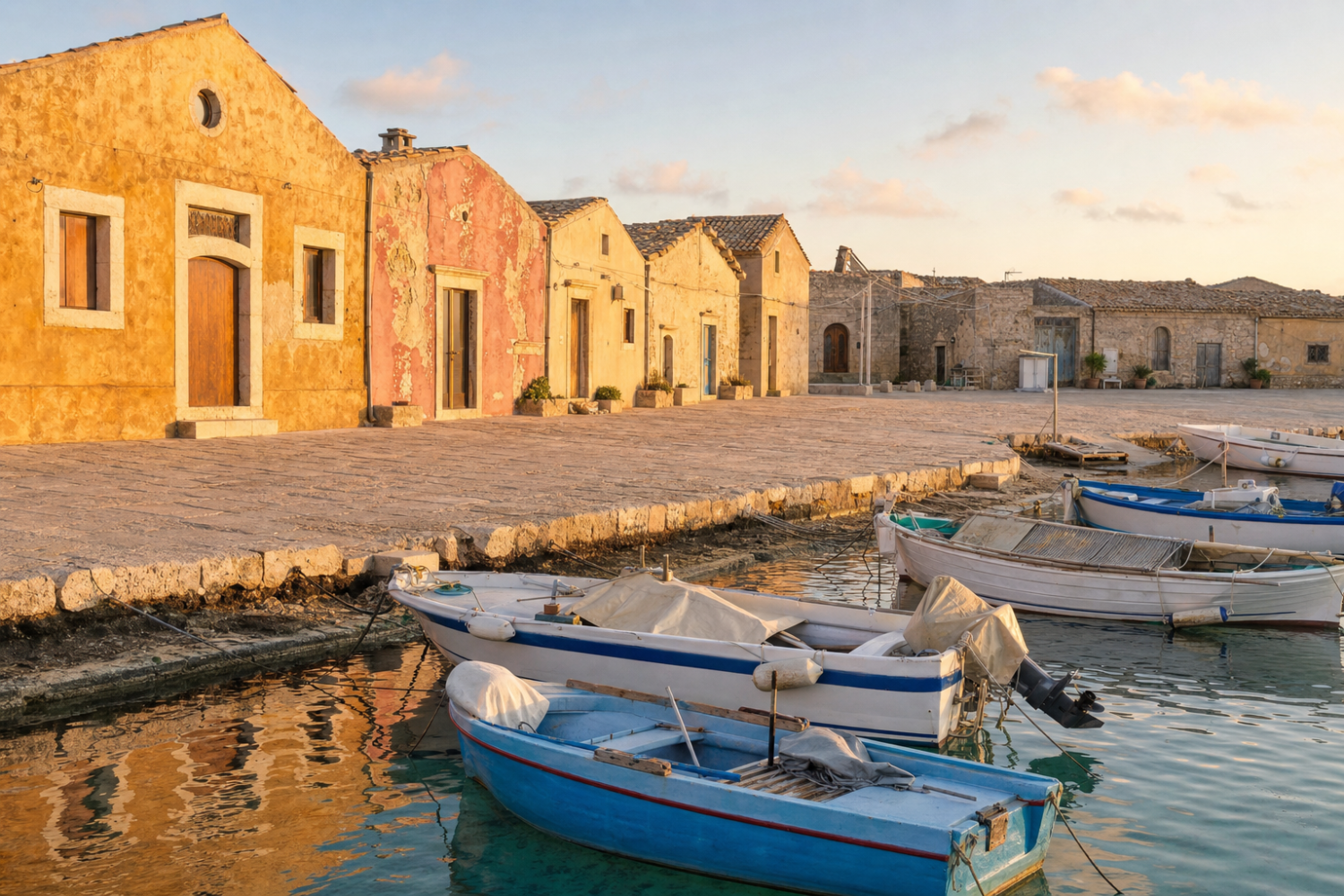
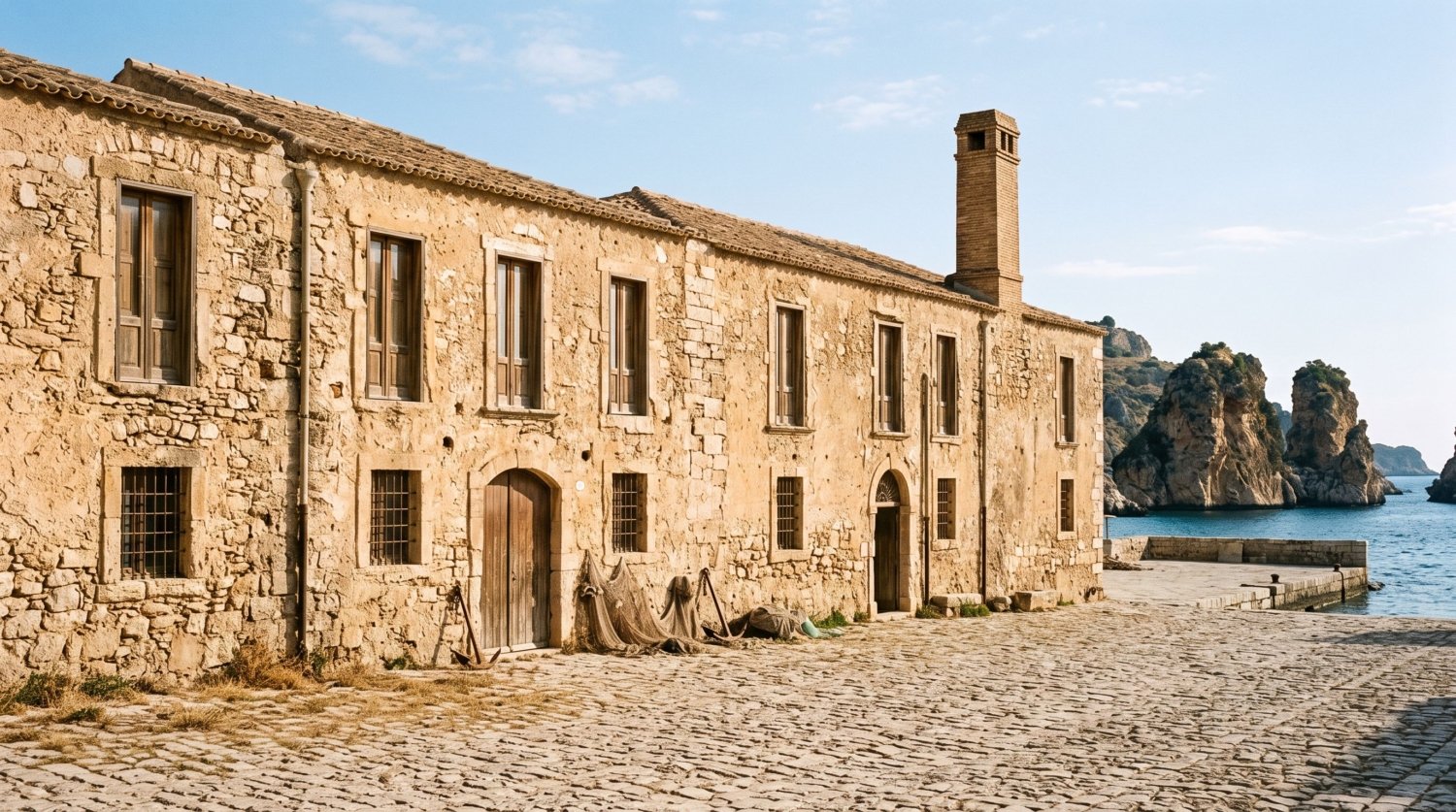
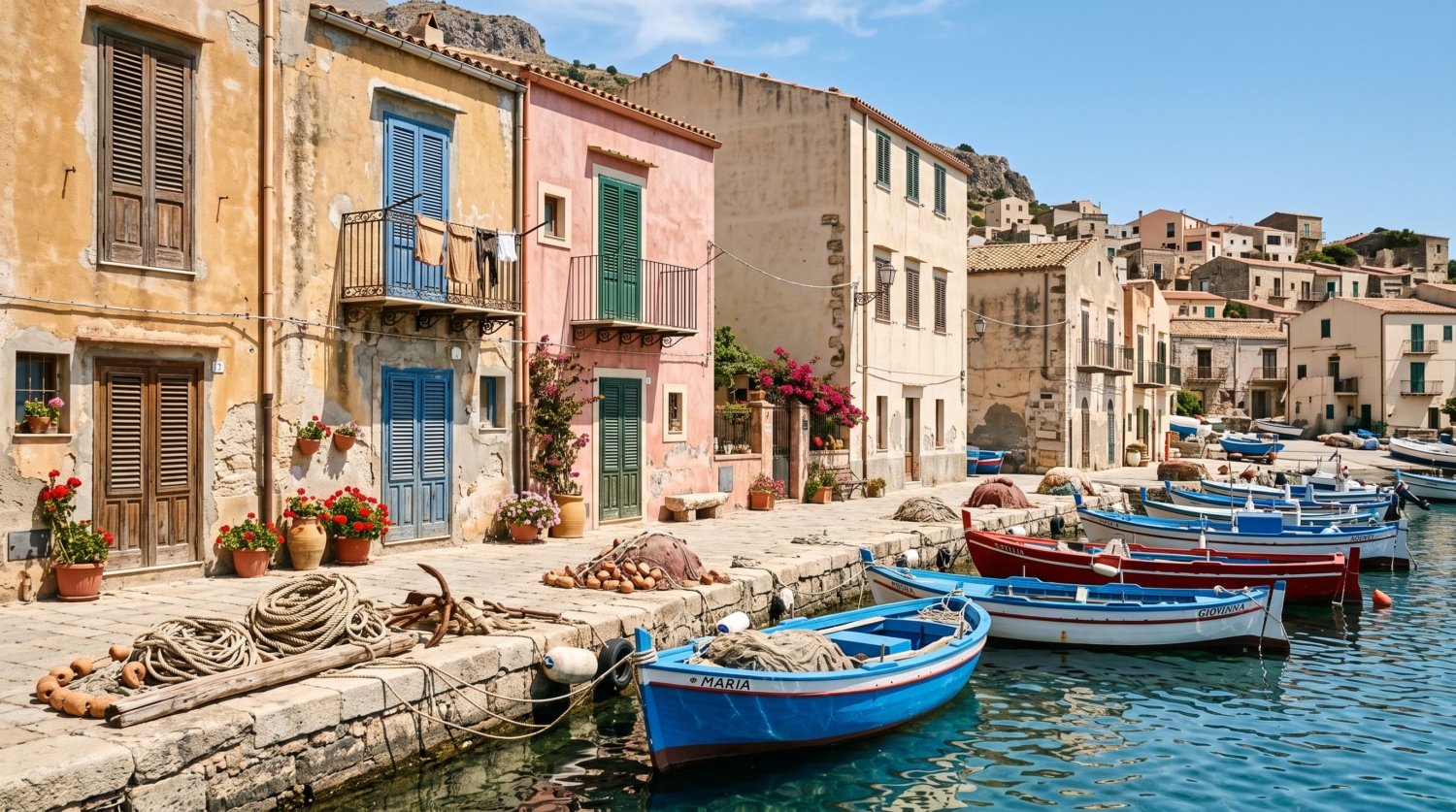
Marzamemi’s harbor existed long before the village did. Arab fishermen were working a tuna fishery, or tonnara, on this stretch of coast as early as the 11th century, drawn by two natural bays that gave boats safe anchorage in a region with few sheltered harbors. The Calascibetta barons acquired the tonnara in 1655 and expanded it, building warehouses along the main street to store and export wine alongside the tuna catch. It wasn’t until 1752 that Prince Nicolaci di Villadorata formally established Marzamemi as a village in its own right, purpose-built to house the workers running the fishery — which is why the settlement still reads, architecturally, as one continuous composition: a row of fishermen’s houses facing directly onto the tonnara’s own processing square, rather than a village that happened to grow up near a harbor.
The fishery reached industrial scale in 1912 with a dedicated plant for salted and oil-preserved tuna, and the mattanza — the traditional, brutal tuna harvest — ran twice a day during the season. One of the tonnara’s chimneys collapsed during an RAF air raid on June 12, 1943; the plant itself kept operating afterward and didn’t close for good until 1969. What’s left is the Prince’s palace in ruins, the old warehouses, and a chimney stump — now restored as an event space rather than a working fishery, but still the visual anchor of the whole village.
The Filmmakers Who Found It First
What draws a film crew to a working fishing village and what draws a tourist are usually different things, and Marzamemi’s filmography reads like a checklist of what a location scout actually needs: a self-contained square with no visible modern intrusions, natural light bouncing off water on two sides, and buildings old enough to read as any decade a script needs. The Taviani brothers used it for Kaos in 1984. Gabriele Salvatores shot Sud here in 1993. Giuseppe Tornatore — Sicily’s best-known director, an Academy Award winner for Cinema Paradiso — brought his own crew for L’uomo delle stelle (The Star Maker) in 1995, a film set in 1950s rural Sicily that needed exactly the unbroken, pre-modern square Marzamemi still had. Klaus Maria Brandauer directed and starred in Mario and the Magician here in 1994; Nello Correale’s Oltremare followed in 1998, and Pasquale Scimeca’s adaptation of I Malavoglia in 2010. On television, the long-running Commissario Montalbano series — adapted from Andrea Camilleri’s novels and one of Italian TV’s most durable exports — has used the village repeatedly, alongside the sitcom Immaturi – La Serie and the series Blindati. Even a Shaggy collaboration, the single “Bella vita,” used the harbor for its video.
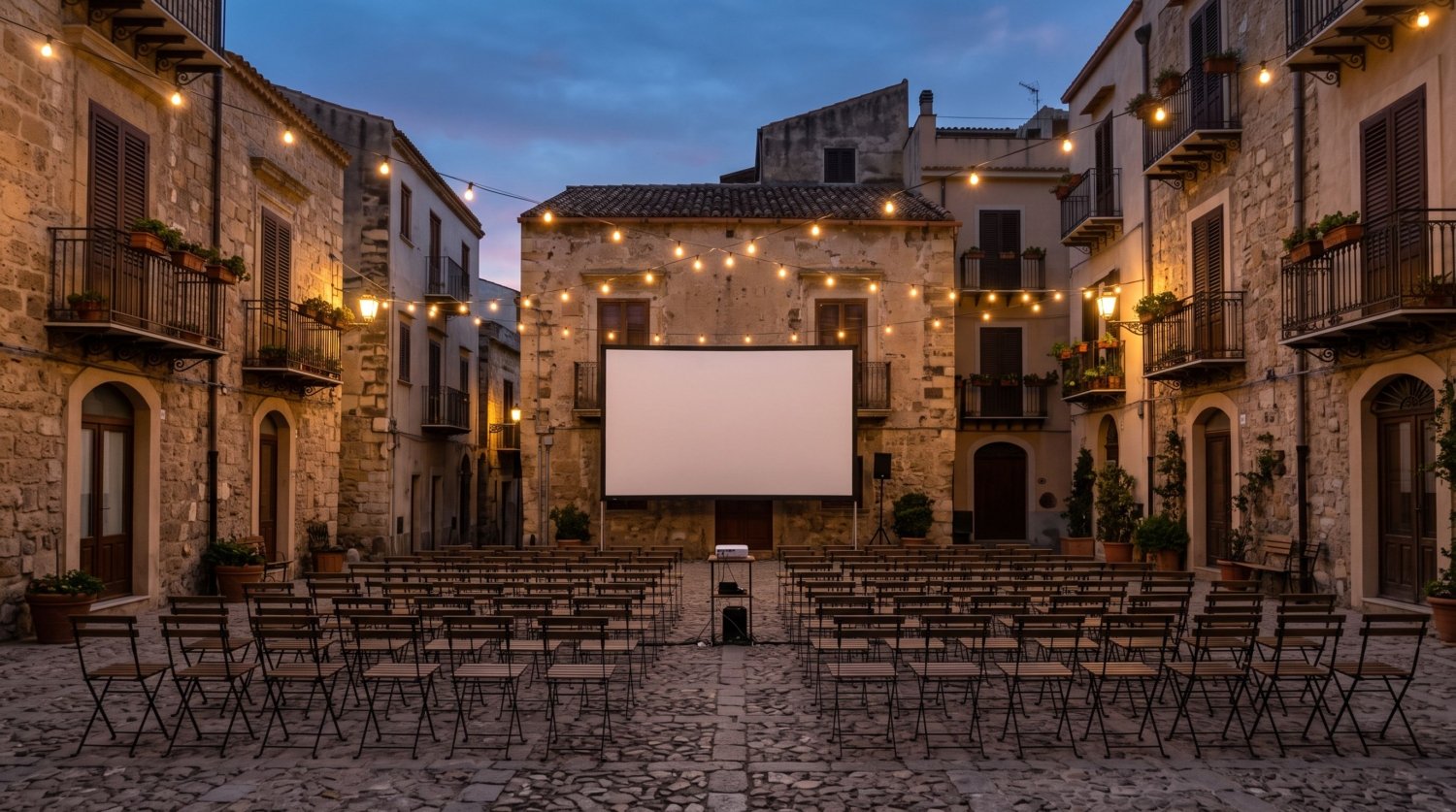
The village has leaned into this rather than downplaying it: since the early 2000s it has run its own open-air festival each July, the Marzamemi International Film Festival of the Frontier, turning Piazza Regina Margherita into a screening venue that organizers describe — a claim worth taking as local pride rather than an independently verified record — as the southernmost and largest open-air cinema square in Europe.
The Films Marzamemi Is Often Credited With (But Didn’t Make)
Two much bigger titles show up constantly in casual write-ups of Marzamemi’s film history, and both deserve a direct check rather than repetition. The first is Cinema Paradiso itself — Tornatore’s most famous film, and the one that would make the strongest headline. Detailed location records for that 1988 film point to Palazzo Adriano, in the Sicilian interior, and Cefalù, on the north coast, as its actual filming towns; Marzamemi isn’t part of the documented location list, and a regional Sicilian outlet’s own comprehensive filmography for the village doesn’t include it either. The second is Michelangelo Antonioni’s L’Avventura (1960), sometimes listed on tourism sites as having used Marzamemi’s coastline. The film’s well-documented locations are the Aeolian Islands, Milazzo, Noto, and Taormina — not Marzamemi, and not anywhere in that immediate stretch of the southeastern coast.
Neither correction diminishes the real list above, which is already unusually long for a village this size. But it’s worth being skeptical of any “a famous movie was filmed here” claim attached to a small, camera-friendly place — the real filmography is more than interesting enough on its own, and doesn’t need the two biggest names attached to hold up.
Why It’s Stayed Small
Marzamemi is not a secret. It has its own film festival, a filmography film buffs actively seek out, and a growing food-and-wine reputation built around the restored tonnara square’s seafood restaurants. What’s kept it from becoming another Taormina or Cefalù is mostly structural rather than accidental: there’s no room for a large hotel, no cruise-ship dock, no train connection since the old Marzamemi–Pachino railway line closed decades ago, and the village’s own footprint — two small bays and a few streets — caps how many visitors can be there at once regardless of demand. Visitor accounts consistently note a heavier mix of Italian and Sicilian visitors than international tourists relative to better-known Sicilian towns, which changes the character of a summer evening even when the piazza is genuinely full.
That’s the honest caveat: summer evenings around Piazza Regina Margherita do get lively, with restaurant tables spilling into the square and a real crowd during the film festival itself. The quiet version of Marzamemi — the one that matches “Europe’s quietest film backdrop” — is a spring or autumn weekday, or a summer morning before the restaurants open, not a Saturday night in August.
Visiting Marzamemi Today
- Getting there: the nearest airport is Catania, roughly an hour’s drive; there’s no functioning train station, so a rental car or a bus connection via Noto or Pachino is the realistic option.
- Best time to go: late spring or early autumn for a genuinely quiet visit; a summer evening if the point is the atmosphere of restaurants and the film-festival crowd rather than solitude.
- What’s actually there: the restored tonnara square and its seafood restaurants, the Church of the Blessed Virgin Mary of Mount Carmel, and two beaches within walking distance — Spinazza and Marinella.
- How long to stay: most visitors treat it as a half-day stop from Noto or Syracuse rather than a base — the village itself is walkable in under an hour, though a summer evening dinner easily fills an entire visit on its own.
Frequently Asked Questions
Is Marzamemi touristy?
It’s known, not undiscovered — it runs its own film festival and has a real seafood-and-wine reputation. But its small footprint means it never scales up into the kind of resort infrastructure seen in Taormina or Cefalù, and outside summer evenings it’s genuinely quiet.
Was Cinema Paradiso filmed in Marzamemi?
No, despite the claim circulating on some travel sites. Cinema Paradiso’s documented filming locations are Palazzo Adriano and Cefalù. Marzamemi’s real filmography — Kaos, Sud, The Star Maker, Mario and the Magician, and others — doesn’t need the borrowed credit.
What’s the best time of day to see it quiet?
Early morning, before the restaurants in the tonnara square open for the day, or any weekday outside July and August, when the village returns to something close to its actual year-round size.
Can Marzamemi be visited as a day trip?
Yes — it’s a common half-day addition to a trip based in Noto or Syracuse, both under an hour away by car, and the village itself can be walked in well under an hour outside of a long restaurant meal.
For another small place that’s had to manage outsized fame relative to its size, our piece on why Hallstatt is fighting its own fame covers a village on the opposite end of the crowding spectrum, and our profile of the small Welsh village behind Wales’ newest UNESCO site looks at another place whose modest size hides a genuinely significant story.