
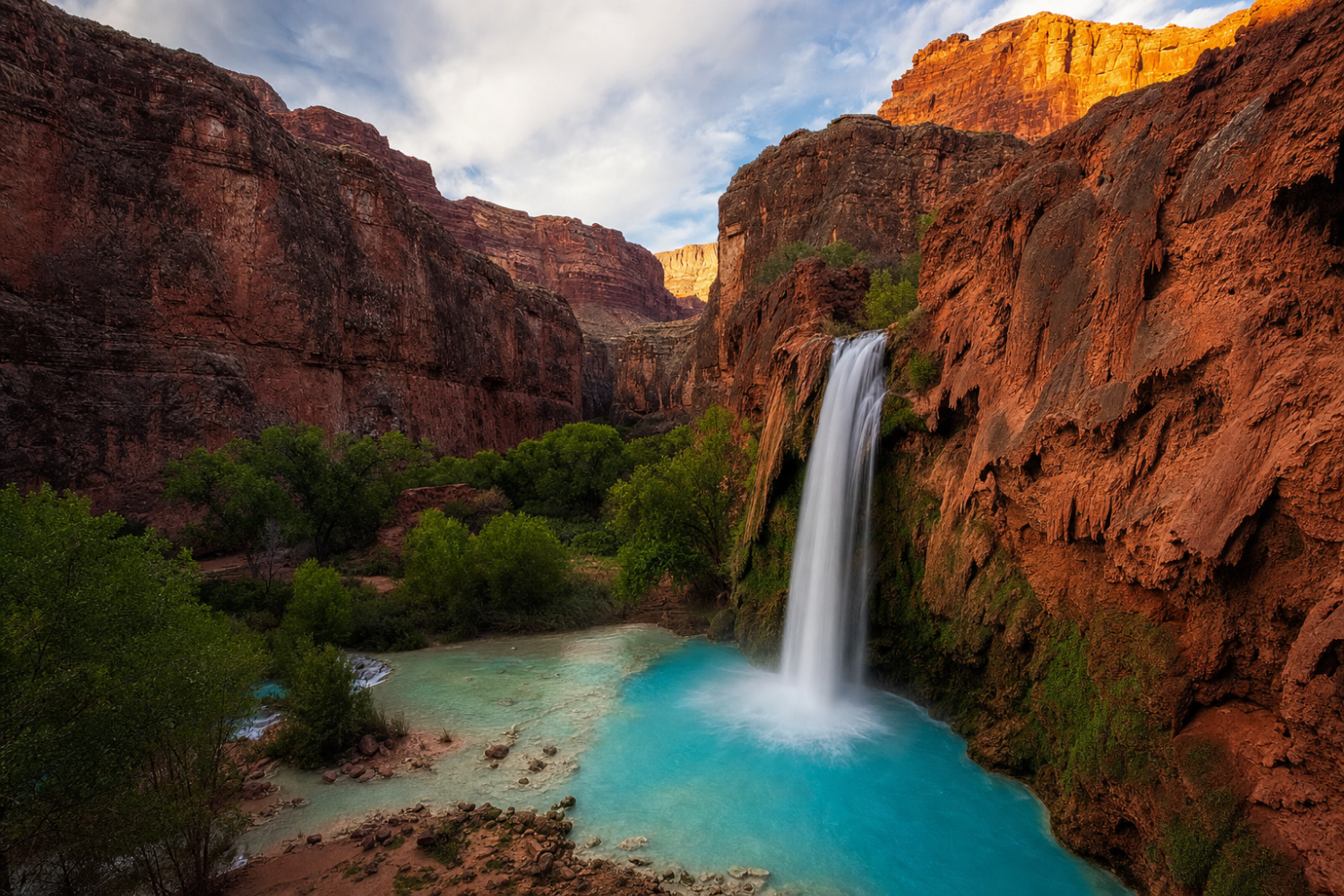
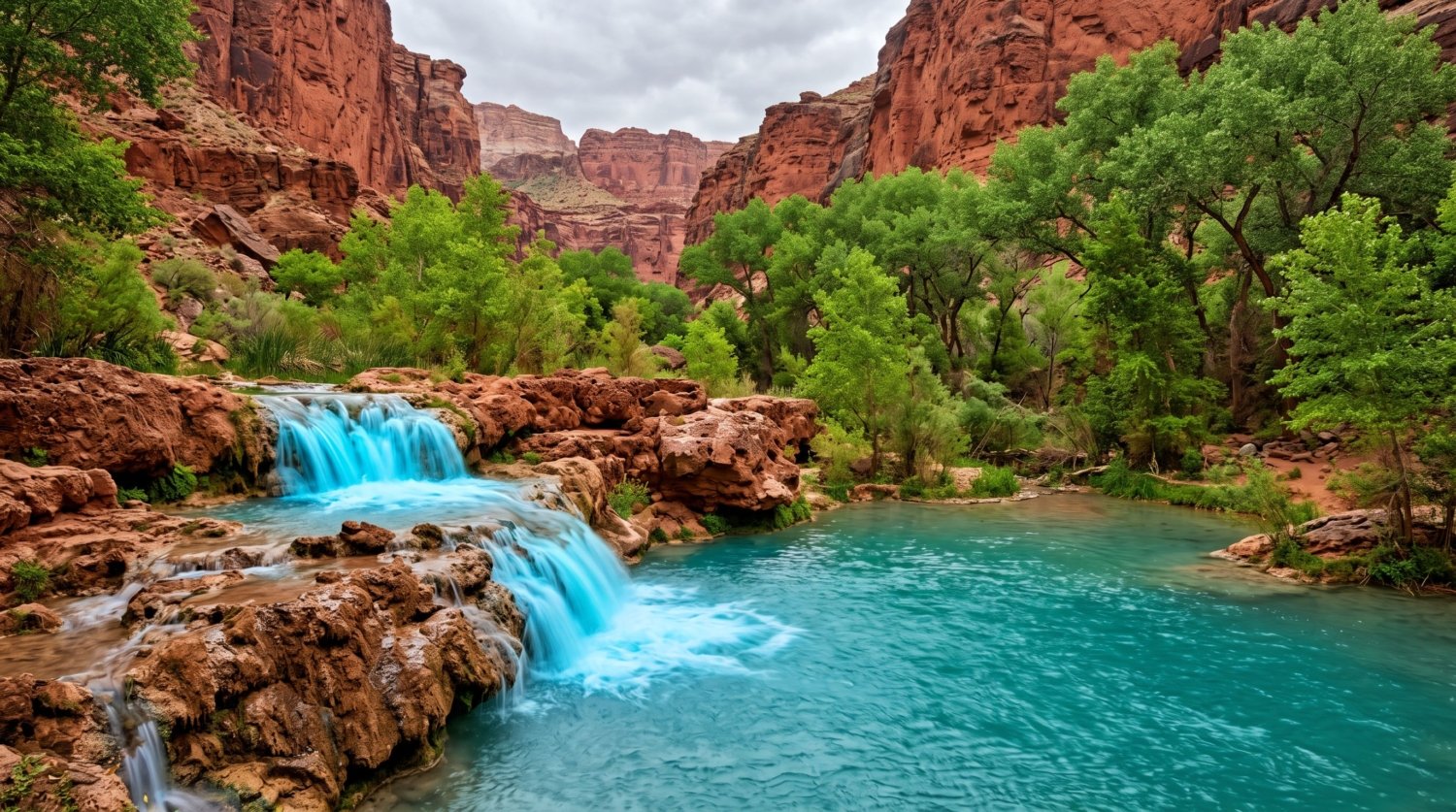
Havasu Falls is not hidden. It’s one of the most photographed waterfalls in the country, and getting there now requires beating thousands of other people to an online booking page that sells out in minutes. What almost none of those photos explain, though, is why the water looks the way it does — a turquoise-blue so saturated it reads as edited even when it isn’t. The color isn’t a filter, a reflection of the sky, or a trick of the desert light. It’s chemistry, and it’s the same chemistry that’s been quietly rebuilding the waterfall itself for over a century.
Last verified: September 13, 2026. This guide was built from University of California, Davis water science education materials, the Havasupai Tribe’s own 2026 reservation system documentation, and geological reporting on the canyon — not a personal visit — and every factual claim below is linked to its source in the sentence that makes it.
| Location | Havasupai Indian Reservation, Grand Canyon, Arizona |
| Height | 90–100 feet |
| Why it’s blue-green | Dissolved calcium and magnesium carbonate reflecting light off a pale limestone streambed |
| Access | Permit only, no day-use or walk-ins — booked online, first-come basis |
| 2026 cost | $455–$495 per person for a mandatory 3-night stay |
| Hike distance | 10 miles one way from Hualapai Hilltop to the campground |
Why the Water Looks Like This
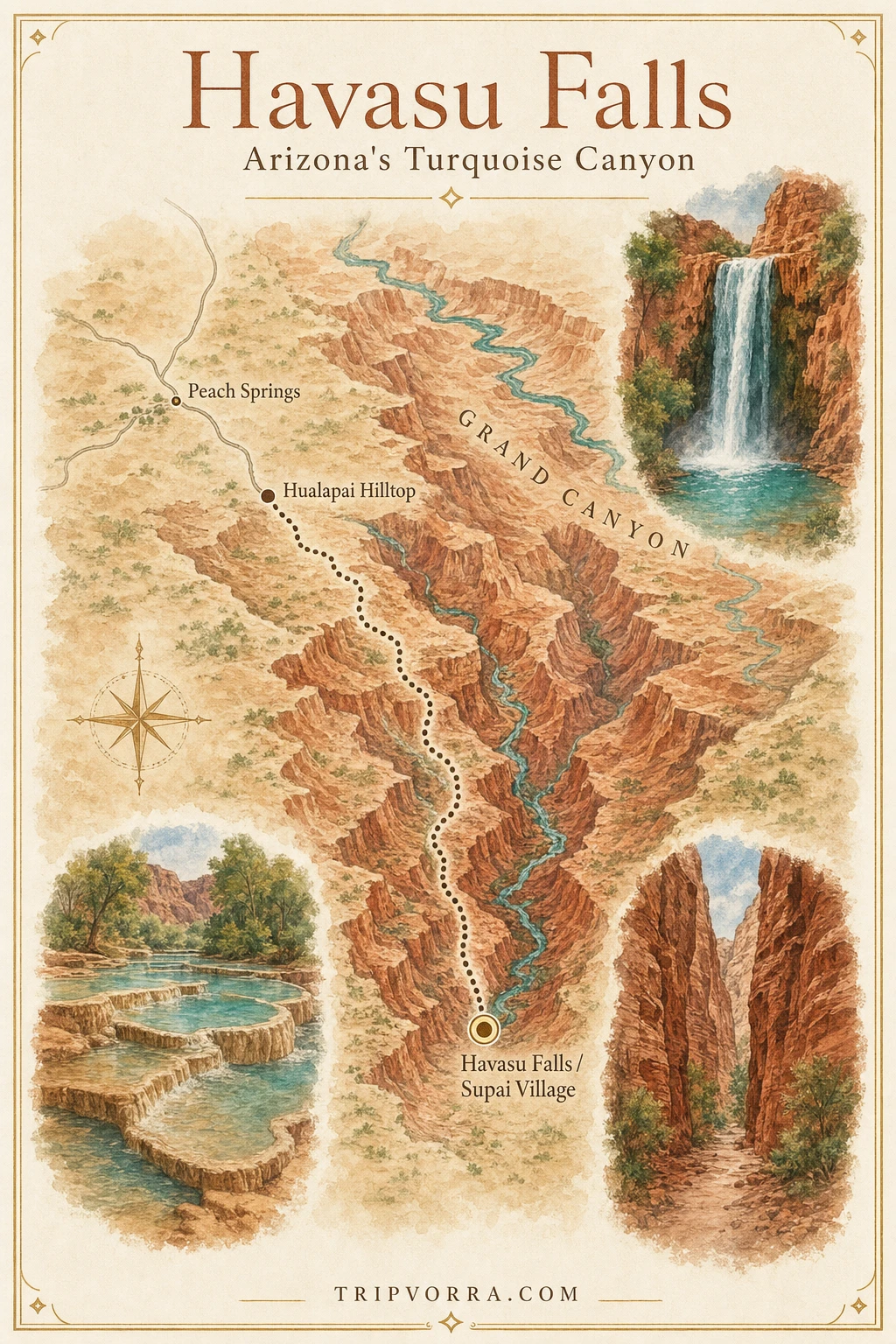
Havasu Creek is spring-fed, and as that groundwater travels underground it dissolves magnesium and calcium out of the surrounding rock, according to water science education materials from UC Davis. Along the way, it also picks up carbon dioxide at concentrations roughly 100 times higher than the air people breathe. That CO2 reacts with the water to form bicarbonate, and when the mineral-rich water finally surfaces at the springs feeding the creek, calcium carbonate — chemically the same substance as chalk, snail shells, and eggshells — precipitates back out of solution. The dissolved magnesium and calcium, combined with the suspended calcium carbonate particles, reflect sunlight in a way that produces the turquoise color, and the effect is amplified because the creek bed itself is pale, reflective limestone rather than dark sediment.
None of this is unique to Havasu — the same calcium carbonate chemistry produces similarly saturated blue-green water at a handful of other desert springs around the world — but the concentration and consistency of it here, feeding a creek that runs for miles through red sandstone, is what makes the color so dramatic and so hard to believe in photographs.
The Rock That Keeps Rebuilding Itself
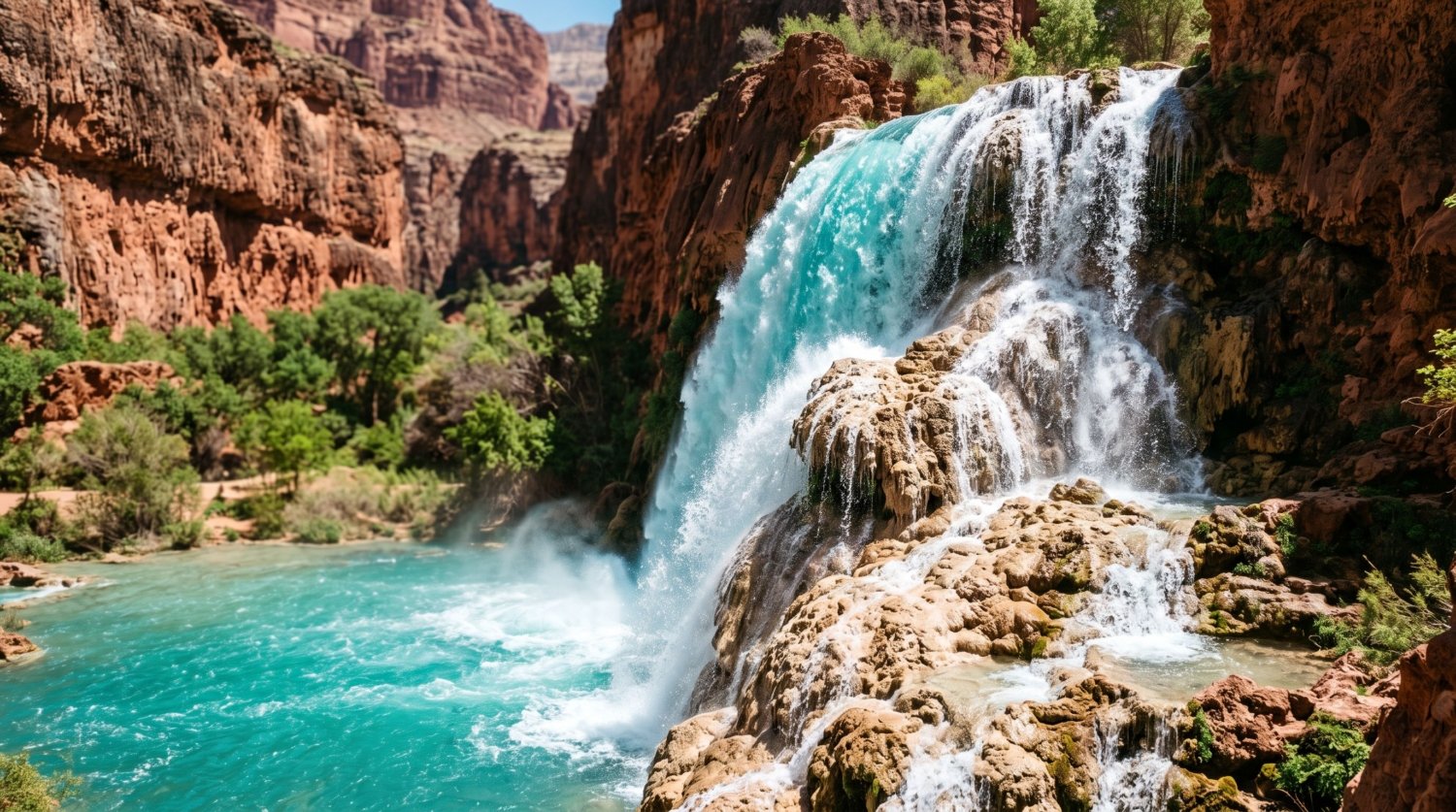
The calcium carbonate precipitating out of the water doesn’t just tint it — it builds rock. As the mineral settles out, it forms travertine, the same stone type used in countertops and building facades, layering into the scalloped, terraced dams that give Havasu Creek its stair-stepped look. These formations are geologically young and still actively growing: every gallon of water that passes over them deposits a little more calcium carbonate, gradually thickening the terraces and, over years, reshaping the pools they hold back. It’s a rare case of a tourist attraction that is quite literally still under construction by the same process that made it in the first place.
How One Flood Reshaped the Entire Canyon
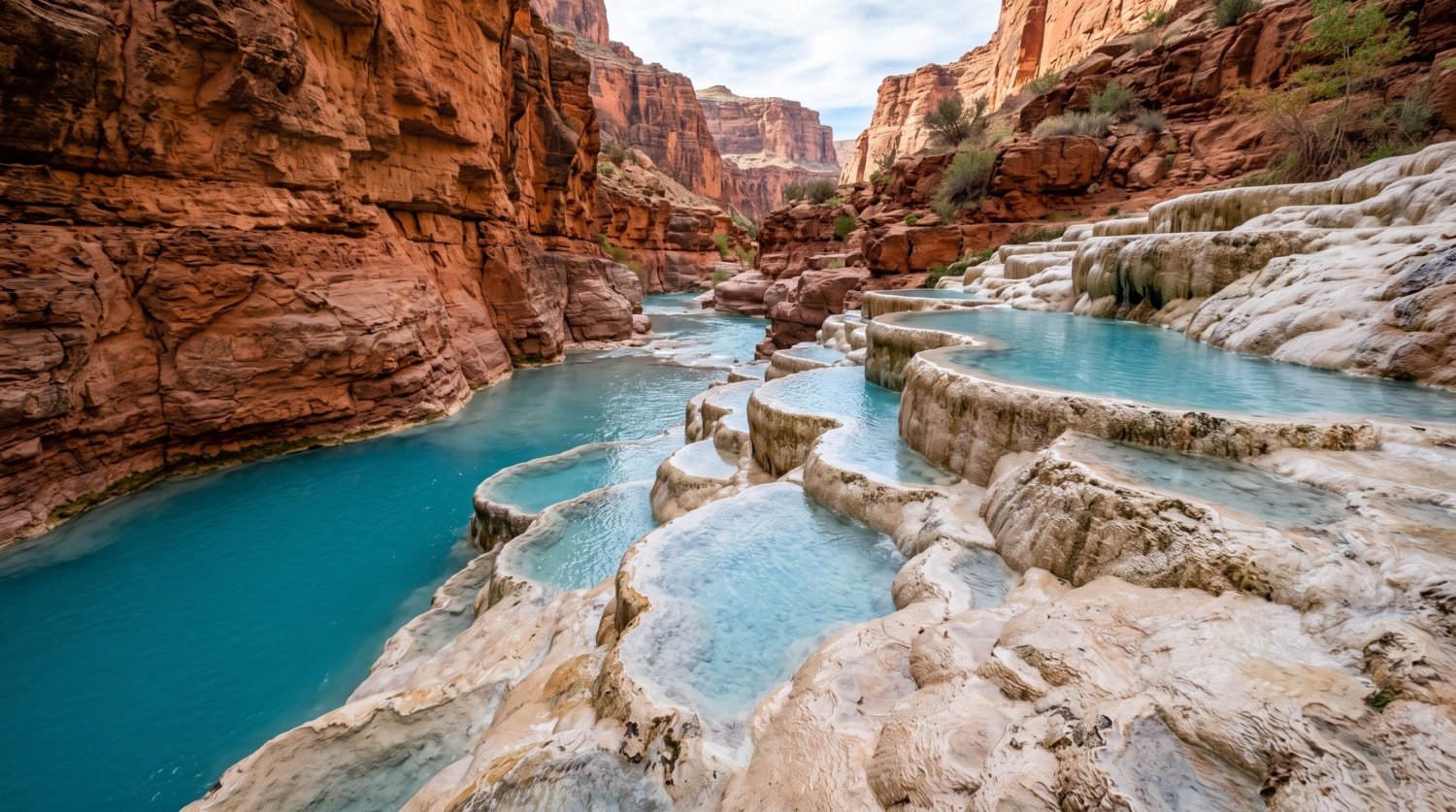
That same young, mineral-built rock is fragile, and the canyon’s waterfalls have proven it more than once. On August 17, 2008, the Redlands Dam upstream burst after heavy rainfall, and several surges of floodwater roared down the creek within twelve hours, destroying the campground and stranding a Boy Scout troop overnight. The flood didn’t destroy the original Navajo Falls so much as bypass it entirely — the mudslide rerouted Havasu Creek around the old falls site, and the water has flowed a different path ever since. In its place, a new 50-foot waterfall (now called Upper Navajo Falls) became the first falls travelers reach in the canyon, while a separate flood-carved drop about a tenth of a mile downstream became Rock Falls. Havasu Falls itself has its own flood history: before 1910, it flowed as a wide, continuous sheet known as Bridal Veil Falls, until that year’s flood cut the single-stream notch visitors see today.
The lesson embedded in that history is that the canyon’s waterfalls aren’t fixed landmarks the way a granite cliff would be. They’re the current state of an ongoing mineral-and-flood process, which means the falls in this year’s photos may look measurably different from the falls in photos from a decade ago — and could again after the next major flood.
Why Almost No One Can Just Show Up Anymore
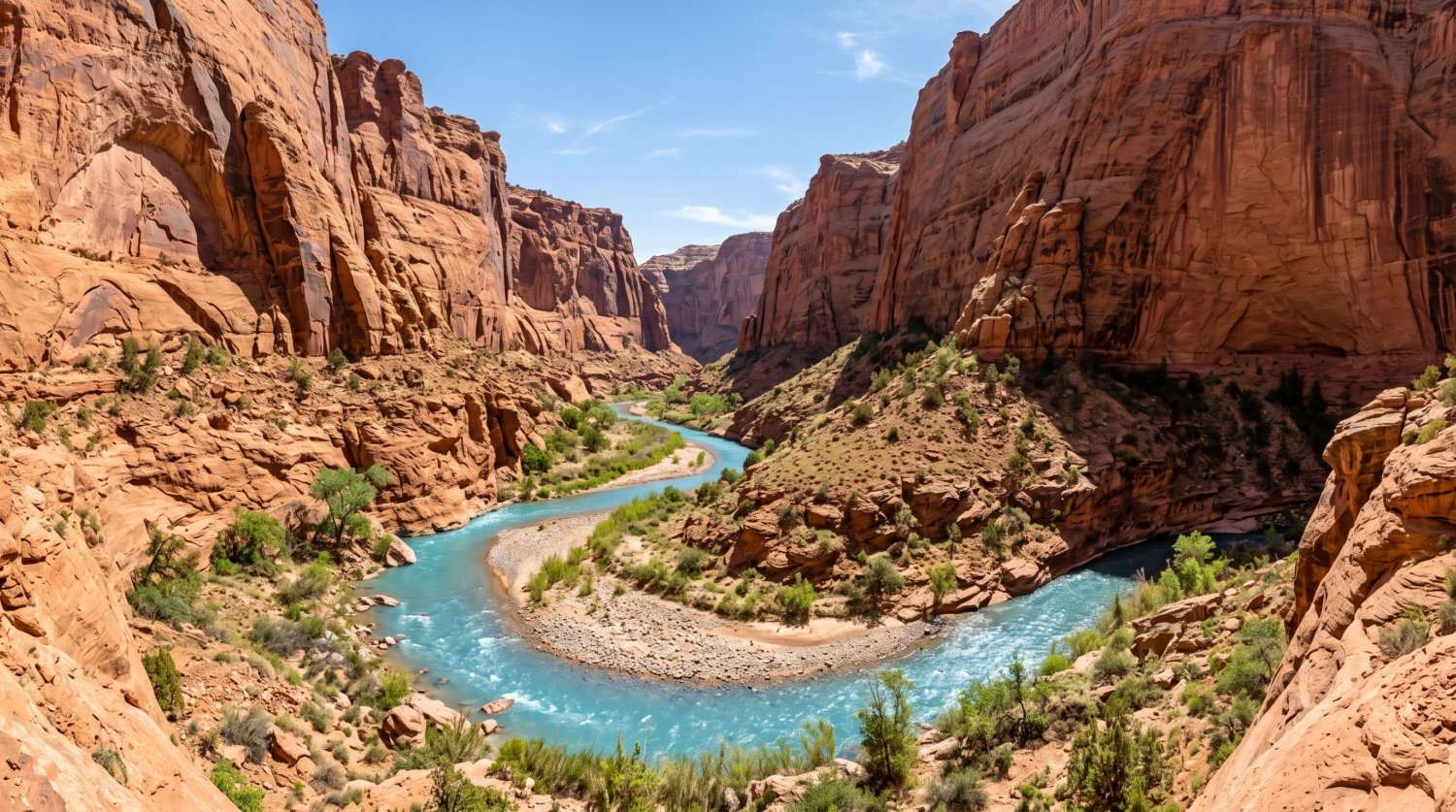
The Havasupai Tribe manages the falls and the surrounding land as a reservation, and access has tightened considerably. The old permit lottery has been permanently discontinued as of 2026, replaced by a first-come, first-served online booking system that opens each February 1st and, by most accounts, sells out within minutes. A 2026 campground permit runs $455 to $495 per person and locks visitors into a mandatory three-night, three-day stay — there’s no day trip or shorter option. A lodge reservation in Supai Village runs into the thousands for up to four guests. Permits are also non-transferable, which closes off the resale workaround that used to exist under the old system.
- Hiking in: 8 miles from Hualapai Hilltop to Supai Village, then 2 more miles to the campground — 10 miles one way, entirely on foot unless you arrange a mule.
- Water: none available on the trail; carry at least a gallon per person for the hike in.
- Helicopter option: Airwest Helicopters flies between Hualapai Hilltop and Supai for $100 per person each way, first-come basis, seasonal schedule.
- Best season: March through May and September through November for hiking comfort; summer brings monsoon flash-flood risk.
- Cancellation policy: a 50% refund is available 90+ days out; nothing is refunded within 90 days of the reservation.
Is It Worth the Cost and the Hike?
The honest answer depends on what someone is actually optimizing for. As a physical undertaking, it’s a genuine commitment: 10 miles in on foot with no water source along the way, and a return trip that climbs the same distance back out of the canyon, described by trip guides as strenuous even for regular hikers. As a financial commitment, $455 and up per person for a mandatory three-night stay is a real cost most single-day waterfall visits don’t carry. What it buys is not exclusivity in the usual sense — roughly 300 people can be camping in the canyon on a given night — but it does buy three days inside a genuinely rare water chemistry event most people will only ever see in a photo. Anyone who books this trip for the same reason they’d book a passport-stamp photo op is likely to find the cost-to-effort ratio rough; anyone who actually wants to understand what they’re looking at usually finds it’s the rare famous place that holds up once you’re standing in it.
Frequently Asked Questions
Is the water color real, or edited in photos?
It’s real. The turquoise color comes from dissolved calcium and magnesium carbonate reflecting light off a pale limestone streambed, not from photo editing or unusually clear water alone.
How do I actually get a permit?
Permits are booked online through the Havasupai Tribe’s official reservation system, released each February 1st on a first-come, first-served basis. They typically sell out within minutes, so having an account created and payment ready in advance matters.
Is it safe to swim in the pools?
Swimming is a major part of the visitor experience and generally considered safe in normal conditions, though diving and jumping are prohibited by tribal rules, and conditions can change quickly during monsoon season flash floods.
What’s the best time of year to visit?
Spring (March to May) and fall (September to November) offer the most comfortable hiking temperatures. Summer brings warmer swimming water but real monsoon flash-flood risk, and winter camping is cold enough that a lodge stay is generally preferable to camping.
Between water chemistry that builds its own waterfalls, a flood record that has physically rerouted the canyon more than once, and a permit system that now makes access harder than the hike itself, Havasu Falls is a reminder that a place can be thoroughly famous and still misunderstood. If you’re planning a wider trip through the Southwest’s natural landscapes, our guides to underrated hiking trails in Colorado’s Front Range and the Bisti Badlands wilderness in New Mexico cover two more corners of the same region where the geology does most of the talking.